
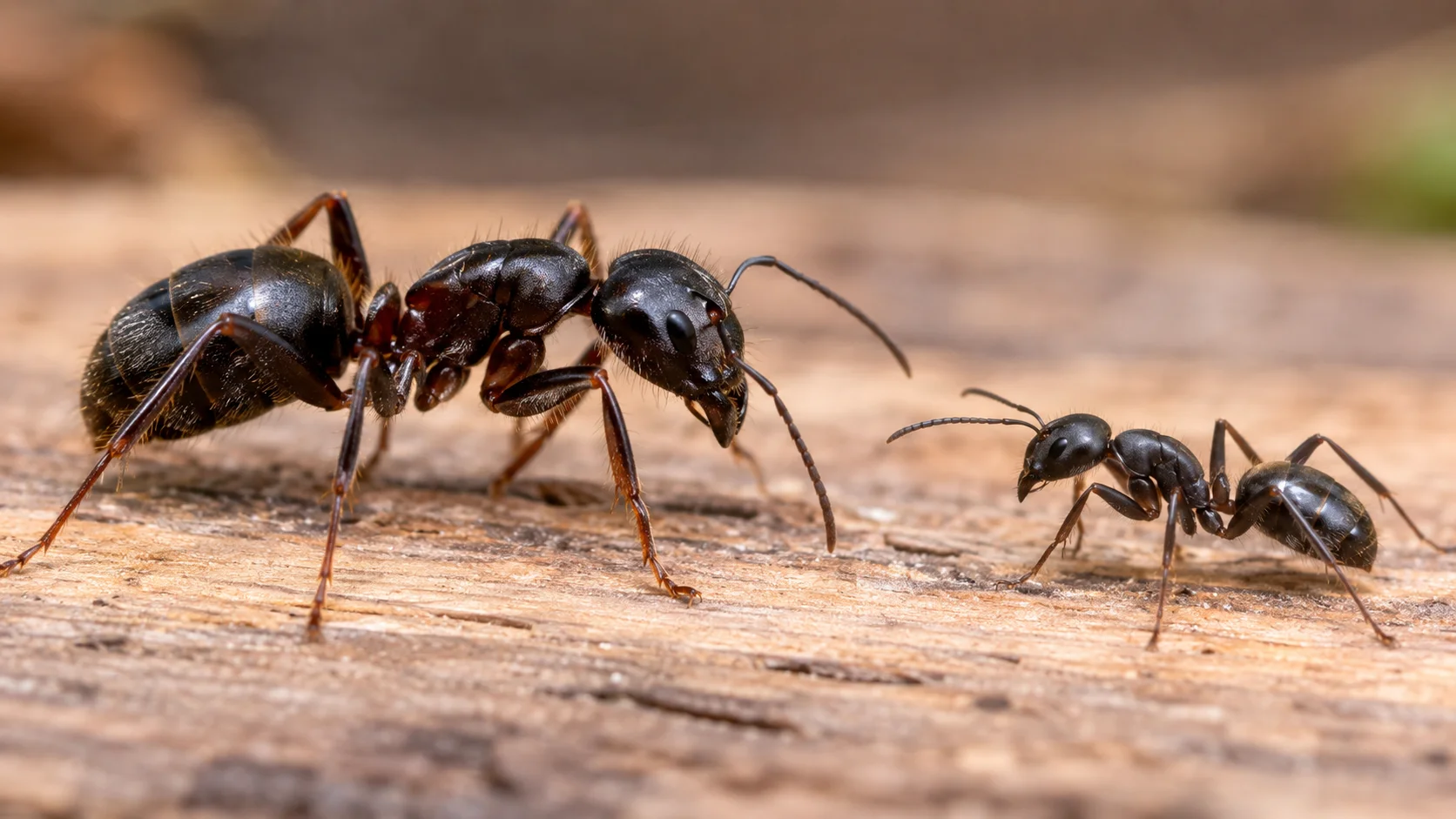
Carpenter ants and black ants can look similar because many carpenter ants are dark brown or black, while several ordinary ant species are also black. The important difference is that black ant is a general description rather than the name of one specific species, so accurate identification requires looking at size, body structure, nesting behavior, and other characteristics.
Carpenter ants belong to the genus Camponotus. They are generally among the larger ants encountered around homes, with workers commonly measuring about 1/4 to 1/2 inch, although size varies by species and worker type. Carpenter ants excavate wood to create nesting galleries but do not eat the wood.
Carpenter Ants vs Black Ants Appearance
The most useful visual differences involve body size, waist structure, thorax shape, and antennae. Carpenter ants are usually noticeably larger than many of the small black ants found around kitchens, gardens, sidewalks, and lawns.
Color alone is not a dependable identification method because carpenter ants can be black, reddish-black, or combinations of black and red, while numerous unrelated ant species can also be black.
Carpenter Ant Appearance
Carpenter ant workers have a relatively large body, a constricted waist, and elbowed antennae. When viewed from the side, their thorax has a smoothly rounded upper surface, which is an important identification feature.
Workers can vary considerably in size within the same colony because carpenter ant colonies contain major and minor workers. This natural size variation means a smaller carpenter ant should not automatically be classified as an ordinary black ant.
Black Ant Appearance
Black ant can describe several different species, including small household ants and larger outdoor ants. Many are considerably smaller than carpenter ants, but some species can overlap in size.
For this reason, a black color and a particular body size are not enough to establish an identification. Extension guidance recommends considering characteristics such as the number of petiole nodes, thorax shape, antennae, and nesting behavior.
Carpenter Ants vs Black Ants Size
Size is one of the most noticeable differences when a large carpenter ant is compared with a typical small black household ant. Carpenter ant workers commonly measure 1/4 to 1/2 inch, while many other black ants are only a few millimeters long.
Penn State Extension lists black carpenter ant workers at about 1/4 to 1/2 inch, while University of Maryland Extension similarly describes commonly encountered carpenter ant workers in the 1/4-to-1/2-inch range.
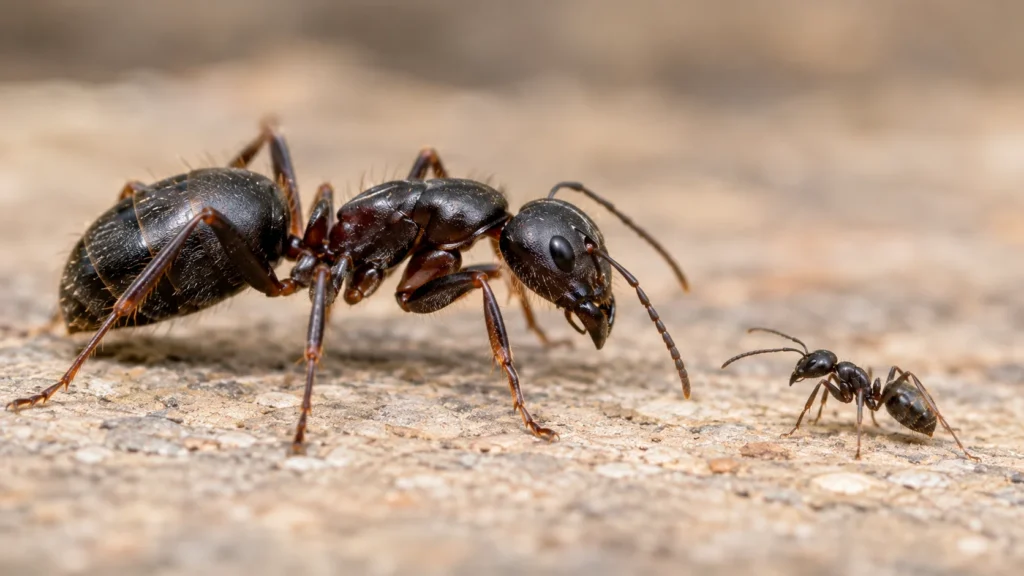
Big Black Ants vs Carpenter Ants
A large black ant is not automatically a carpenter ant. Some other ant species can reach substantial sizes, and carpenter ant workers themselves occur in different sizes within one colony.
Identification should therefore combine size with the one-node petiole, smoothly rounded thorax, elbowed antennae, body coloration, and nesting association with wood.
Little Black Ants vs Carpenter Ants
Small black ants are often much smaller than carpenter ants and generally have a different overall body proportion. Their tiny size can make them appear almost like moving specks compared with a large carpenter ant.
A very small black ant around food does not necessarily indicate carpenter ants. The location of the nest and the physical characteristics of the ant should also be considered.
How to Identify Carpenter Ants vs Black Ants
A reliable identification uses several characteristics instead of depending on color. Carpenter ants generally have one visible node between the thorax and abdomen, an evenly rounded thorax, and elbowed antennae.
Other ants may have one or two nodes and different thorax shapes. University of Minnesota Extension specifically recommends examining the petiole, thorax, antennae, and other anatomical characteristics when identifying ants.
Waist and Thorax
Carpenter ants have a narrow waist with one petiole node. Their thorax has a smoothly rounded upper profile when viewed from the side.
This combination is more useful than color because many unrelated ants can appear black. A close inspection of the body structure can therefore separate a carpenter ant from an ordinary dark-colored ant.
Antennae
Carpenter ants have elbowed antennae, meaning the antennae bend noticeably after the first segment. This feature is characteristic of ants generally but is useful when combined with the other carpenter-ant characteristics.
Body Color
Black carpenter ants can have shiny black bodies, while other carpenter ant species may show red-and-black coloration. This means the term black carpenter ant describes appearance rather than every carpenter ant species.
Other black ants may also be shiny or dark, so body color should be treated as one identification clue rather than definitive proof.
Carpenter Ants vs Black Ants in the House
Carpenter ants can enter homes while searching for food even when their main nest is outdoors. They may travel along branches, wires, pipes, or other routes that provide access to the building.
Finding a large black ant indoors therefore does not automatically mean that a carpenter ant nest is inside the walls. Penn State Extension notes that carpenter ants found indoors may be foraging from an outdoor nest, while University of Maryland Extension states that workers can travel significant distances from their nests.
Indoor Carpenter Ant Signs
Common indicators include:
- Large dark ants repeatedly appearing indoors
- Ant activity near damp wood
- Coarse sawdust-like frass
- Ants emerging from wall or ceiling voids
- Activity around leaking plumbing
- Ant trails near windows or doors
- Damaged or decaying wooden areas
- Winged carpenter ants indoors
- Ant activity around roof or gutter leaks
- Ants appearing mainly after dark
Winged carpenter ants inside a building can be particularly significant because their presence may indicate an established indoor nest.
Carpenter Ants vs Black Ants and Wood Damage
Carpenter ants differ fundamentally from termites because they do not consume wood as food. Instead, they excavate galleries in wood to create nesting spaces and travel routes.
They especially favor damp, decaying, or moisture-compromised wood because it is easier to excavate. Persistent carpenter ant activity can therefore indicate an underlying moisture or wood-decay problem.
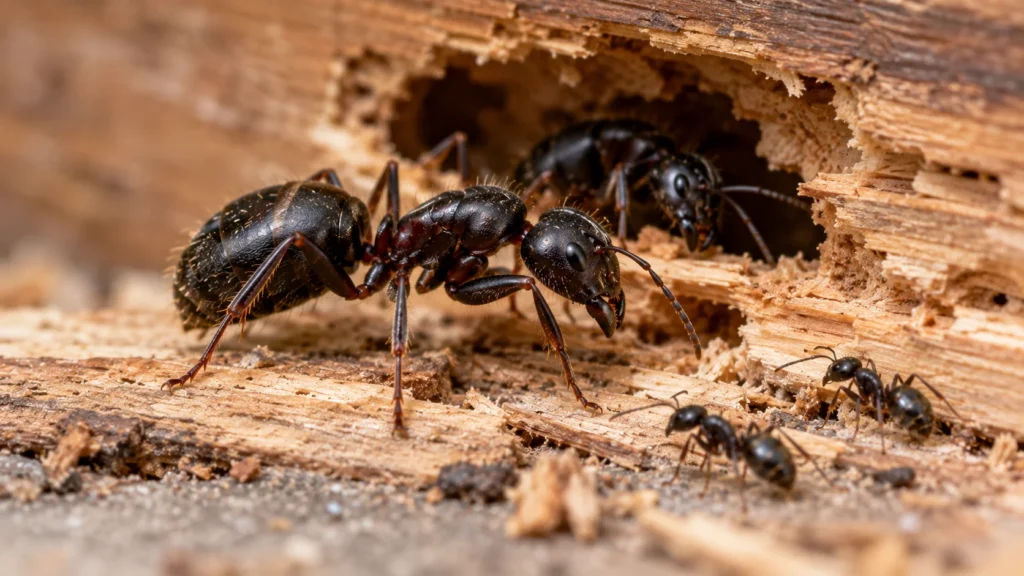
Carpenter Ant Galleries
Carpenter ant galleries are generally smooth and clean because the ants remove the excavated material. Coarse wood particles or frass may accumulate near nest openings.
Penn State Extension notes that carpenter ants may excavate moist or rotting wood, while University of Maryland Extension describes their galleries as smooth and relatively clean compared with termite galleries.
Regular Black Ant Nesting
Many ordinary black ants nest in soil, beneath stones, around pavement, in lawns, or in other locations that do not involve structural wood. Their presence near a building therefore does not automatically indicate wood damage.
The exact nesting behavior depends on the species, which is another reason the broad term black ant should not be treated as a precise pest identification.
Carpenter Ants vs Black Ants Bites
Carpenter ants do not have a sting, but they can bite with their mandibles if handled or threatened. University of Maryland Extension describes carpenter ants as capable of giving a small nip when handled.
Most encounters with carpenter ants do not result in a significant bite. Avoid squeezing or handling unidentified ants, especially when disturbing a nest or a heavily infested piece of wood.
Bite Appearance
A carpenter ant bite can produce localized irritation or discomfort, but a skin mark alone cannot reliably identify the ant species responsible.
If a bite produces severe, persistent, or unusual symptoms, medical advice should be sought rather than attempting to diagnose the insect from the skin reaction.
Explore more articles:
- Fruit Flies vs Gnats
- Rat vs Mouse
- Bugs That Look Like Flying Termites
- Bugs That Look Like Fleas
- What Do Fleas Look Like?
- Wood Ants vs Termites
- What Are Centipedes Attracted To?
- What Do Drain Flies Look Like
- What Do Baby Black Widows Look Like?
- What Do Dust Mites Look Like?
Carpenter Ants vs Flying Black Ants
Winged carpenter ants can be mistaken for other winged black ants or even termites. Reproductive carpenter ants have two pairs of wings, with the front wings longer than the hind wings.
Termite swarmers have wings that are approximately equal in length, straight antennae, and a broader, less constricted body. Carpenter ants instead have elbowed antennae and a narrow waist.
Winged Carpenter Ant Features
Winged carpenter ants are larger than ordinary workers and can reach roughly 3/4 inch in some species. Their dark bodies, narrow waists, bent antennae, and unequal wing lengths help distinguish them from termite swarmers.
Winged Black Ant Confusion
Not every winged black ant is a carpenter ant. Different ant species produce winged reproductive individuals during mating periods, and their size and appearance can overlap.
A winged specimen should therefore be evaluated using wing proportions, antennae, waist shape, and thorax structure rather than its black coloration alone.
Carpenter Ants vs Black Ants vs Termites
Termites are another common source of confusion because winged termites can resemble winged ants. The body structure provides important clues.
| Feature | Carpenter Ants | Other Black Ants | Termites |
| Body color | Black or black/red | Varies by species | Workers pale; swarmers often dark |
| Typical carpenter worker size | 1/4–1/2 inch | Highly variable | Workers generally smaller |
| Waist | Narrow | Depends on species | Broad, not constricted |
| Antennae | Elbowed | Usually elbowed | Straight/beaded |
| Petiole | One node | One or two depending on species | No ant-like narrow waist |
| Wings | Front longer than hind | Varies | Four wings approximately equal |
| Wood relationship | Excavates wood for nests | Species-dependent | Feeds on cellulose-containing material |
| Frass | Coarse wood particles | Species-dependent | Mud/frass characteristics differ |
Carpenter ants and termites require different identification and management approaches, making accurate classification important when wood damage is suspected.
Common Places Carpenter Ants Nest
Carpenter ants are strongly associated with wood, particularly areas affected by moisture. Common locations include decaying trees, stumps, logs, wall voids, damp window areas, roof structures, and locations affected by plumbing or roof leaks.
University of Maryland Extension identifies damp areas around windows, doors, gutters, downspouts, and other moisture-compromised parts of structures as potential carpenter ant nesting sites.
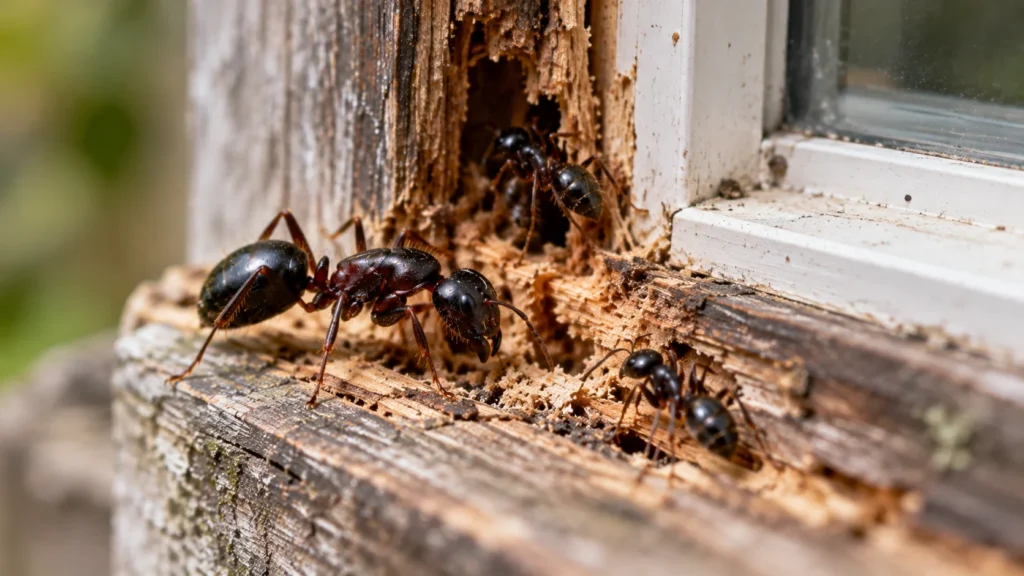
Moisture-Compromised Wood
Water leaks, condensation, poor drainage, and decaying wood can create conditions that favor carpenter ant nesting. Correcting the moisture source is therefore an important part of addressing a carpenter ant problem.
Penn State Extension similarly notes that carpenter ants prefer soft, moist, or decaying wood rather than healthy dry wood.
Carpenter Ants vs Black Ants Comparison
The most practical distinction is that carpenter ants are generally larger wood-nesting ants with a one-node petiole, smoothly rounded thorax, and elbowed antennae, while black ants covers numerous species that can differ substantially in size and behavior.
| Identification Point | Carpenter Ants | General Black Ant Category |
| Classification | Camponotus | Multiple genera/species |
| Color | Black or black and red | Often black, but variable |
| Size | Common workers 1/4–1/2 inch | Often smaller, but variable |
| Waist | One node | One or two nodes depending on species |
| Thorax | Evenly rounded | Species-specific |
| Nesting | Wood and cavities | Soil, structures, plants, wood, etc. |
| Wood excavation | Yes | Species-dependent |
| Food | Insects, proteins, sugars, honeydew | Species-dependent |
| Indoor significance | May indicate a nearby or indoor nest | Depends on species |
| Identification | Physical traits + nesting behavior | Requires species-level clues |
Ten Key Facts About Carpenter Ants and Black Ants
- Carpenter ants belong to the genus Camponotus.
- Black ant is a broad descriptive term rather than one species.
- Carpenter ant workers commonly measure about 1/4 to 1/2 inch.
- Carpenter ants can be black or black and red.
- Carpenter ants have one petiole node.
- Carpenter ants have elbowed antennae.
- Carpenter ants excavate wood but do not eat it.
- Moist or decaying wood is particularly attractive to carpenter ants.
- Coarse sawdust-like frass can indicate carpenter ant excavation.
- A large black ant should not be identified as a carpenter ant from color alone.
Conclusion
Carpenter ants vs black ants is not simply a comparison between two colors or two sizes. Carpenter ants are a specific group of large ants in the genus Camponotus, while black ants can refer to many different species. Carpenter ants commonly have one petiole node, a smoothly rounded thorax, elbowed antennae, and workers around 1/4 to 1/2 inch long.
The strongest clues are the ant's body structure, size, nesting location, and relationship with wood. Large dark ants associated with damp or decaying wood, particularly when accompanied by coarse frass, deserve closer inspection because carpenter ants can establish nests in moisture-damaged areas.
How can carpenter ants be distinguished from regular black ants?
Carpenter ants are generally larger and have a one-node petiole, smoothly rounded thorax, and elbowed antennae. Regular black ants may belong to many different species and can have different body structures and nesting habits.
Are carpenter ants always black?
No. Many carpenter ants are black, but some species have black-and-red or other coloration. Color should therefore be combined with size and body characteristics for identification.
Are big black ants carpenter ants?
Not necessarily. Carpenter ants are often large and dark, but several other ant species can also be relatively large. A one-node petiole, rounded thorax, elbowed antennae, and association with wood provide stronger identification clues.
Are carpenter ants bigger than little black ants?
Carpenter ants are generally much larger than the small black ants commonly encountered around homes. Carpenter ant workers commonly measure about 1/4 to 1/2 inch, although sizes vary among species and colony members.
Do carpenter ants eat wood?
No. Carpenter ants excavate wood to create nesting galleries and tunnels, but they do not use wood as their food. They feed on insects, proteins, sugars, and honeydew.
Do carpenter ants damage houses?
They can. Carpenter ants are particularly associated with damp or decaying wood, and extensive gallery excavation can damage wooden structures. Their presence can also indicate an underlying moisture problem.
Do carpenter ants bite?
Carpenter ants can bite when handled or threatened, using their jaws. They do not sting, and bites generally cause localized discomfort rather than the effects associated with venomous stinging insects.
Can flying black ants be carpenter ants?
Yes. Carpenter ants produce winged reproductive forms that can appear dark and are sometimes mistaken for other flying ants or termites. Their unequal wing lengths, elbowed antennae, and narrow waist help with identification.