
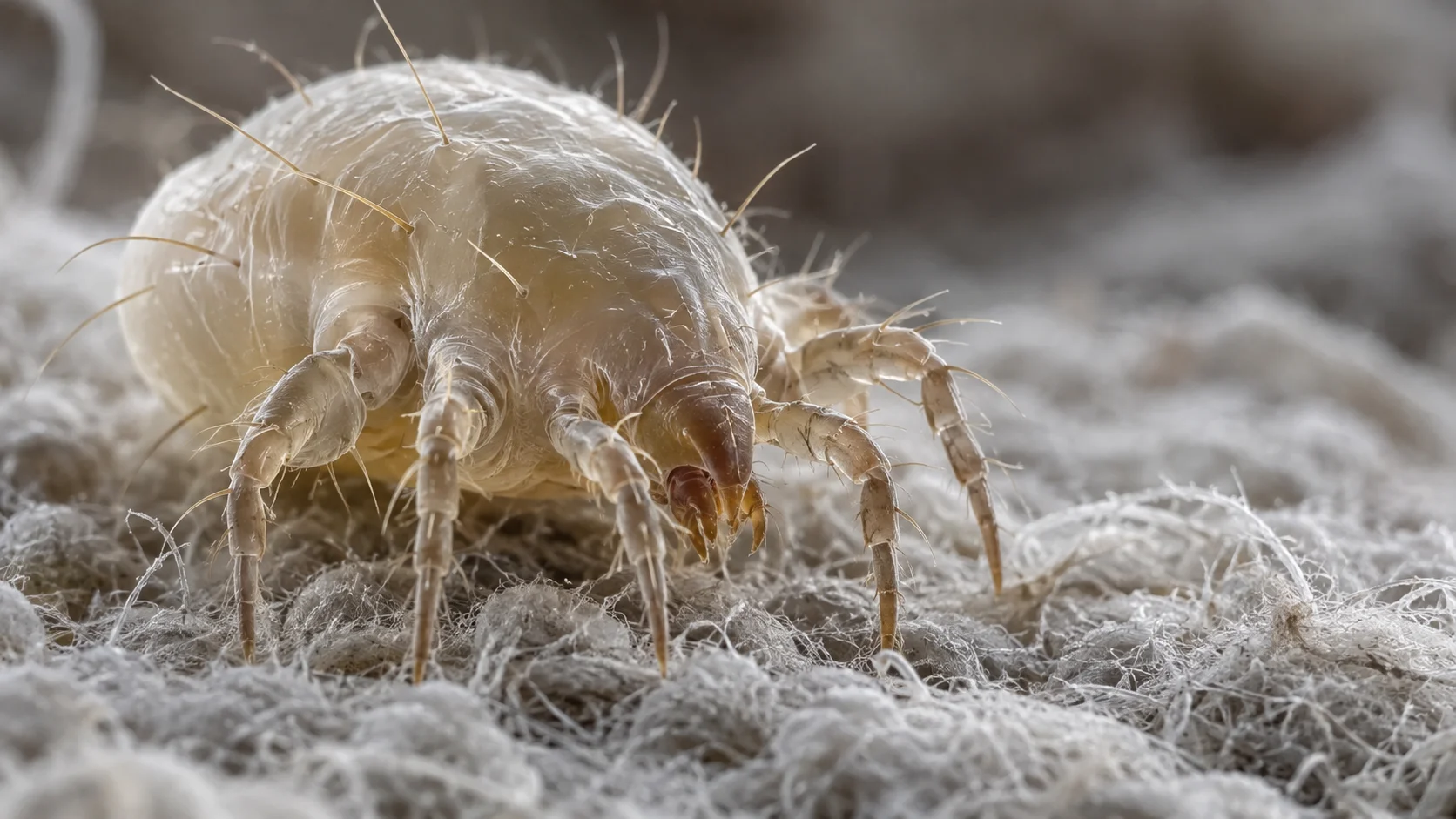
Dust mites are microscopic arachnids commonly found in household dust, especially in bedding, mattresses, carpets, upholstered furniture, and other fabric-rich areas. The most common house dust mites include Dermatophagoides farinae and Dermatophagoides pteronyssinus. Unlike insects, dust mites have eight legs and are related to spiders and ticks.
Their extremely small size makes them different from pests that can be identified by simply looking at a bed or carpet. Adult house dust mites are generally around 0.2–0.4 millimeters long, so they are virtually invisible to the naked eye. Under magnification, they appear as tiny pale or translucent, oval-bodied creatures with eight legs.
Understanding their actual appearance is especially important because dust mites are frequently confused with bed bugs or blamed for unexplained skin marks. Dust mites are not biting parasites, and many supposed dust mite bites are actually allergic skin reactions or another condition. So, let's understand what do dust mites look? like
What Dust Mites Look Like
House dust mites have tiny oval or broadly rounded bodies that are generally creamy, whitish, or translucent. Their bodies can look somewhat plump under a microscope, but their microscopic scale makes individual features impossible to see without magnification.
Adult mites have eight legs, which distinguishes them from insects, and their bodies contain fine structures such as hairs and other microscopic surface features. Scientific descriptions place common house dust mites at roughly 0.2–0.4 mm in length.
Tiny Pale Bodies
Under a microscope, dust mites can appear white or translucent rather than dark brown or black. Their pale coloration can make them blend into dust particles and fabric fibers.
Their bodies are also small enough that ordinary household dust may completely obscure them. A microscope is therefore necessary for reliable visual identification of individual mites.
Eight Legs
Dust mites have eight legs because they are arachnids rather than insects. Their legs and other anatomical structures become visible when the specimen is examined under sufficient magnification.
This eight-legged structure is useful for distinguishing dust mites from tiny insects, although an ordinary household observer cannot normally see these details without microscopy.
What Dust Mites Look Like to the Human Eye
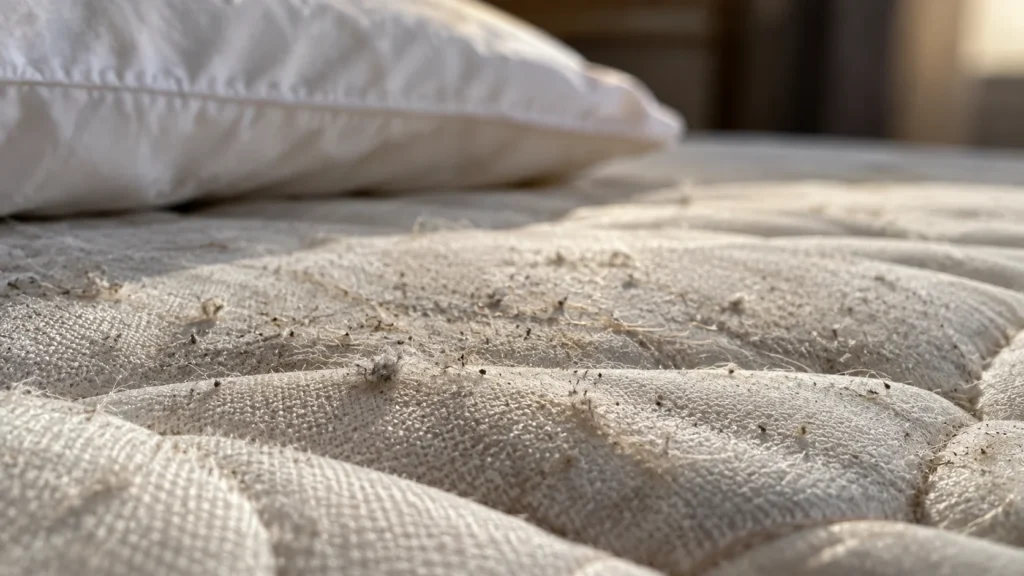
Dust mites cannot normally be seen as individual creatures with the naked eye. At approximately 0.2–0.4 mm, they are below the practical visual resolution needed to recognize their body shape and legs.
A person may see dust, fibers, skin flakes, or other particles on bedding and assume that visible particles are mites. Those particles should not automatically be identified as dust mites because mites themselves are generally invisible without magnification.
Naked-Eye Visibility
The American Academy of Allergy, Asthma & Immunology notes that dust mites are too small to see with the eyes alone and are approximately one-quarter to one-third of a millimeter long.
This means a visible moving bug on a mattress is unlikely to be a typical house dust mite. A larger insect should be evaluated separately because bed bugs, fleas, carpet beetles, and other pests are visible at substantially greater sizes.
What Dust Mites Look Like Under a Microscope
Microscopic examination reveals considerably more detail than is visible in household dust. Under magnification, house dust mites have oval bodies, eight legs, and a pale or translucent appearance. Some scientific images show surface hairs, body structures, and other anatomical features.
House dust mites can be observed with ordinary light microscopy rather than requiring an electron microscope for basic visualization. Research literature reports that they can be readily seen at approximately 20× to 80× magnification.
Microscopic Body Features
Under magnification, the body is broadly oval with a relatively compact appearance. Fine hairs and other structures can be visible around the body and legs.
Microscopic images can make dust mites appear much larger than they really are because the specimen has been highly magnified. The apparent size in a photograph should therefore never be confused with the mite's actual physical dimensions.
What Dust Mites Look Like on a Bed
Dust mites do not normally appear as visible bugs crawling across sheets or pillows. They live within household dust and fabric materials, where they feed mainly on shed skin flakes and other organic debris.
Bedrooms provide favorable habitat because mattresses, pillows, blankets, carpets, and upholstered furniture can retain skin particles and moisture. NIEHS identifies mattresses, bedding, upholstered furniture, carpets, and curtains as common household locations for dust mites.
Dust Mites on Sheets
Freshly washed sheets can still contain dust-mite allergens even though washing can substantially reduce the mite population and allergen load. The mites themselves are too small to identify visually on the fabric.
Visible specks, stains, or moving insects on sheets should therefore not automatically be called dust mites. A visible pest may belong to an entirely different species.
Dust Mites on a Mattress
Mattresses can provide suitable conditions because they collect shed skin and can retain warmth and moisture. Dust mites are commonly associated with bedding and mattresses, particularly where humidity is sufficient for their survival.
A mattress cannot be visually inspected for individual dust mites in the same way that it can be inspected for bed bugs. Dust-mite management focuses on reducing allergen exposure and environmental conditions rather than visually finding every individual mite.
What Baby Dust Mites Look Like
Immature dust mites are also microscopic and generally cannot be identified with the naked eye. Their developmental stages are much smaller than ordinary household pests and require magnification for meaningful examination.
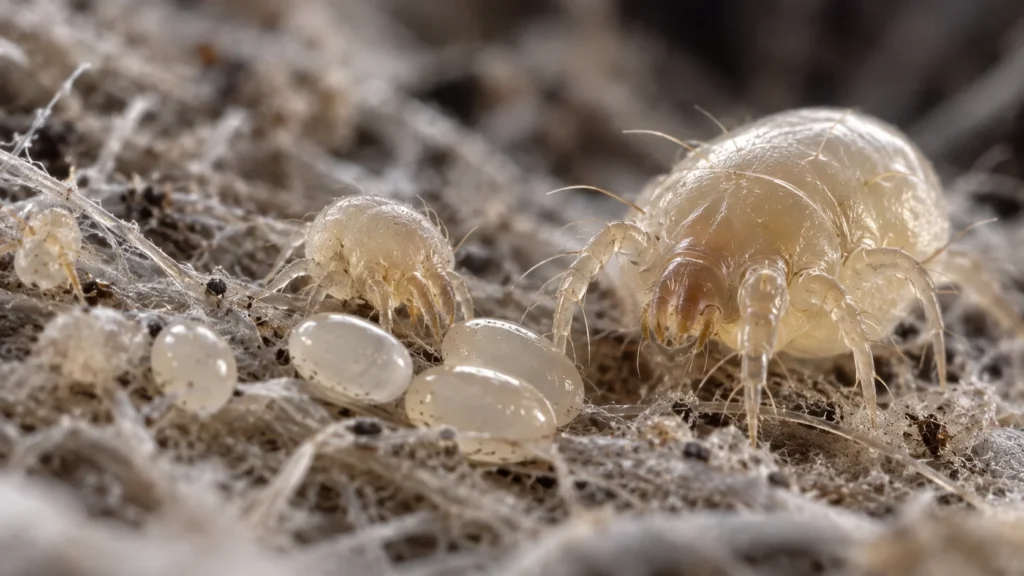
Eggs and immature stages can be observed in microscopic preparations. Scientific literature includes microscopic images of house dust mites alongside their eggs and fecal material.
Dust Mite Eggs
Dust mite eggs are extremely small and are not visible as individual eggs during an ordinary inspection of bedding or household dust. Microscopic examination is used to observe and identify them.
Because eggs are microscopic, visible white particles on a mattress should not automatically be identified as dust mite eggs.
Explore more articles:
- Fruit Flies vs Gnats
- Rat vs Mouse
- Bugs That Look Like Flying Termites
- Bugs That Look Like Fleas
- What Do Fleas Look Like?
- Wood Ants vs Termites
- What Are Centipedes Attracted To?
- What Do Drain Flies Look Like
- What Do Baby Black Widows Look Like?
What Dust Mites Look Like on Human Skin
Dust mites do not normally live on or burrow into human skin. House dust mites live in the surrounding environment and feed primarily on shed skin flakes rather than living tissue.
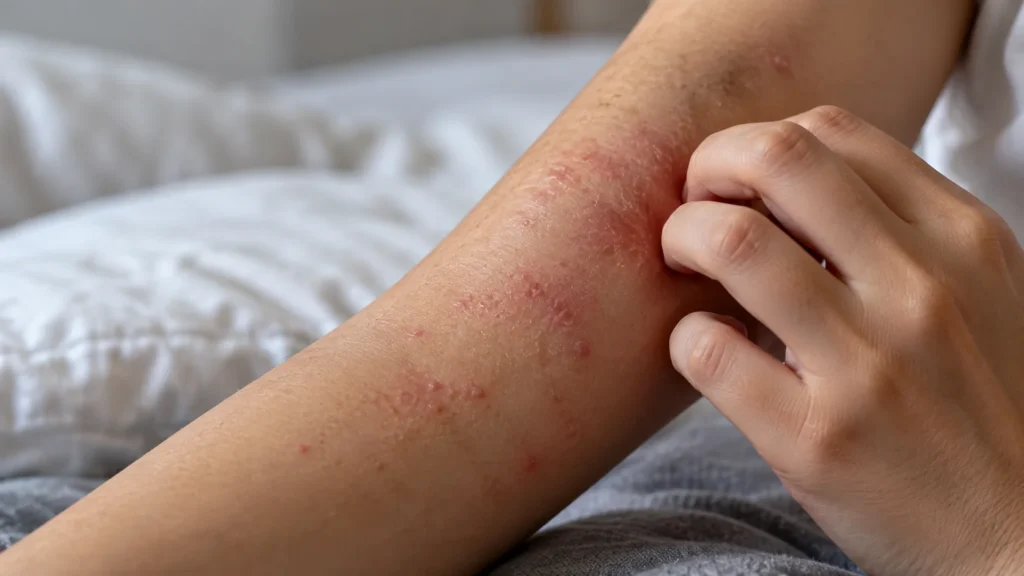
A person cannot normally look at their skin and see dust mites crawling on the surface. Skin redness, itching, or bumps associated with a suspected dust-mite problem are more appropriately considered in the context of an allergic reaction or another skin condition.
Dust Mite Allergy Skin Reactions
Dust-mite allergens can trigger allergic reactions in susceptible people. Common allergy symptoms include sneezing, congestion, runny nose, itchy or watery eyes, and asthma symptoms. Some allergic reactions can also involve skin symptoms such as itching or rashes.
The reaction is caused by exposure to dust-mite allergens rather than the mites biting the skin. Major allergens are found in mite fecal material and body parts.
What Dust Mite Bites Look Like
The term dust mite bites is misleading for ordinary house dust mites because they do not bite humans. Dust mites are not parasitic and do not burrow beneath human skin.
Skin bumps or itchy marks sometimes attributed to dust mites may have other causes, including allergic dermatitis, eczema, bed bugs, fleas, mosquitoes, or other environmental factors. AAFA specifically distinguishes allergic reactions to non-biting allergens such as dust mites from reactions caused by biting or stinging insects.
Skin Marks and Allergy Symptoms
A dust-mite allergy can contribute to itchy skin or allergic symptoms in susceptible individuals, but there is no characteristic dust mite bite pattern that reliably identifies house dust mites.
Persistent, severe, spreading, or unexplained skin symptoms should be assessed by a healthcare professional rather than diagnosed from photographs or assumptions about household pests.
Dust Mites vs Bed Bugs
Dust mites and bed bugs are very different organisms. Dust mites are microscopic arachnids that are generally invisible without magnification, while adult bed bugs are much larger insects that can be seen without a microscope.
Bed bugs have six legs and a flattened, oval body, whereas dust mites have eight legs and a microscopic oval body. Visible insects crawling on a mattress therefore require a different identification process than suspected dust mites.
| Feature | Dust Mites | Bed Bugs |
| Classification | Arachnid | Insect |
| Legs | 8 | 6 |
| Typical size | About 0.2–0.4 mm | Several millimeters as adults |
| Visible to naked eye | Generally no | Yes |
| Main food source | Shed skin and organic debris | Blood |
| Common habitat | Bedding, carpets, furniture, dust | Mattress seams, furniture, cracks |
| Human biting | No | Yes |
| Main concern | Allergens | Bites and infestation |
Dust mites are primarily an allergen exposure concern, whereas bed bugs are blood-feeding pests.
Dust Mites on Dogs and Pets
Dust mites can live in household environments containing pets because they feed on organic material, including flakes of human or pet skin. They are therefore not restricted to human bedding.
Finding a visible mite on a dog, however, does not automatically indicate a house dust mite. Several other mite species can live on or affect animals, so visible parasites on a pet should be evaluated by a veterinarian when necessary. House dust mites themselves are primarily environmental allergens rather than parasites.
Where Dust Mites Commonly Live
Dust mites favor warm, humid indoor environments where food and moisture are available. Their preferred habitats include mattresses, pillows, bedding, carpets, upholstered furniture, curtains, and other fabric-rich areas.
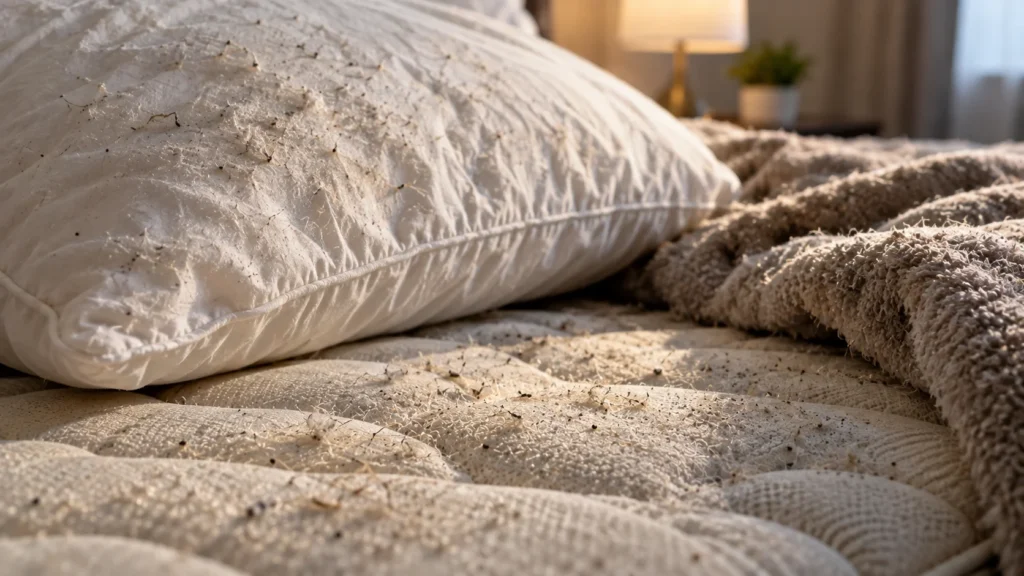
Bedroom and Fabric Areas
Bedrooms can contain substantial dust-mite habitat because people continuously shed skin flakes into bedding and surrounding fabrics. Mattresses and pillows can also retain warmth and moisture.
NIEHS recommends humidity control, allergen-impermeable mattress and pillow covers, regular hot washing of bedding, and effective dust removal as measures that can reduce dust-mite exposure.
Ten Essential Dust Mite Appearance Facts
- Dust mites are microscopic arachnids.
- Common house dust mites are generally about 0.2–0.4 mm long.
- They are usually too small to see with the naked eye.
- Their bodies are oval or broadly rounded.
- They generally appear pale, creamy, or translucent under magnification.
- Adult dust mites have eight legs.
- They are related to spiders rather than insects.
- Microscopy reveals their body hairs and other fine structures.
- Dust mites commonly live in bedding, mattresses, carpets, and upholstered furniture.
- Ordinary house dust mites do not bite humans or burrow into human skin.
Conclusion
Dust mites are so small that individual mites cannot normally be seen on beds, sheets, mattresses, or human skin with the naked eye. Common house dust mites measure only around 0.2–0.4 millimeters and generally have pale, oval bodies with eight legs that become visible under a microscope.
They should also be distinguished from bed bugs and other visible household pests. Most importantly, ordinary house dust mites do not bite people. Their primary health significance comes from allergens associated with their feces and body material, which can trigger allergic symptoms in susceptible individuals.
Can dust mites be seen with the human eye?
No. Common house dust mites are generally too small to see individually without magnification. They are approximately one-quarter to one-third of a millimeter long.
What do dust mites look like under a microscope?
Under a microscope, dust mites appear as tiny pale or translucent, oval-bodied arachnids with eight legs. Fine hairs and other anatomical structures become visible with appropriate magnification.
What do dust mite bites look like?
Ordinary house dust mites do not bite humans. Itchy bumps or rashes blamed on dust mites may have another cause or may represent an allergic skin reaction rather than an actual bite.
What do dust mites look like on skin?
Individual house dust mites are not normally visible on human skin. They do not burrow into skin or live as parasites on people.
What do dust mites look like on a bed?
Dust mites cannot normally be seen crawling across a bed. They live within bedding and other fabric materials, where they feed on shed skin and organic debris.
What do baby dust mites look like?
Immature dust mites are microscopic and require magnification for meaningful identification. Their eggs and developmental stages can be observed through microscopic examination.
What do dust mites look like to the human eye?
They generally look like nothing at all to the unaided eye because their body size is below normal visual resolution. Visible particles in household dust should not automatically be identified as dust mites.
What do house dust mites look like?
House dust mites have tiny oval bodies that are generally creamy, whitish, or translucent. They have eight legs and are related to spiders.