
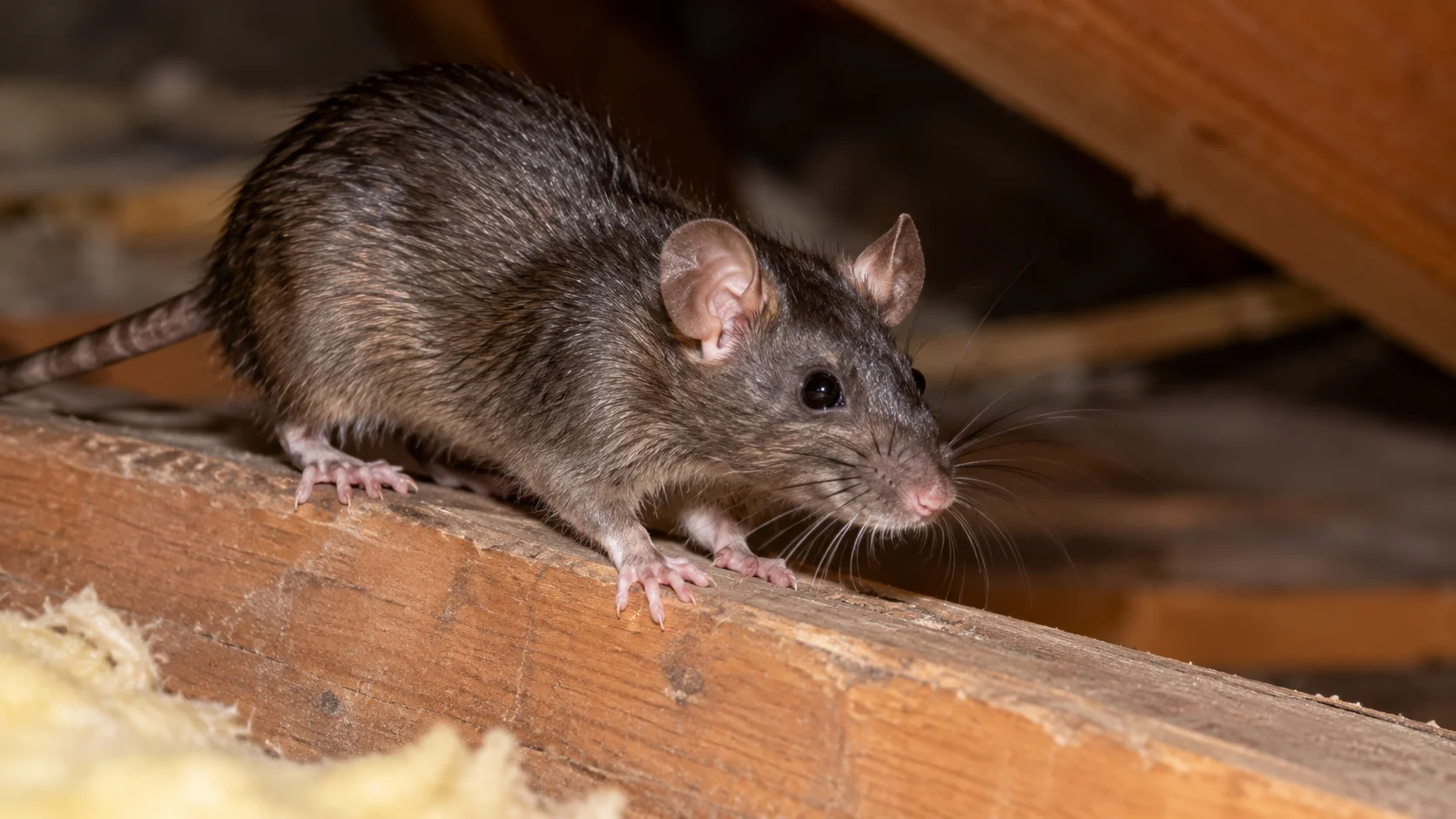
The roof rat (Rattus rattus) is a slender climbing rodent commonly associated with attics, roofs, trees, wall spaces, garages, and other elevated areas. It is also known as the black rat or ship rat. Roof rats are generally smaller and more slender than Norway rats, with large ears, prominent eyes, and a long tail.
Roof rats are primarily nocturnal and often live in colonies. They can enter buildings through relatively small openings and may cause property damage by gnawing, contaminate food and surfaces with droppings and urine, and create nests in protected spaces. Effective roof rat control focuses on removing food and shelter, blocking entry points, managing vegetation, and trapping or otherwise controlling rats that are already present.
What Is a Roof Rat
A roof rat is a species of rat scientifically known as Rattus rattus. Its common names include black rat and ship rat. The species occurs widely around the world and is particularly associated with warmer regions and coastal areas in the United States.
Unlike Norway rats, which commonly occupy lower areas such as basements and sewers, roof rats are excellent climbers and frequently use trees, roofs, rafters, attics, and other elevated structures for movement and nesting.
Roof Rat Characteristics
Several physical and behavioral characteristics make roof rats easier to distinguish from other common rodents.
- Slender body shape
- Dark brown, black, or grayish upper fur
- Lighter-colored underside
- Large eyes
- Large ears
- Pointed muzzle
- Long, scaly tail
- Tail often longer than the body
- Strong climbing ability
- Mostly nocturnal activity
The University of Arizona Cooperative Extension describes adult roof rats as approximately 5–7 inches long, with the tail bringing the total length to about 12 inches.
What Does a Roof Rat Look Like
A roof rat has a noticeably slender appearance compared with the heavier-bodied Norway rat. Its dark or brownish fur, large ears, pointed nose, and long tail are among its most recognizable characteristics.
The tail is especially useful when making an initial identification. University of Arizona guidance notes that the roof rat's scaly tail is almost always longer than its body, while its ears are large and nearly hairless.
Roof Rat Color and Body Features
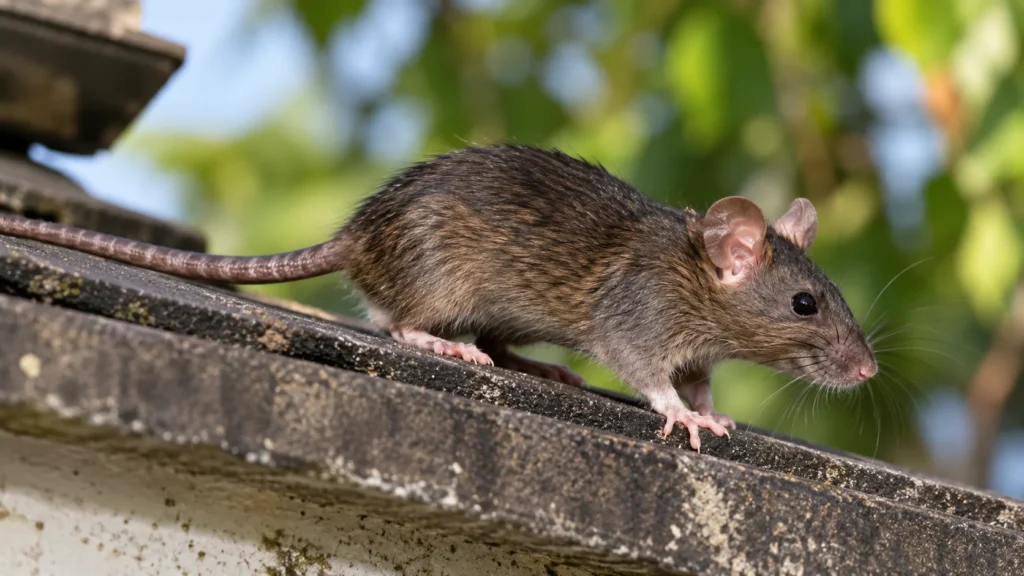
Color can vary between individuals, so identification should not depend on fur color alone.
- Black or dark-brown upper body
- Grayish or brownish variations possible
- Lighter belly
- Large black eyes
- Large ears
- Pointed nose
- Slender body
- Long scaly tail
- Four legs with strong climbing ability
- Relatively thin appearance compared with a Norway rat
Roof Rat Size
Roof rat size is typically smaller than Norway rat size. PestWorld lists a total length of about 16 inches, including a body of approximately 6–8 inches and a tail of approximately 6–8 inches.
Regional descriptions can differ slightly because adult size varies among individual rats and populations. A large roof rat can therefore appear surprisingly substantial while still having the slender proportions associated with the species.
Large Roof Rat Appearance
A large roof rat may look much bigger than expected when seen close to a person, particularly because its long tail adds considerably to its total length.
Body proportions remain useful for identification. Roof rats generally have a slimmer body and proportionally longer tail than Norway rats.
Explore more articles:
- Fruit Flies vs Gnats
- Rat vs Mouse
- Bugs That Look Like Flying Termites
- Bugs That Look Like Fleas
- What Do Fleas Look Like?
- Wood Ants vs Termites
- What Are Centipedes Attracted To?
- What Do Drain Flies Look Like
- What Do Baby Black Widows Look Like?
- Deer Mouse vs House Mouse
- Bugs That Look Like Lice
Roof Rat Habitat and Behavior
Roof rats are particularly associated with elevated habitats. They can nest in trees, attics, roof spaces, rafters, wall voids, and other protected locations above ground level. PestWorld reports that roof rats typically live in colonies and prefer upper portions of structures or trees.
They are primarily nocturnal, meaning activity often becomes easier to notice after dark. Roof rats can repeatedly use established routes between nesting and feeding areas.
Where Roof Rats Commonly Hide
Their climbing ability allows them to use locations that are less accessible to other rodents.
- Attics
- Roof spaces
- Rafters
- Eaves
- Trees
- Wall voids
- Garages
- Sheds
- Dense vegetation
- Utility lines and elevated pathways
The University of Arizona also notes that roof rats can move inside walls and beneath floors while using roofs and other elevated structures.
Roof Rat Nest
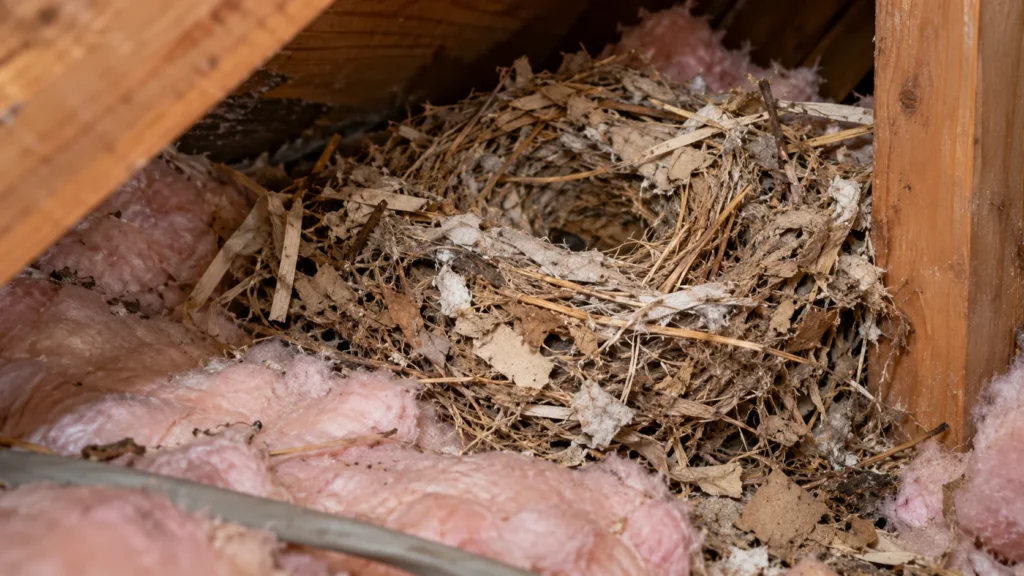
A roof rat nest is usually constructed in a protected, relatively dry location. Roof rats may nest in trees, dense vegetation, attics, roof structures, wall spaces, and other areas that provide shelter from predators and weather.
Because roof rats are strong climbers, an attic or elevated structure can provide particularly suitable nesting conditions. Their nests can contain shredded plant material and other soft materials collected from the surrounding environment.
Roof Rat Nest in Attic
An attic can provide warmth, darkness, shelter, and proximity to roof access points. Signs of a roof rat nest may include shredded material, droppings, gnaw marks, unusual nighttime noises, and disturbed insulation.
Do not handle rodent nesting material with bare hands. CDC recommends appropriate protective measures and disinfection procedures when cleaning rodent nests, droppings, or dead rodents.
Roof Rat Droppings and Poop
Roof rat droppings are one of the most useful signs of an infestation. PestWorld describes fresh roof rat droppings as soft and moist, while older droppings become hard and dry. They are generally around 1/2 inch or 12–13 mm long and have pointed ends.
Droppings may occur near feeding locations, nesting areas, travel routes, attics, garages, and other areas used frequently by rats.
Roof Rat vs Norway Rat Droppings
Dropping size and shape can help distinguish the two species, although identification should consider multiple signs.
| Feature | Roof Rat Droppings | Norway Rat Droppings |
| Typical length | About 1/2 inch | About 3/4 inch |
| Shape | More pointed ends | More blunt ends |
| Rat body type | Slender | Heavier |
| Common habitat | Elevated areas | Lower areas |
| Typical nesting | Attics, trees, upper structures | Basements, burrows, lower areas |
PestWorld describes Norway rat droppings as approximately 3/4 inch long with blunt ends, compared with the smaller, pointed-ended droppings of roof rats.
Roof Rat vs Norway Rat
The roof rat vs Norway rat comparison is one of the most useful ways to identify an unknown rat. Roof rats are generally more slender, have larger ears and eyes, and have a tail that is usually longer than the body.
Norway rats are heavier-bodied and tend to occupy lower areas such as basements, ground-level spaces, and burrows. Roof rats are more likely to climb and use elevated structures.
Norway Rat vs Roof Rat Features
- Roof rats have slimmer bodies
- Norway rats have heavier bodies
- Roof rats have proportionally larger ears
- Roof rats have larger eyes
- Roof rats have longer tails relative to body length
- Norway rats have shorter tails relative to body length
- Roof rats are strong climbers
- Norway rats commonly use ground-level habitats
- Roof rats frequently occupy attics and trees
- Both species can damage property and contaminate food
Roof Rat vs Mouse
A roof rat vs mouse comparison is usually straightforward because adult roof rats are substantially larger. Roof rats have thicker bodies, longer tails, and more powerful limbs than house mice.
However, a juvenile roof rat can be mistaken for a large mouse. Tail length, body proportions, ears, head shape, and droppings can help distinguish them.

Roof Rat vs House Mouse
House mice are much smaller and generally have a compact body with a relatively thin tail. A mature roof rat is considerably longer and more robust.
When an animal appears unusually large for a mouse, examining the droppings and physical proportions can help determine whether a young rat rather than a mouse is present.
Roof Rat Droppings, Grease Marks, and Other Signs
Droppings are not the only evidence of roof rat activity. Rats can leave greasy rub marks where their fur repeatedly contacts walls, beams, pipes, and established runways. Gnaw marks, damaged food, nests, and nighttime sounds can also indicate an infestation.
Roof rats often reuse travel routes, which can make these signs more concentrated in particular areas.
Common Roof Rat Infestation Signs
Look for multiple signs rather than relying on a single clue.
- Dark rodent droppings
- Pointed-ended fecal pellets
- Gnaw marks
- Damaged food packaging
- Greasy rub marks
- Shredded nesting material
- Damaged insulation
- Scratching noises
- Noises in attic spaces
- Damaged electrical wiring
Roof Rat Control
Effective roof rat control requires more than removing individual rats. The surrounding environment needs to become less suitable for feeding, nesting, and repeated access.
The CDC recommends removing food, water, and shelter sources while sealing openings around the home. The University of Arizona also recommends reducing vegetation around structures and preventing roof rats from using tree branches as routes onto buildings.
Roof Rat Prevention Around the Home
Physical exclusion is one of the most important long-term measures.
- Seal cracks and openings around the building
- Screen vents and windows
- Trim branches away from the roof
- Keep shrubs away from exterior walls
- Remove fallen fruit from yards
- Store garbage in tightly covered containers
- Secure pet food
- Store dry foods in sealed containers
- Eliminate unnecessary outdoor water sources
- Reduce clutter and vegetation near structures
Roof Rat Removal
Roof rat removal generally combines exclusion, sanitation, monitoring, and trapping. Simply catching one rat does not guarantee that the entry route has been eliminated or that other rats are absent.
CDC recommends continuing to trap until there are no more rodents and no new signs of activity. If fresh droppings, urine spots, or gnawing continue, an infestation may remain active.
Roof Rat Traps
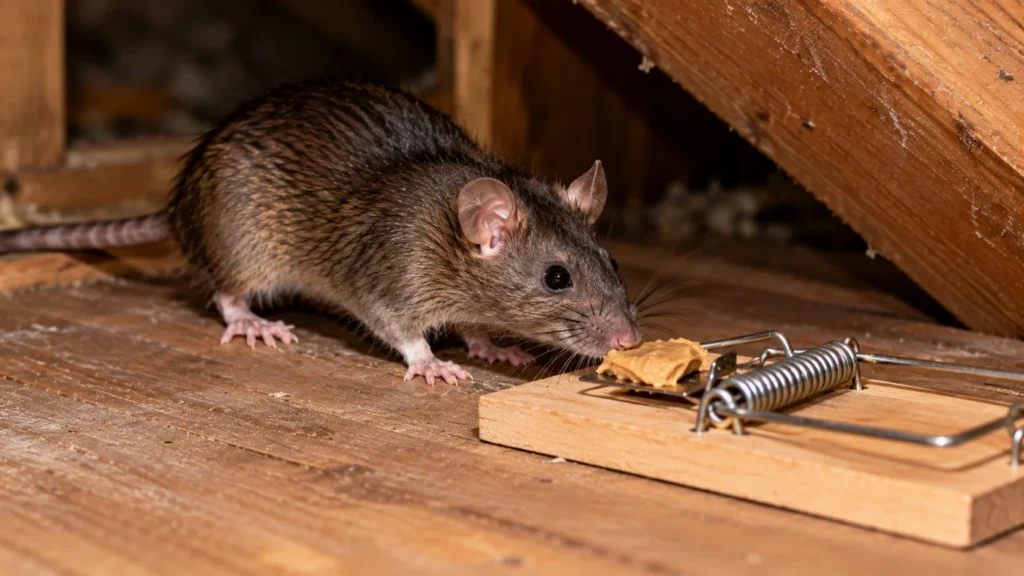
Roof rats can be controlled with properly positioned snap traps. Because they frequently travel above ground, trapping may need to occur along elevated pathways such as rafters, beams, ledges, pipes, or attic routes.
The Internet Center for Wildlife Damage Management identifies snap traps as an effective roof rat control option and notes that traps can be positioned along frequently used travel routes.
Roof Rat Bait and Poison
Roof rat bait and rodenticides can be used in certain situations, but they require careful placement and strict compliance with product labels. Poison should never be placed where children, pets, or non-target wildlife can reach it.
For household infestations, CDC recommends traditional snap traps first and indicates that poison or bait stations may be considered when trapping does not resolve the problem.
Safe Roof Rat Bait Practices
Rodenticide use carries additional risks compared with mechanical trapping. Follow the registered product label and use appropriate bait stations wherever required.
The EPA recommends using rodenticide products according to their label directions and taking precautions to prevent accidental exposure to people and animals.
Roof Rat Removal Cost and Professional Control
Roof rat removal cost varies according to the size of the infestation, location, accessibility, exclusion work, trapping requirements, and geographic area. An attic infestation that requires sealing roof-level entry points can require more work than a small, easily accessible problem.
Professional inspection becomes particularly valuable when rats are inside inaccessible wall or roof spaces, when activity continues despite trapping, or when extensive exclusion work is required.
When Professional Roof Rat Extermination Helps
A licensed pest professional can identify entry points, nesting locations, travel routes, and conditions that are supporting the infestation.
Professional assistance is especially useful when:
- Rats are active inside walls
- Rats are nesting in inaccessible roof spaces
- Droppings continue appearing after trapping
- Electrical wiring has been damaged
- Multiple entry points are present
- The infestation involves difficult-to-reach areas
- Roof-level exclusion requires specialized access
- Children or pets complicate trap placement
- The infestation repeatedly returns
- Cleanup involves substantial contamination
Roof Rat Control in Different Regions
Roof rats are particularly associated with warmer and coastal areas of the United States. PestWorld identifies the southern third of the country and coastal states as major areas where roof rats occur.
Regional terms such as Texas roof rat, Florida roof rat, Arizona roof rat, and California roof rat generally refer to roof rats occurring in those locations rather than separate universally recognized species.
Regional Roof Rat Considerations
Local climate and landscaping can strongly influence roof rat activity. Warm regions with fruit trees, dense vegetation, outdoor food, and accessible structures can provide particularly favorable conditions.
The University of Arizona specifically recommends vegetation management and removal of fallen fruit as important roof rat prevention measures.
10 Essential Roof Rat Facts
- The roof rat is scientifically known as Rattus rattus.
- It is also called the black rat or ship rat.
- Roof rats are generally smaller and more slender than Norway rats.
- Adults commonly measure about 5–7 inches in body length, with a longer total length including the tail.
- Their tails are usually longer than their bodies.
- Roof rats have large eyes, large ears, pointed muzzles, and slender bodies.
- They commonly nest in trees, attics, rafters, and other elevated locations.
- Roof rat droppings are typically around 1/2 inch long with pointed ends.
- Trimming vegetation and sealing building openings can reduce roof rat access.
- Snap trapping, exclusion, sanitation, and professional inspection can all contribute to effective control.
Conclusion
The roof rat is a slender, highly adaptable climbing rodent that commonly uses trees, roofs, attics, rafters, and other elevated spaces. Its large ears, prominent eyes, pointed muzzle, dark coloration, and long tail help distinguish it from the heavier-bodied Norway rat. Droppings, grease marks, gnawing, nesting material, and nighttime noises can provide additional evidence of an infestation.
Successful roof rat control requires more than catching individual animals. Seal openings, trim branches and vegetation away from structures, remove fallen fruit and accessible food, secure garbage, and use appropriately positioned traps. For persistent or difficult infestations, professional inspection and exclusion can help identify the access points and nesting areas that allow roof rats to return.
What is a roof rat?
A roof rat is a slender rodent scientifically called Rattus rattus. It is also known as the black rat or ship rat and commonly lives in trees and elevated parts of buildings.
What does a roof rat look like?
A roof rat typically has dark brown or blackish fur, a lighter underside, large eyes, large ears, a pointed muzzle, and a long scaly tail that is usually longer than its body.
How big is a roof rat?
Adult roof rats commonly have a body length of about 5–8 inches, with the tail adding another 6–8 inches. PestWorld gives an approximate total length of 16 inches.
What do roof rat droppings look like?
Roof rat droppings are generally around 1/2 inch long and tend to have pointed ends. Fresh droppings are softer and moist, while older droppings become dry and hard.
How can roof rats be removed?
Roof rat removal usually involves sealing entry points, reducing food and shelter sources, trimming vegetation, and using appropriately positioned traps. Persistent infestations may require professional inspection and control.