
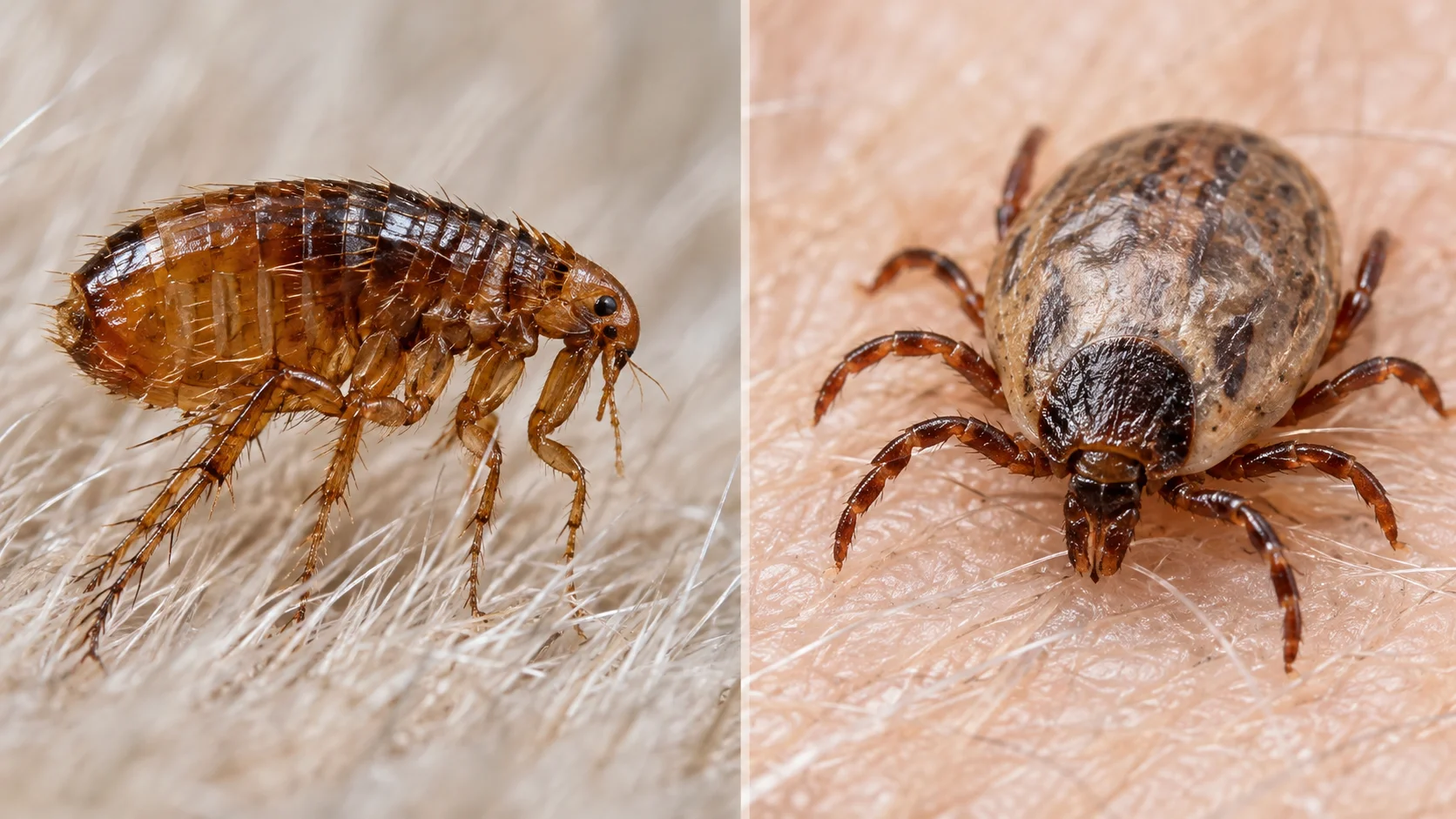
Fleas and ticks are both blood-feeding external parasites that can affect pets and people, but they belong to different biological groups and behave very differently. Fleas are insects with six legs, while ticks are arachnids whose nymphs and adults have eight legs. Fleas are built for jumping and moving rapidly through fur, whereas ticks generally crawl onto hosts from vegetation and attach to the skin.
The distinction matters because both pests can cause irritation and transmit disease, but their identification, life cycles, and control strategies are not identical. Fleas can establish populations inside homes, while ticks may enter homes on pets or people and some species can establish indoor infestations.
Fleas vs Ticks: Basic Identification
The clearest difference between fleas and ticks is their body structure. Fleas are small, wingless insects with a laterally flattened body and powerful legs adapted for jumping. Ticks have a rounded or oval body, eight legs in nymphal and adult stages, and specialized mouthparts for attaching to and feeding on a host.
Their movement also provides a useful clue. Fleas can jump quickly when disturbed, while ticks do not fly or jump and commonly climb vegetation before attaching to a passing host.
Flea Identification
Adult fleas are tiny and can be difficult to see among dense pet fur. Their laterally flattened bodies allow them to move through hair, while their powerful hind legs help them jump between locations and hosts.
- Small, wingless insect
- Six legs
- Laterally flattened body
- Usually reddish-brown to dark brown
- Powerful hind legs
- Adapted for jumping
- Fast movement through fur
- Blood-feeding adult stage
- Often found around pets
- Can establish populations in carpets and bedding
Tick Identification
Ticks have a different body structure from fleas because they are arachnids rather than insects. Nymphs and adults normally have eight legs, while tick larvae have six legs.
- Arachnids rather than insects
- Eight legs in nymphs and adults
- Six legs in larvae
- Oval or rounded body
- No wings
- No jumping ability
- Attach to skin
- Feed on blood
- Can become enlarged after feeding
- Often found around vegetation and wildlife habitats
Explore more articles:
- Fruit Flies vs Gnats
- Rat vs Mouse
- Bugs That Look Like Flying Termites
- Bugs That Look Like Fleas
- What Do Fleas Look Like?
- Wood Ants vs Termites
- What Are Centipedes Attracted To?
- What Do Drain Flies Look Like
- What Do Baby Black Widows Look Like?
- False Widow vs Black Widow
Difference Between Fleas and Ticks by Appearance
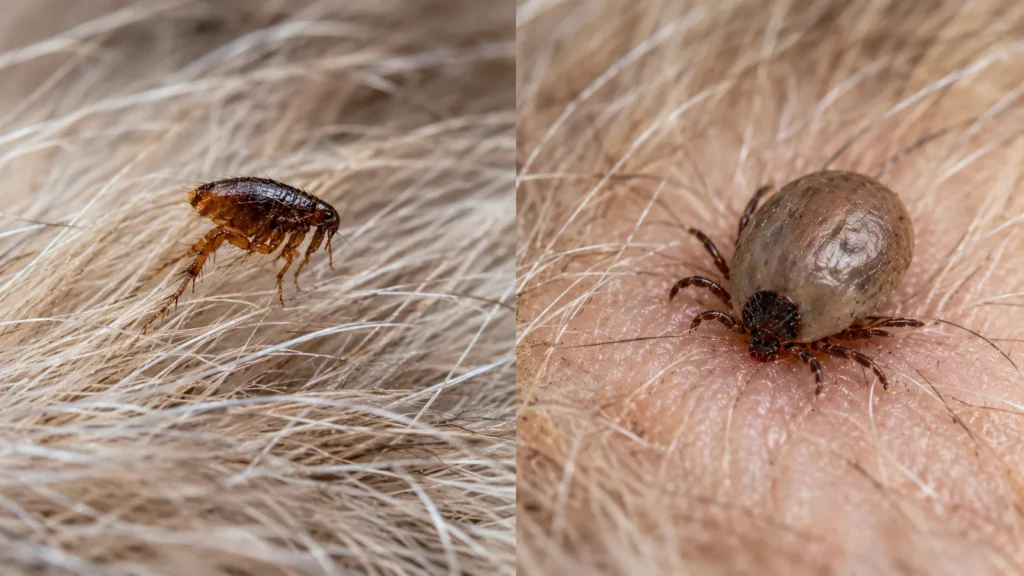
Fleas generally look like tiny dark specks moving rapidly through hair or fur. Their bodies are narrow from side to side, which helps them move between hairs. Ticks tend to look more like tiny flat or rounded dots attached to the skin, especially before they become engorged.
The size and appearance of ticks can vary considerably by species and life stage. Some nymphal ticks are extremely small and may be difficult to detect without careful inspection.
Visible Appearance Differences
A close inspection can usually separate the two when the organism is visible. Leg number, body shape, attachment behavior, and movement are more reliable than color alone.
- Fleas are laterally flattened
- Ticks are generally rounded or oval
- Fleas have six legs
- Adult and nymphal ticks have eight legs
- Fleas move rapidly
- Ticks move more slowly
- Fleas jump
- Ticks do not jump or fly
- Fleas usually move through fur
- Ticks commonly remain attached to skin
Fleas vs Ticks on Dogs
Dogs can host both fleas and ticks, but the signs can differ. Fleas may move rapidly through the coat and cause repeated scratching, licking, chewing, or irritation. Flea infestations can also produce flea dirt, which consists of digested blood and may appear as dark particles in the fur.
Ticks are generally easier to find by feeling or visually inspecting the dog's skin, particularly around areas where ticks commonly attach. A tick can remain attached while feeding, unlike a flea that typically moves through the coat.
Dog Flea Signs
Flea activity can involve both the pet and its indoor environment. Once established, flea populations may persist because immature stages develop away from the animal.
- Frequent scratching
- Excessive licking
- Biting at the skin
- Restlessness
- Fleas moving through fur
- Dark flea dirt
- Irritated skin
- Hair loss from excessive scratching
- Flea eggs in the environment
- Flea activity around bedding
Dog Tick Signs
Ticks may be noticed as small attached organisms on the skin. Dogs that spend time outdoors, particularly in grassy or brushy areas, can encounter ticks more frequently.
- Small attached parasite
- Raised bump on skin
- Tick visible between hairs
- Swollen tick after feeding
- Scratching at attachment site
- Licking one area repeatedly
- Tick around ears
- Tick between toes
- Tick around the neck
- Tick around other thin-skinned areas
Fleas vs Ticks on Cats
Cats can also be affected by both fleas and ticks, although flea infestations are particularly common among companion animals. Fleas can cause significant itching and may trigger flea allergy dermatitis in sensitive pets.
Ticks can attach to cats after outdoor exposure. Cats are also especially sensitive to certain chemicals, so flea and tick products should be selected according to the animal's species, age, weight, and label instructions.
Cat Flea Signs
A cat may groom away visible fleas, making an infestation harder to recognize. Flea dirt, scratching, skin irritation, and excessive grooming can provide additional clues.
- Excessive grooming
- Frequent scratching
- Hair thinning
- Irritated skin
- Flea dirt
- Restlessness
- Fleas around the neck
- Fleas near the tail base
- Increased licking
- Flea activity around sleeping areas
Cat Tick Signs
Ticks can attach to cats after outdoor exposure and may be found in areas where the animal cannot easily remove them through grooming. Regular inspection is useful for cats that spend time outside.
- Attached tick
- Small skin bump
- Tick around ears
- Tick near the head
- Tick between toes
- Tick around the neck
- Licking at one location
- Localized skin irritation
- Swollen tick after feeding
- Recent outdoor exposure
Flea vs Tick Bites
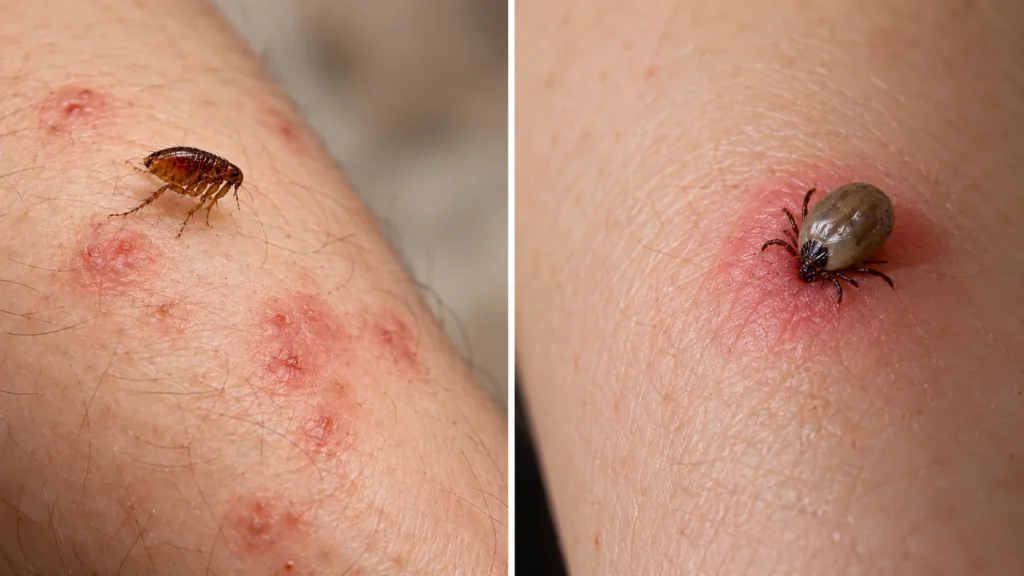
Flea bites and tick bites can both produce itching and skin irritation, but the circumstances differ. Fleas commonly bite repeatedly and may cause multiple itchy spots, especially around areas such as the lower legs in people. Flea bites can also trigger allergic reactions in pets.
Ticks generally attach to the skin and feed for a longer period. Their bites can be associated with transmission of pathogens, depending on the tick species and geographic area.
Flea Bite Characteristics
Flea bites may occur in clusters or groups because fleas can move between feeding sites. People sharing an environment with an infested animal may also be bitten.
- Small itchy spots
- Multiple bites
- Redness
- Skin irritation
- Repeated feeding
- Bites often around lower legs
- Possible allergic reaction
- Scratching can worsen irritation
- Pets may develop flea allergy dermatitis
- Heavy infestations can cause serious problems in vulnerable animals
Tick Bite Characteristics
Tick bites may initially go unnoticed because the tick can remain attached while feeding. Some tickborne infections can produce symptoms later, depending on the pathogen transmitted.
- Often associated with an attached tick
- May initially be painless
- Local skin irritation
- Possible redness
- Tick may remain attached for days
- Feeding causes the tick to enlarge
- Different species transmit different pathogens
- Tick removal reduces continued feeding
- Bite sites should be monitored
- Medical advice may be appropriate after certain tick exposures
Fleas vs Ticks: Life Cycle and Behavior
Fleas and ticks have substantially different life cycles. Fleas develop through egg, larva, pupa, and adult stages, with immature stages commonly developing in the environment. This means treating only the visible adult fleas may not immediately eliminate an established infestation.
Ticks develop through egg, larva, nymph, and adult stages. Most ticks require a blood meal at each active stage, and many species use different hosts during different stages of their life cycle.
Flea Life Cycle
Flea control must account for both the animal and its environment. Carpets, bedding, furniture, and other areas used by pets can harbor developing flea stages.
- Eggs are produced after feeding
- Eggs can fall into the environment
- Larvae develop away from the host
- Pupae form protective cocoons
- Adults emerge when conditions are suitable
- Adult fleas seek a blood meal
- Pets are common hosts
- Fleas can survive indoors
- Environmental treatment can be necessary
- Established infestations may take time to control
Tick Life Cycle
Ticks spend important parts of their life cycle in the environment while seeking suitable hosts. Some species can take years to complete their life cycle.
- Eggs hatch into larvae
- Tick larvae have six legs
- Nymphs have eight legs
- Adults have eight legs
- Active stages require blood meals
- Different stages may use different hosts
- Wildlife can maintain tick populations
- Vegetation can provide questing sites
- Ticks can enter homes on hosts
- Some species can establish indoor populations
Fleas vs Ticks and Disease Risks
Both fleas and ticks can transmit pathogens, but the diseases associated with them differ. CDC notes that some fleas can spread pathogens responsible for diseases including flea-borne typhus, plague, and cat scratch disease.
Ticks are important vectors of numerous pathogens, including those responsible for Lyme disease, ehrlichiosis, Rocky Mountain spotted fever, babesiosis, and other tickborne diseases. Pets can also bring ticks into the home.
Health Considerations
Disease risk varies according to parasite species, geographic location, host, and pathogen. A visible flea or tick does not automatically mean disease transmission has occurred.
- Fleas can transmit certain bacterial pathogens
- Fleas can cause allergic reactions
- Heavy flea infestations can cause anemia in vulnerable pets
- Ticks transmit numerous pathogens
- Lyme disease is tickborne
- Ehrlichiosis is tickborne
- Anaplasmosis is tickborne
- Rocky Mountain spotted fever is tickborne
- Pets can transport ticks indoors
- Regional disease risks vary
Fleas vs Ticks: Prevention and Control
Effective control starts with correctly identifying the pest and addressing the appropriate host and environment. Flea management may require treatment of every pet and environmental control because immature fleas can remain in the home. CAPC recommends ongoing flea control for dogs and cats to reduce infestations and prevent household flea populations.
Tick prevention focuses on reducing exposure, checking pets, and using an appropriate preventive product. CAPC recommends consistent tick control for dogs and cats because ticks can transmit pathogens and may be brought into homes.

Practical Prevention Steps
Products should always be selected and used according to their labels and the animal's species and life stage. FDA specifically warns against using dog flea and tick products on cats unless the product is labeled for cats.
- Check pets regularly
- Use a flea comb when appropriate
- Inspect pets after outdoor activity
- Wash pet bedding regularly
- Vacuum carpets and rugs frequently
- Reduce outdoor tick habitat around homes
- Keep grass and vegetation maintained
- Follow veterinary guidance
- Use products labeled for the correct species
- Follow all product directions carefully
Fleas vs Ticks Quick Comparison
| Feature | Fleas | Ticks |
| Classification | Insects | Arachnids |
| Adult legs | 6 | 8 |
| Body shape | Laterally flattened | Oval or rounded |
| Movement | Jumping and crawling | Crawling |
| Wings | None | None |
| Feeding | Blood-feeding | Blood-feeding |
| Host attachment | Usually move through fur | Attach to skin |
| Main environment | Pets and household areas | Vegetation, wildlife habitats, hosts |
| Indoor infestation | Common with established flea populations | Possible with certain tick species |
| Disease transmission | Some flea-borne diseases | Many tickborne diseases |
10 Key Differences Between Fleas and Ticks
- Fleas are insects, while ticks are arachnids.
- Adult fleas have six legs.
- Nymphal and adult ticks have eight legs.
- Fleas can jump, while ticks cannot jump or fly.
- Fleas are laterally flattened to move through animal fur.
- Ticks attach directly to the skin while feeding.
- Fleas can establish populations in carpets, bedding, and other household areas.
- Ticks commonly reach hosts by climbing vegetation and questing.
- Fleas can cause flea allergy dermatitis in susceptible pets.
- Both parasites require consistent prevention and appropriate control measures.
Conclusion
The main difference between fleas vs ticks is their anatomy and feeding behavior. Fleas are six-legged insects that move rapidly and jump through fur, while ticks are arachnids with eight legs in their nymphal and adult stages that attach to skin and feed for an extended period.
Both parasites can affect dogs, cats, and people, but they require different approaches to identification and control. Flea management must account for the pet and indoor environment, while tick prevention should focus on regular pet checks, reducing exposure, and appropriate veterinary-recommended protection.
1. Are fleas and ticks the same thing?
No. Fleas are insects with six legs, while ticks are arachnids whose nymphs and adults have eight legs. Their body structures, life cycles, and feeding behaviors are different.
2. Are fleas or ticks more dangerous to dogs?
Both can harm dogs, but the specific risk depends on the parasite species, exposure, and geographic location. Fleas can cause allergic skin disease and heavy infestations can cause anemia, while ticks can transmit numerous pathogens.
3. Can fleas jump like ticks?
Fleas can jump, but ticks cannot. Ticks generally climb vegetation and wait for a suitable host to brush against them.
4. Can fleas and ticks live on cats?
Yes. Both fleas and ticks can infest cats. Cats require products specifically labeled for feline use because some flea and tick chemicals intended for dogs can be dangerous to cats.
5. Can fleas and ticks get into the house?
Yes. Fleas can establish populations in carpets, bedding, furniture, and other areas used by pets. Ticks can be carried indoors by pets or people, and certain species can establish indoor infestations.