
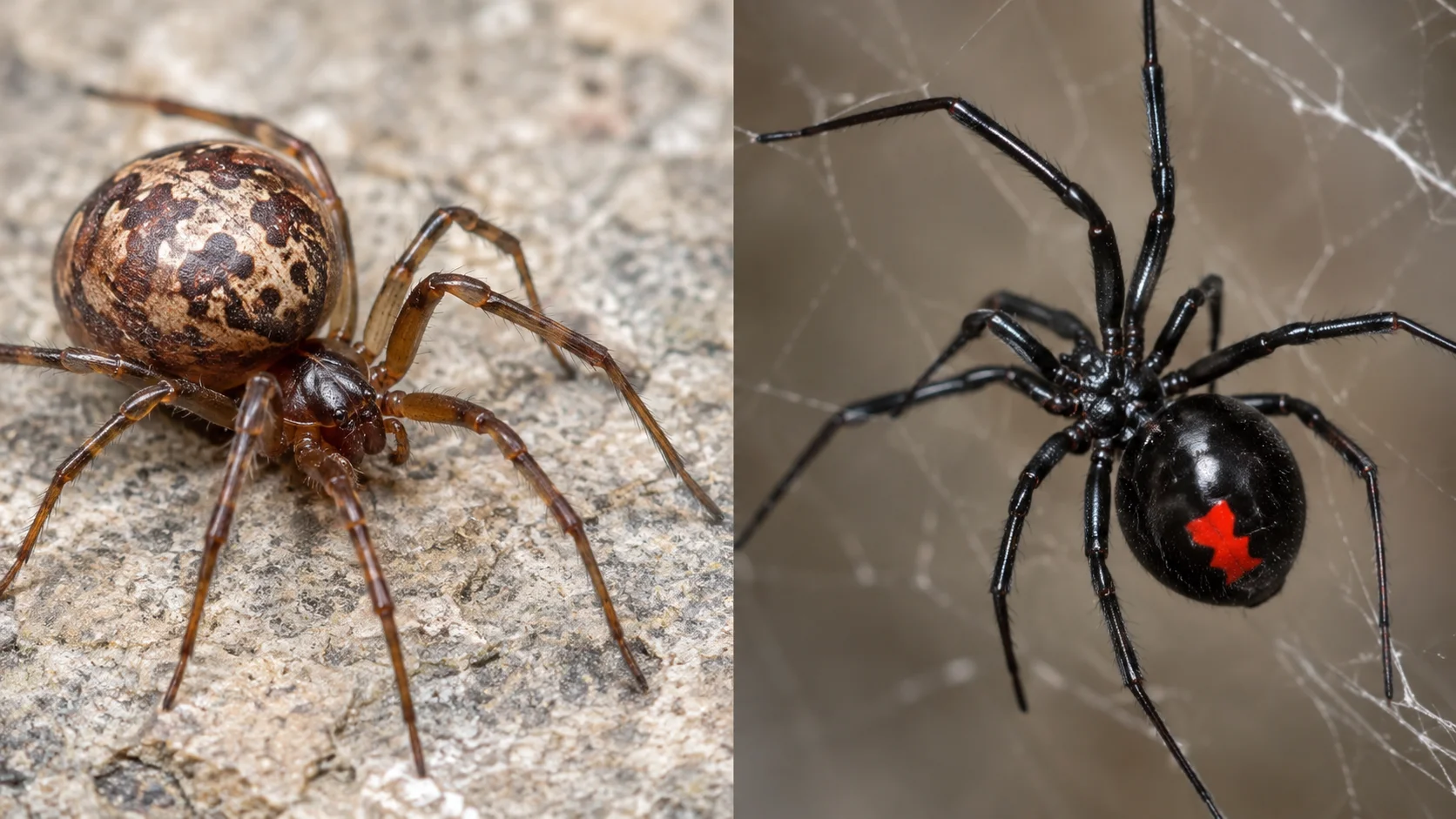
False widow and black widow spiders are often confused because both belong to the cobweb-weaver family Theridiidae and have rounded abdomens, dark coloration, and irregular webs. However, they are not the same spiders. True black widows belong to the genus Latrodectus, while false widows belong mainly to the genus Steatoda.
The most useful identification clues include body color, abdominal markings, body shape, web structure, and geographic location. Adult female black widows are typically glossy black and have a red or orange marking on the underside of the abdomen, whereas false widows are commonly brown to dark purplish and generally lack the classic red hourglass.
False Widow vs Black Widow Appearance
The two groups can look remarkably similar at first glance, especially when viewed from a distance. Both have relatively rounded abdomens and relatively short legs compared with spiders such as orb weavers, which contributes to frequent misidentification.
A closer inspection of the abdomen provides some of the most useful clues. False widows often have pale cream, gray, tan, or reddish abdominal markings, while mature female black widows are usually much more uniformly black.
False Widow Appearance
False widows are generally small to medium-sized spiders with a rounded or bulbous abdomen. Their coloration can range from brown and chocolate brown to almost black, depending on the species.
The noble false widow (Steatoda nobilis) commonly has a pale pattern on the abdomen, while the cupboard spider (Steatoda grossa) can be much darker with faint markings. These markings can become difficult to see in some adult females.
Black Widow Appearance
A mature female western black widow has a shiny black body and a large rounded abdomen. The characteristic red or orange marking occurs on the underside of the abdomen and commonly resembles an hourglass.
The exact hourglass shape can vary, and in some individuals the red marking can be reduced or difficult to see. Therefore, the absence of a perfect hourglass alone should not be treated as the only identification feature.
Black Widow vs False Widow Identification
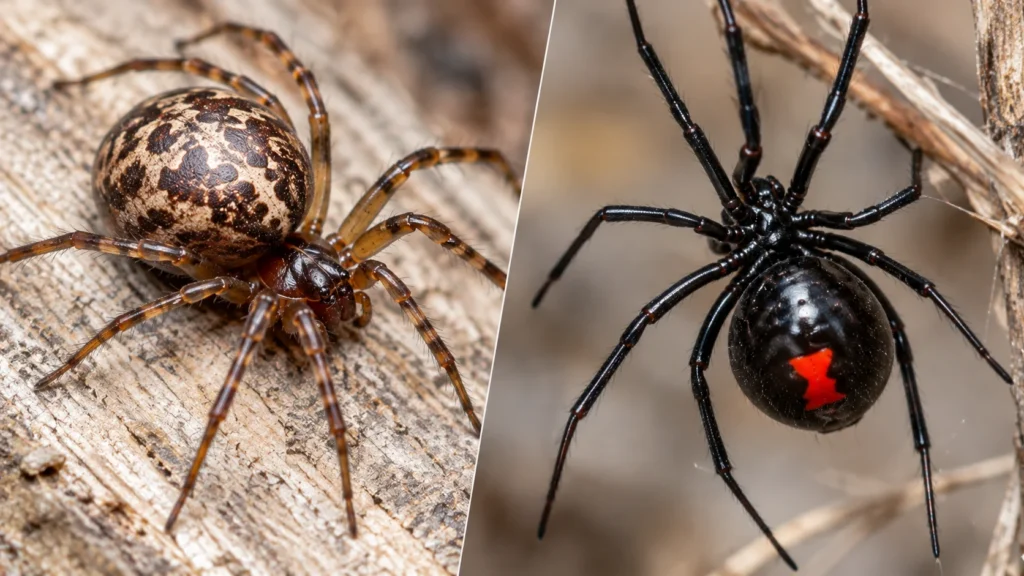
The abdomen is one of the most useful places to start when distinguishing these spiders. False widows generally have patterned or brownish abdomens, whereas adult female black widows typically have a glossy black abdomen with a red or orange underside marking.
Species and life stage matter, however. Juvenile black widows can look very different from adult females and may have white, tan, olive-gray, orange, and red markings.
Color and Abdominal Markings
A false black widow, usually referring to Steatoda grossa, is commonly chocolate brown to dark purplish-brown and lacks red coloration on the underside of the abdomen. Pale markings can occur on the abdomen but may be faint.
A mature female black widow is usually shiny black, with a red or orange hourglass-like marking underneath. The marking can vary in shape and intensity between individuals.
Abdomen Shape
Both spiders have rounded abdomens, so body shape by itself cannot reliably separate them. Female false widows often have a distinctly globular, shiny abdomen, while black widows have a large, rounded abdomen that becomes particularly noticeable in mature females.
False Black Widow vs Black Widow Size
Size can provide supporting evidence, but it should not be used alone. There are several false widow species, and their sizes overlap with some black widow measurements.
Penn State Extension reports adult female Steatoda grossa at approximately 6–10.5 millimeters in body length. UC IPM reports mature female western black widows at approximately 13 millimeters in body length, excluding the legs.
Size Differences by Species
The noble false widow can reach around 14–15 millimeters, meaning some false widows can be similar in body length to or even approach the size of a mature female western black widow.
This overlap makes markings, coloration, web structure, and species-specific characteristics more useful than simply measuring the spider.
False Widow Web vs Black Widow Web
Both spiders build irregular cobwebs rather than the classic circular orb webs associated with many garden spiders. Their webs can therefore look similar when viewed casually.
False widow webs are often described as loose tangles of criss-crossing silk. Black widows also construct irregular, messy cobwebs, frequently in sheltered spaces such as cracks, corners, clutter, and other protected locations.
False Widow Web Structure
False widow webs can form a three-dimensional framework of tangled threads. Noble false widows may construct webs in elevated areas around buildings, while cupboard spiders often favor darker, lower locations.
The spider may remain in a silken retreat or hang upside down within the web while waiting for prey.
Black Widow Web Structure
Black widow webs are also irregular and untidy rather than geometrically organized. They are commonly associated with protected locations where the spider can remain hidden.
UC IPM lists holes, cracks, crevices, trash, and clutter around structures as suitable black widow habitat.
Explore more articles:
- Rat vs Mouse
- Bugs That Look Like Flying Termites
- Bugs That Look Like Fleas
- What Do Fleas Look Like?
- Wood Ants vs Termites
- What Are Centipedes Attracted To?
- What Do Drain Flies Look Like
- What Is a Pantry Moth?
False Widow vs Black Widow Habitat
Habitat can provide an important supporting clue. Both types may occur around buildings, but their preferred locations and geographic distributions vary according to species.
False widows are frequently associated with homes, sheds, garages, cupboards, walls, and other sheltered structures. Black widows commonly use undisturbed spaces such as wood piles, storage areas, structural gaps, clutter, and protected outdoor locations.
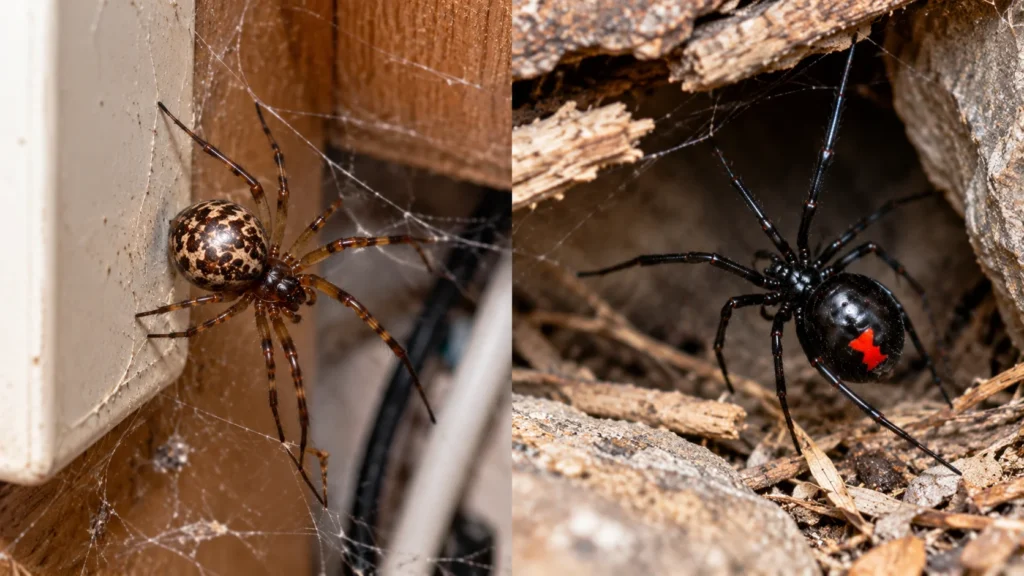
Indoor False Widow Locations
False widows can thrive around human structures. Depending on species, they may occur behind furniture, underneath appliances, inside cupboards, in garages, or in dark corners.
Penn State Extension reports Steatoda grossa as a common spider in homes and other structures in parts of the United States.
Black Widow Locations
Black widows tend to favor quiet, sheltered areas where webs can remain undisturbed. Common sites include cracks, holes, clutter, storage spaces, wood piles, and areas around building foundations.
The western black widow is widespread in the western United States, while other Latrodectus species occupy different regions.
False Widow vs Black Widow Geographic Differences
Geography can help narrow identification because different widow species have different distributions. False widow species occur in several regions, while black widows are native or established across broad parts of the Americas and other areas depending on species.
In the United States, Steatoda grossa occurs particularly in coastal Atlantic, Gulf, and Pacific regions, according to Penn State Extension. The western black widow (Latrodectus hesperus) is widespread in the western United States.
Noble False Widow Distribution
The noble false widow, Steatoda nobilis, is especially associated with the United Kingdom and has also established populations in parts of coastal California. The Natural History Museum describes it as one of the most commonly reported false widow species in Britain.
False Black Widow vs Real Black Widow Bite
The bite effects are another important distinction, but a spider should not be identified solely from symptoms. False widow bites and black widow bites can produce different clinical effects, and individual reactions can vary.
Penn State Extension reports that Steatoda grossa bites can cause local pain and other symptoms, generally considered less severe than those associated with true black widow envenomation. UC IPM describes black widow bites as potentially painful and medically significant, although serious outcomes are uncommon.
Black Widow Bite Risk
Black widow venom can produce symptoms that extend beyond the immediate bite area. UC IPM notes that black widow bites are relatively rare even where these spiders are common, but larger immature females and adult females can inject enough venom to cause a painful reaction.
False Widow Bite Effects
False widow venom is generally considered less medically significant than true black widow venom. The Natural History Museum reports that false widow bites are usually associated with localized pain and other relatively limited symptoms.
Spiders That Look Like Black Widows
Several spiders can be mistaken for black widows because of their dark color, rounded abdomen, or cobweb-style webs. False widows are among the most commonly discussed examples, but they are not the only spiders capable of causing confusion.
Some species have markings or body proportions that resemble widow spiders without belonging to the genus Latrodectus. Reliable identification should consider several characteristics instead of relying on color alone.
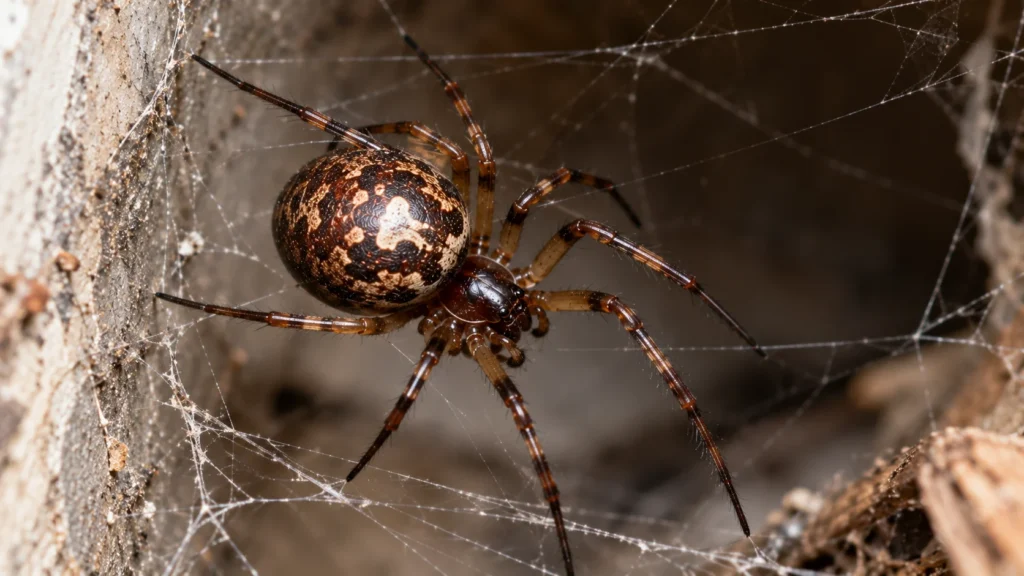
False Black Widow
The false black widow, Steatoda grossa, is particularly similar in overall body form. It has a rounded abdomen and irregular web but generally lacks the red underside marking characteristic of a black widow.
Noble False Widow
The noble false widow has a rounded abdomen with a distinctive pale pattern that can resemble a simplified structure or house-like shape. The pattern is clearer in some individuals than others.
Black Lace Weaver
The black lace weaver and other dark cobweb spiders can also be confused with false widows. The Natural History Museum notes that lace webbed spiders have more matte, hairy abdomens and a different overall shape from the shiny, rounded false widows.
Black Widow vs False Widow Comparison Table
| Feature | Black Widow | False Widow |
| Scientific group | Latrodectus | Mainly Steatoda |
| Typical adult female color | Glossy black | Brown, purplish-brown, or dark |
| Abdomen | Large and rounded | Rounded or bulbous |
| Red hourglass | Common on underside of adult female | Generally absent |
| Body markings | Often limited in mature females | Pale patterns often visible |
| Web | Irregular cobweb | Loose tangled cobweb |
| Habitat | Sheltered, undisturbed areas | Homes, sheds, garages, sheltered areas |
| Adult female size | Western species around 13 mm body length | Varies by species |
| Medical significance | Potentially significant | Generally less severe |
| Common confusion | False widows and other dark spiders | Black widows |
The table describes broad identification patterns rather than a universal rule for every species or life stage. Juvenile black widows, in particular, can look quite different from adult females.
Male Black Widow vs False Widow
Male black widows can create additional identification confusion because they do not resemble the familiar adult female. They are considerably smaller and retain pale juvenile-like abdominal patterns, including a longitudinal stripe and side markings.
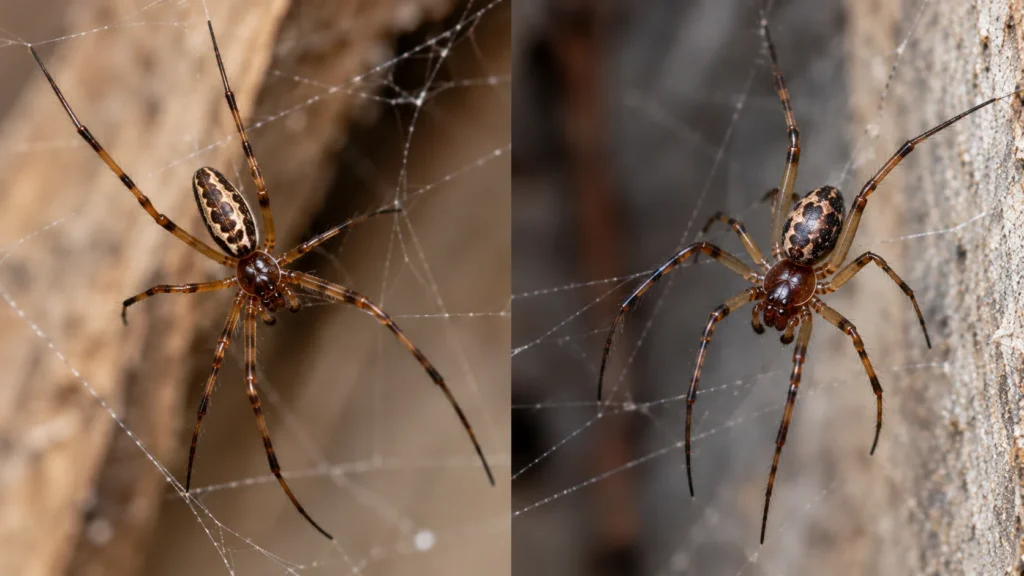
False widow males also differ from females in size and abdominal shape. In several false widow species, males have clearer abdominal markings and smaller, less rounded abdomens than females.
Ten Key Differences Between False and Black Widows
- Black widows belong to the genus Latrodectus.
- False widows mainly belong to the genus Steatoda.
- Mature female black widows are usually glossy black.
- False widows are commonly brown, chocolate, purplish, or dark.
- Adult female black widows commonly have a red or orange underside marking.
- False black widows generally lack the red hourglass.
- Both groups have rounded abdomens.
- Both can construct irregular, tangled cobwebs.
- Juvenile black widows can have white, tan, orange, and olive-gray markings.
- False widow bites are generally considered less medically significant than true black widow bites.
Conclusion
False widow and black widow spiders share several physical characteristics, which explains why they are frequently confused. Both have rounded abdomens and irregular cobwebs, but their coloration, abdominal markings, species, and typical habitat can provide useful distinctions.
A mature female black widow is usually glossy black with a red or orange underside marking, while false widows are commonly brown or dark purplish and may display pale abdominal patterns. Juvenile black widows require additional care during identification because their appearance can be very different from the adult female.What is the main difference between a false widow and a black widow?
The main distinction is the combination of species, coloration, and abdominal markings. Black widows belong to Latrodectus and mature females commonly have a red or orange underside marking, while false widows belong mainly to Steatoda and generally lack that red marking.
Can a false widow have markings?
Yes. False widow species can have pale cream, gray, tan, yellow, orange, or reddish abdominal markings. Some markings become faint or nearly invisible in darker adult females.
Do false widows have a red hourglass?
A classic red hourglass is not characteristic of false widows. Steatoda grossa, for example, lacks red coloration on the underside of the abdomen.
Can false widows bite?
Yes. False widows are capable of biting, generally when threatened, trapped, or pressed against skin. Documented symptoms can include localized pain and other temporary effects, although they are generally less severe than typical black widow envenomation.
Are false widows the same as black widows?
No. False widows and black widows are different spiders. False widows mainly belong to the genus Steatoda, whereas true black widows belong to the genus Latrodectus.
Can juvenile black widows look like false widows?
Yes. Immature black widows have patterned abdomens and can look very different from mature females. Their coloration can include tan, olive-gray, white, orange, and reddish markings, making juvenile identification more complicated.