
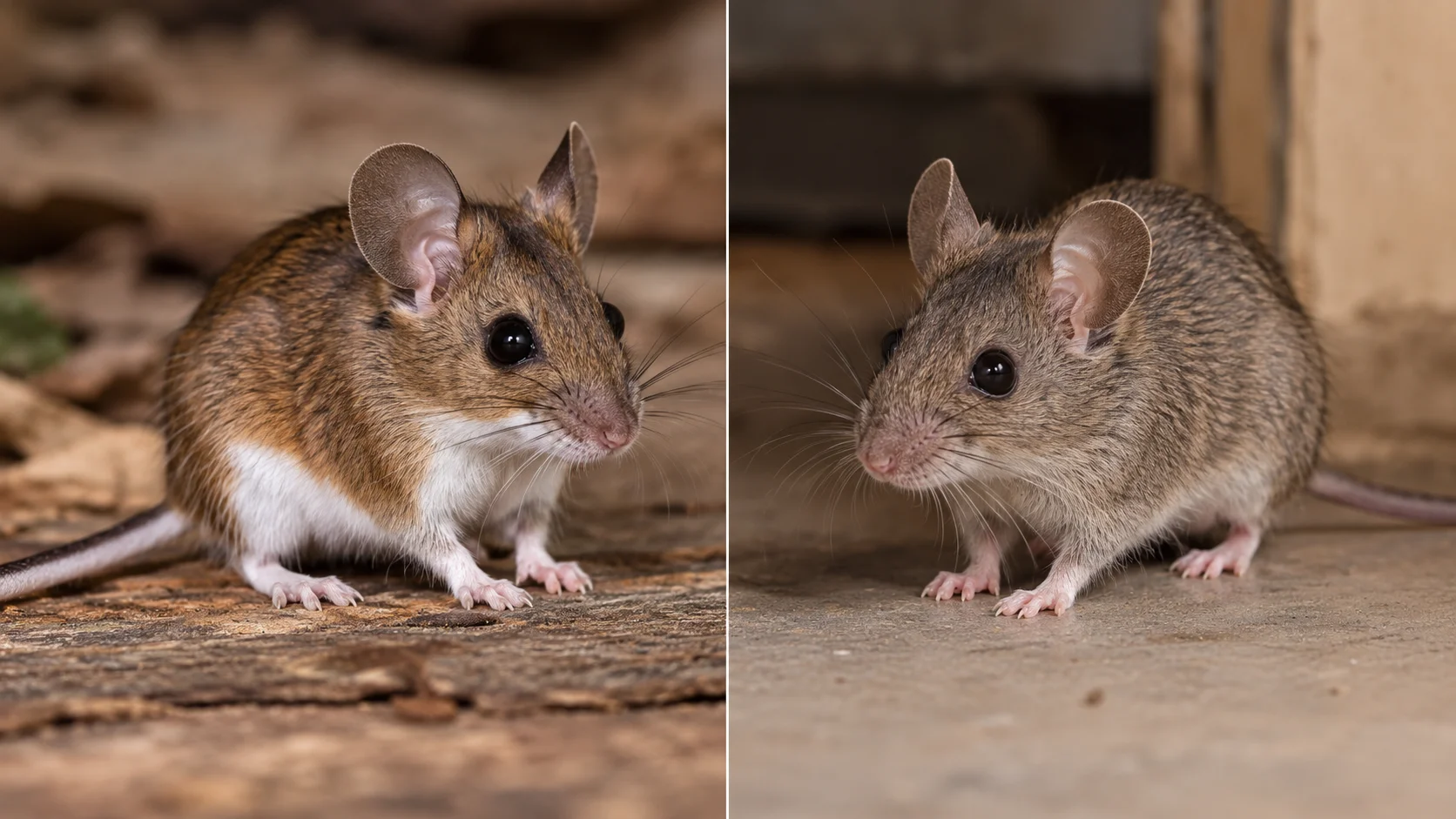
Deer mice and house mice are both small rodents that can enter buildings, leave droppings, build nests, and damage household materials. Their similar size and nocturnal behavior can make identification difficult, especially when only droppings, nesting material, or a quick glimpse is available. The most useful visual distinction is the sharp color contrast of a deer mouse compared with the more uniformly gray-brown appearance of a house mouse.
The deer mouse (Peromyscus maniculatus) is strongly associated with fields, woodland edges, rural properties, cabins, and other areas with nearby natural habitat. The house mouse (Mus musculus) is much more adapted to living around people and commonly occupies buildings where food, shelter, and nesting materials are available.
Deer Mouse vs House Mouse Appearance
Appearance provides the quickest starting point for identification. Deer mice usually have a brown, reddish-brown, or gray upper body with a sharply contrasting white underside, white feet, and a distinctly two-colored tail. House mice generally have a more uniform gray or light-brown coat with a nearly hairless tail.
The distinction can become less obvious in immature mice or poor lighting. When a reliable species identification matters, habitat, physical characteristics, and professional inspection should be considered together.
Deer Mouse Identification
Deer mice have several recognizable characteristics that separate them from typical house mice. Their large eyes, white underside, white feet, and bicolored tail are especially useful field marks.
- Brown, reddish-brown, or gray upper body
- Bright or pale white belly
- White feet
- Large dark eyes
- Prominent ears
- Pointed snout
- Moderately to well-furred tail
- Dark upper side of tail
- White underside of tail
- Sharp color boundary between upper and lower body
House Mouse Identification
House mice have a more consistent gray-brown appearance and are strongly adapted to indoor environments. Their tail is relatively thin and almost hairless compared with the furry, bicolored tail of a deer mouse.
- Gray to light-brown coat
- Lighter underside
- Pointed nose
- Relatively large ears
- Small black eyes
- Slender body
- Nearly hairless tail
- Tail similar in length to the head and body
- Typical adult length of about 5–7 inches including tail
- Strong association with buildings
Deer Mouse vs House Mouse Size
Size alone is not a dependable way to separate these rodents because their overall dimensions overlap. UC IPM places adult house mice at roughly 5–7 inches including the tail, while deer mice can also fall within a similar overall range.
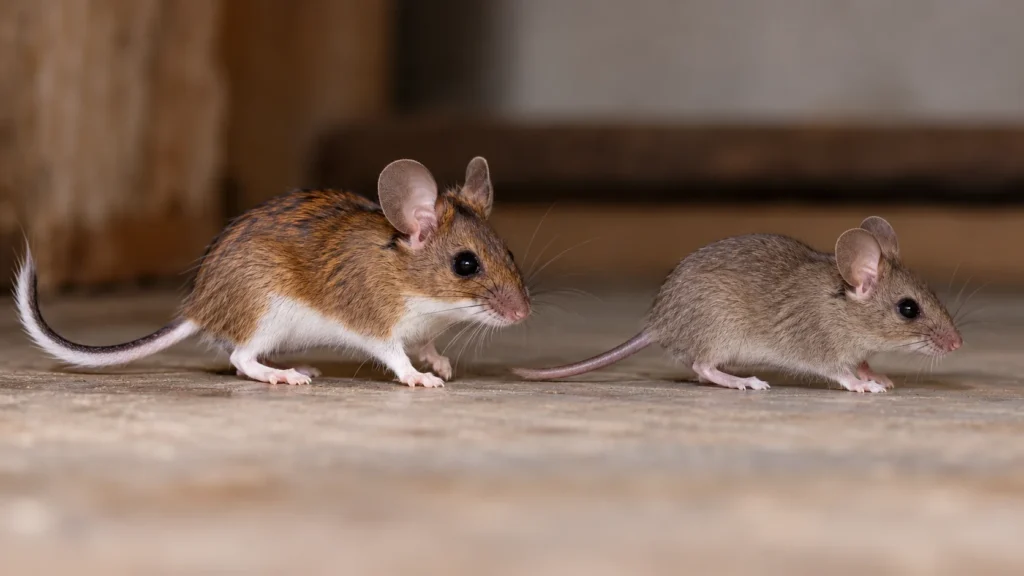
Body proportions and coloration therefore provide more useful clues than measuring the animal. A deer mouse may appear more distinctly two-toned, while a house mouse generally has a more uniform coat.
Size and Body Comparison
Both rodents are small enough to enter surprisingly narrow openings. Their physical overlap means that size should be used together with tail, coat, feet, and habitat characteristics.
- Both are small rodents
- Overall lengths commonly overlap
- Deer mice can reach roughly 5–8 inches including tail
- House mice commonly measure about 5–7 inches including tail
- Deer mice often look more strongly two-toned
- House mice usually look more uniformly colored
- Deer mice have a more visibly furred tail
- House mice have a thinner, nearly hairless tail
- Deer mice have white feet
- Body size alone should not determine identification
Deer Mouse vs House Mouse Tail
The tail is one of the most useful characteristics in a deer mouse vs house mouse comparison. A deer mouse has a distinctly bicolored, furry tail, with a darker upper surface and lighter or white underside. A house mouse has an almost hairless tail that generally lacks this strong two-tone pattern.
This feature can remain useful even when the animal's body coloration is difficult to see. Looking at the tail from the side can reveal the sharp transition between dark and white on a deer mouse.
Tail Features
Tail structure can provide a stronger identification clue than overall size. UC IPM specifically identifies the bicolored deer mouse tail as one of the easiest ways to distinguish it from a house mouse.
- Deer mouse tail is well furred
- Deer mouse tail is dark above
- Deer mouse tail is light underneath
- Color division is usually sharp
- Tail can have a small tuft at the tip
- House mouse tail is almost furless
- House mouse tail has visible scale rings
- House mouse tail is generally one overall color
- Both species have relatively long tails
- Tail appearance is highly useful for identification
Deer Mouse vs House Mouse Droppings
Droppings from deer mice and house mice can look remarkably similar. Both can produce small, dark, rice-like or rod-shaped droppings with pointed ends, generally around 1/8 to 1/4 inch long. Because of this overlap, droppings alone may not provide a reliable species identification.
Location and surrounding evidence can provide additional clues. Deer mice are more commonly associated with rural buildings, cabins, garages, barns, and properties near fields or wooded habitat, while house mice are strongly associated with food storage areas and occupied structures.
Dropping Characteristics
A careful inspection should consider shape, size, location, and other evidence instead of relying only on color. Rodent droppings should also be handled carefully because contaminated material can present health risks. (ICWD Management)
- Both can produce small dark droppings
- Both may have pointed ends
- Droppings can resemble rice grains
- Typical mouse droppings are around 1/8–1/4 inch
- Color can vary with diet and age
- Droppings alone may not identify species
- Deer mouse signs may occur in rural structures
- House mouse signs often occur near food
- Multiple droppings indicate rodent activity
- Avoid touching droppings with bare hands
Deer Mouse vs House Mouse Habitat
Habitat is another important distinction. Deer mice commonly occupy fields, grasslands, woodland edges, agricultural areas, cabins, sheds, and other locations near natural vegetation. They can enter buildings when suitable shelter is available, particularly in rural or semi-rural settings.
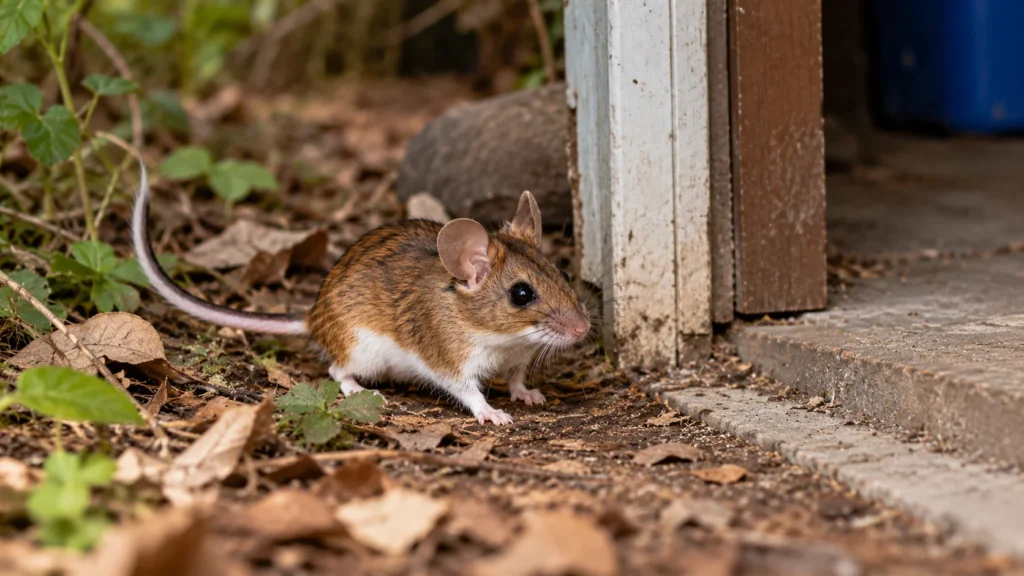
House mice are highly adapted to human environments. They commonly nest in walls, attics, basements, storage spaces, kitchens, and other protected locations close to food and warmth.
Typical Habitat Clues
The surrounding environment can help narrow down the likely species when physical identification is uncertain. Natural habitat near a building increases the likelihood of encountering Peromyscus mice.
- Deer mice favor fields
- Deer mice occur around woodland edges
- Deer mice use brushy areas
- Deer mice enter cabins
- Deer mice may enter garages and outbuildings
- House mice commonly occupy kitchens
- House mice use wall voids
- House mice use attics
- House mice use basements
- House mice stay close to available food and nesting materials
Deer Mouse vs House Mouse Behavior
Both species are generally active at night and can move quietly through buildings. Their behavior overlaps enough that movement alone is rarely sufficient for identification.
Deer mice tend to forage outdoors and can cache seeds, acorns, and nuts, while house mice have a strong association with stored human food and indoor food sources. Deer mice also have a greater tendency to cache food than house mice.
Behavioral Differences
Behavior becomes more useful when combined with habitat and physical characteristics. Repeated observations can reveal where a mouse is feeding, nesting, and traveling.
- Both species are primarily nocturnal
- Both can travel along walls
- Both build nests
- Both can enter buildings
- Deer mice frequently forage outdoors
- Deer mice commonly cache seeds
- Deer mice cache nuts and acorns
- House mice exploit stored food
- House mice favor protected indoor spaces
- Both can damage nesting materials
Explore more articles:
- Fruit Flies vs Gnats
- Rat vs Mouse
- Bugs That Look Like Flying Termites
- Bugs That Look Like Fleas
- What Do Fleas Look Like?
- Wood Ants vs Termites
- What Are Centipedes Attracted To?
- What Do Drain Flies Look Like
- What Do Baby Black Widows Look Like?
- False Widow vs Black Widow
Deer Mouse vs House Mouse Droppings and Nesting Signs
Nests can provide additional information when an actual mouse is not seen. Deer mice commonly build nests from fibrous plant materials and may use fur, feathers, shredded cloth, or similar materials. House mice also shred paper and other soft materials for nesting. (Animal Diversity Web)
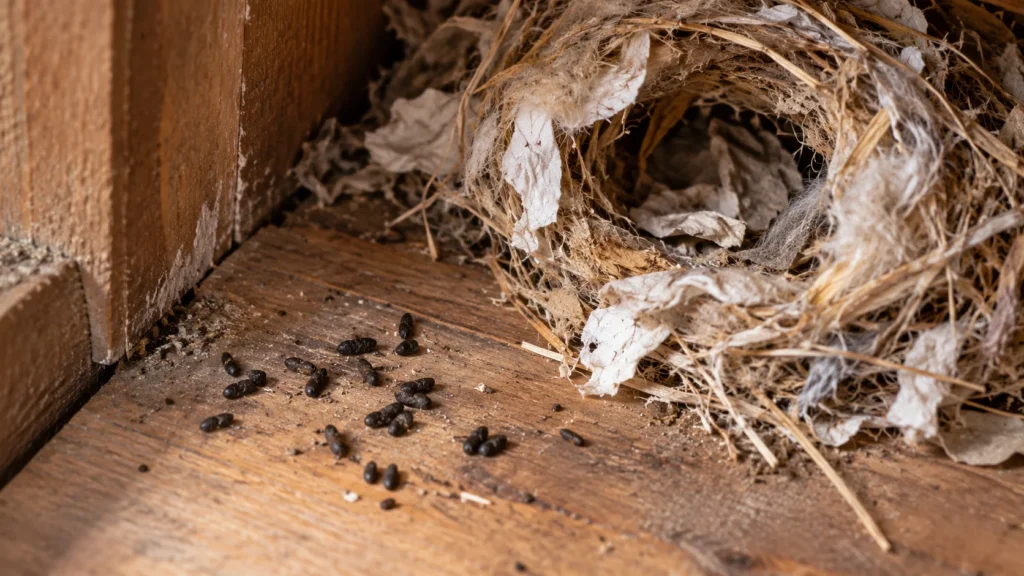
Neither nesting material nor droppings should be treated as definitive proof of species by themselves. A combination of physical evidence and location provides a more reliable identification.
Nesting and Activity Evidence
Inspecting several areas can reveal a broader pattern of rodent activity. Signs around food, insulation, stored materials, and entry points can help establish where the animal is living.
- Shredded paper
- Shredded fabric
- Fibrous plant material
- Fur or feathers
- Nesting inside wall cavities
- Nesting in attics
- Nesting in garages
- Stored seeds or nuts
- Food packages with gnaw marks
- Grease or rub marks along travel routes
Deer Mouse vs House Mouse Hantavirus Concerns
The health distinction is important because deer mice are recognized reservoirs for hantaviruses associated with hantavirus pulmonary syndrome in the United States. CDC identifies the deer mouse as the primary host for the hantavirus most commonly associated with HPS in the U.S.
This does not mean every deer mouse carries hantavirus, and identifying a mouse visually cannot establish infection. The safest approach is to avoid exposure to rodent urine, feces, saliva, and nesting materials and to follow CDC precautions when cleaning rodent-contaminated areas.
Safety Around Rodent Signs
Safe cleanup is particularly important where deer mice may occur. Disturbing contaminated droppings or nesting material can create exposure to infectious particles.
- Avoid bare-hand contact with droppings
- Do not deliberately stir up contaminated dust
- Keep children away from rodent nesting areas
- Keep pets away from contaminated material
- Ventilate enclosed areas according to CDC guidance
- Follow CDC cleanup recommendations
- Wear appropriate protective equipment when required
- Seal openings that allow rodents to enter
- Remove accessible food sources
- Seek professional help for significant infestations
Deer Mouse vs House Mouse Quick Comparison
| Feature | Deer Mouse | House Mouse |
| Scientific name | Peromyscus maniculatus | Mus musculus |
| Upper body | Brown, reddish-brown, or gray | Gray to light brown |
| Belly | White | Usually lighter than back |
| Feet | White | Not sharply white |
| Tail | Furry and bicolored | Nearly hairless |
| Tail pattern | Dark above, white below | Usually uniformly colored |
| Eyes | Relatively large | Smaller |
| Habitat | Fields, woods, rural areas | Buildings and human environments |
| Food behavior | Often caches seeds and nuts | Frequently uses stored human food |
| Hantavirus relevance | Important U.S. reservoir species | Not the primary U.S. HPS reservoir |
10 Key Deer Mouse vs House Mouse Identification Points
- A deer mouse usually has a sharply bicolored tail.
- A house mouse generally has an almost hairless tail.
- Deer mice have white feet and white underparts.
- House mice usually have a more uniform gray-brown coat.
- Deer mice often have larger-looking eyes.
- Both species can measure within a similar overall size range.
- Droppings from both species can look very similar.
- Deer mice are more strongly associated with natural and rural habitats.
- House mice are highly adapted to indoor environments.
- Physical appearance, habitat, and signs should be considered together for reliable identification.
Conclusion
The most useful difference in a deer mouse vs house mouse comparison is the overall color pattern and tail. Deer mice have a sharply defined white underside, white feet, and a furry tail that is dark above and light underneath, while house mice generally have a gray-brown coat and an almost hairless tail.
Droppings, nests, habitat, and behavior can provide supporting evidence, but they are not always enough for a confident species identification. When rodent contamination is present, particularly in an area where deer mice occur, safe cleanup and exclusion are important because deer mice are a recognized reservoir for hantaviruses associated with HPS in the United States.
1. How to identify deer mouse vs house mouse?
Look first at the tail and underside. Deer mice typically have a furry, sharply bicolored tail, white feet, and a white underside, while house mice usually have a nearly hairless tail and a more uniformly gray-brown coat.
2. Are deer mouse droppings different from house mouse droppings?
They can be very similar. Both may produce small, dark, pointed droppings around 1/8 to 1/4 inch long, so droppings alone are not a dependable way to identify the species.
3. Are deer mice more dangerous than house mice?
Deer mice are important reservoirs for hantaviruses associated with hantavirus pulmonary syndrome in the United States. Not every deer mouse is infected, but CDC recommends avoiding contact with rodent urine, feces, saliva, and nesting materials.
4. Can deer mice live inside houses?
Yes. Deer mice can enter homes, cabins, garages, and other structures, especially where buildings are near fields, forests, or other suitable habitat.
5. Is a field mouse the same as a deer mouse?
The term field mouse is used inconsistently for different small rodents. In North American pest discussions, it is sometimes used for deer mice or other Peromyscus species, so the physical characteristics and scientific identification are more reliable than the common name.