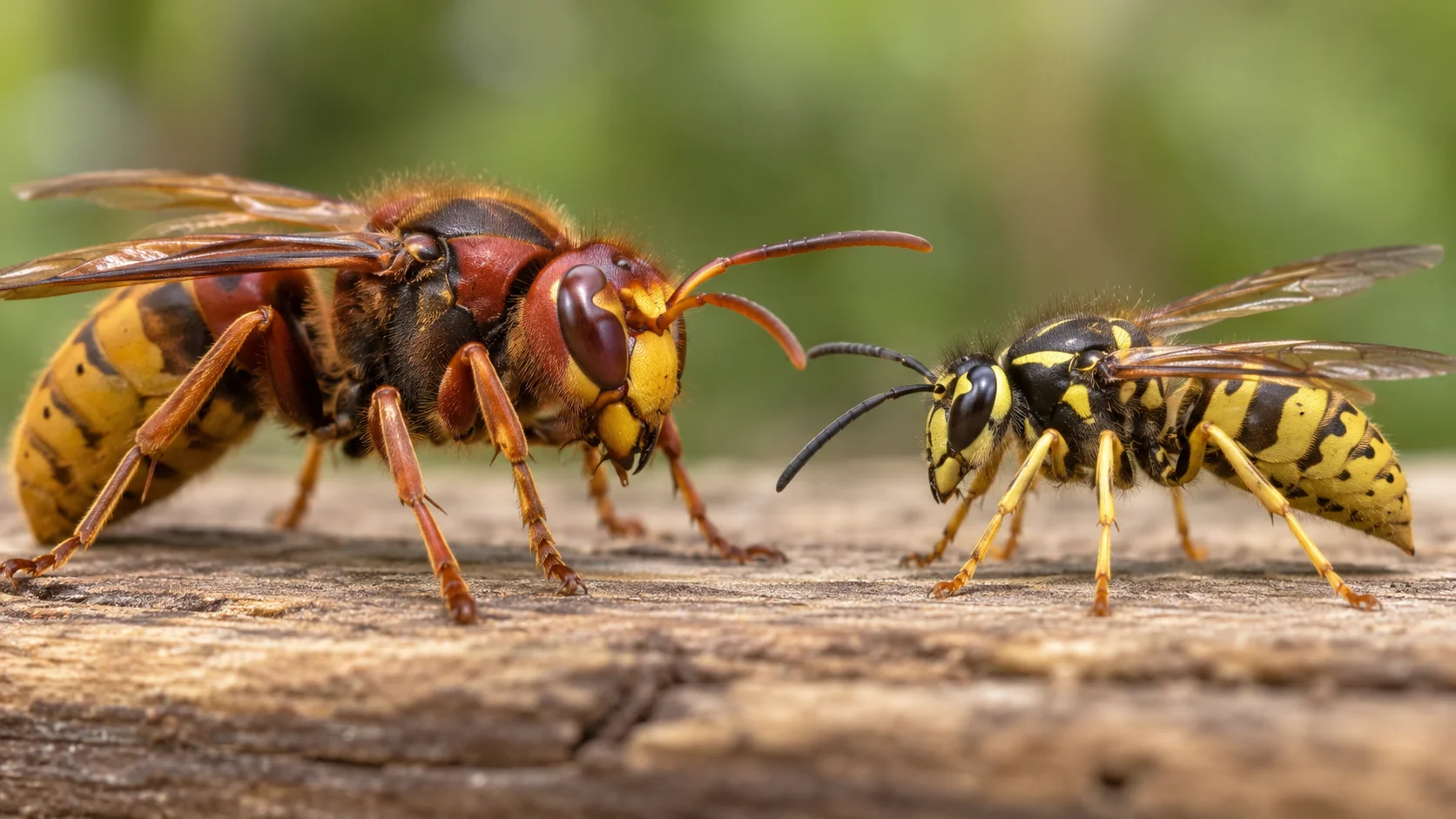
Hornets and wasps are closely related insects, and the names are often used interchangeably in everyday conversation. In biological terms, however, a hornet is a type of wasp. The important distinction is that wasp covers a much broader group, including paper wasps, yellowjackets, and hornets.
Identification becomes easier when you compare body shape, coloration, size, nesting style, and behavior together rather than relying on one feature. Some insects commonly called hornets are actually yellowjackets, while bees can also be mistaken for wasps because of similar black-and-yellow patterns.
Hornets vs Wasps: The Basic Difference
The word wasp describes a large group of insects within the order Hymenoptera, while hornet is used for particular wasps, especially species in the genus Vespa. This means every hornet is a wasp, but not every wasp is a hornet.
In North America, terminology can create additional confusion. Penn State Extension notes that the bald-faced hornet is actually an aerial yellowjacket rather than a true hornet, while the European hornet is the true hornet species established in much of eastern North America.
Hornet and Wasp Classification
A useful way to organize these insects is by their major groups:
- Hornets: A specialized group of large wasps, including Vespa species
- Yellowjackets: Social wasps in genera such as Vespula and Dolichovespula
- Paper wasps: Slender wasps primarily in the genus Polistes
- Solitary wasps: Individual wasps that construct or occupy their own nests
- Bald-faced hornets: Black-and-white aerial yellowjackets rather than true hornets
- European hornets: Large true hornets established in eastern North America
- Bees: Separate from wasps, despite their superficial resemblance
Hornets vs Wasps by Appearance
Body shape is one of the most useful identification clues. Many wasps have relatively narrow waists and smooth bodies, while different hornet species tend to have larger, more robust bodies. Color patterns vary considerably between species, so size and structure should be considered together.
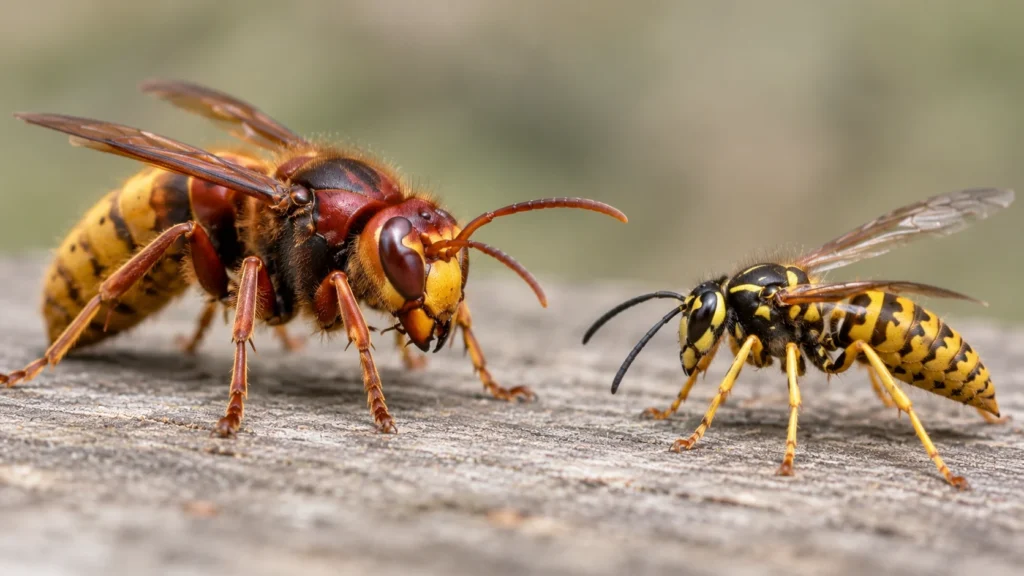
Yellowjackets commonly have bright yellow and black markings and a hard, shiny body with relatively little hair. Paper wasps are generally more slender and have noticeably long legs that dangle during flight. Bald-faced hornets are primarily black with white or cream-colored markings.
Size and Color Differences
Size alone cannot establish an identification because different wasp species overlap considerably. European hornets are among the larger wasps encountered in eastern North America, while yellowjackets are generally smaller. Penn State Extension reports European hornet workers at about 1 inch and queens around 1.4 inches, whereas many yellowjackets are considerably smaller.
Color can be particularly helpful when combined with body structure:
- European hornets have reddish-brown and yellow coloration
- Bald-faced hornets have black-and-white coloration
- Yellowjackets commonly show black-and-yellow patterns
- Paper wasps can be brown, red, black, yellow, or combinations of these colors
- Many wasps have smooth, relatively hairless bodies
- Bees generally have hairier, more robust bodies
Wasps vs Hornets vs Yellow Jackets
Yellowjackets are wasps, but the term hornet is sometimes incorrectly applied to them. Bald-faced hornets demonstrate this naming problem particularly well because they are commonly called hornets even though they belong to the aerial yellowjacket group.
Yellowjacket Identification
Yellowjackets typically have compact bodies with yellow and black or, in some species, black-and-white markings. They are social insects and can establish colonies containing hundreds or even thousands of individuals. Their nests may occur underground or in protected aerial locations.
Paper Wasp Identification
Paper wasps have a noticeably different appearance. They tend to be slender, with long legs that hang beneath the body during flight. Their nests usually consist of a single exposed comb without the enclosed outer envelope characteristic of yellowjacket nests.
Explore more articles:
- Fruit Flies vs Gnats
- Rat vs Mouse
- Bugs That Look Like Flying Termites
- Bugs That Look Like Fleas
- What Do Fleas Look Like?
- Wood Ants vs Termites
- What Are Centipedes Attracted To?
- What Do Drain Flies Look Like
- What Do Baby Black Widows Look Like?
- False Widow vs Black Widow
Bees vs Wasps vs Hornets
Bees, wasps, and hornets all belong to the broader order Hymenoptera, but they have important differences in appearance and feeding behavior. Bees generally have hairier and more robust bodies, while many wasps have smoother bodies and more pronounced narrow waists.
Recognizing Bees Among Stinging Insects
Honey bees and bumble bees commonly collect pollen and nectar, with pollen serving as an important food resource for developing young. Wasps and hornets generally have more predatory or scavenging behavior, although adult wasps may also consume nectar and other sugary foods.
This distinction matters because a bee visiting flowers is not automatically a wasp or hornet. Hairiness, body proportions, feeding behavior, and the insect's interaction with flowers can provide useful identification clues.
Wasps vs Hornets vs Yellow Jackets vs Bees
A side-by-side comparison makes the major differences easier to understand.
| Feature | Hornets | Yellowjackets | Paper Wasps | Bees |
| Body | Usually robust | Compact and smooth | Slender | Hairier and robust |
| Typical colors | Species-dependent | Often yellow/black | Brown, red, black, yellow | Often brown, black, or yellow |
| Legs in flight | Usually held close | Usually held close | Often dangling | Variable |
| Feeding | Predators, scavengers, sugary foods | Predators and scavengers | Predators and nectar | Nectar and pollen |
| Social species | Yes for common hornets | Yes | Yes | Social and solitary species |
| Nest style | Often enclosed paper structure | Enclosed paper nest | Open comb | Wax or other species-specific nests |
Hornets Nest vs Wasps Nest
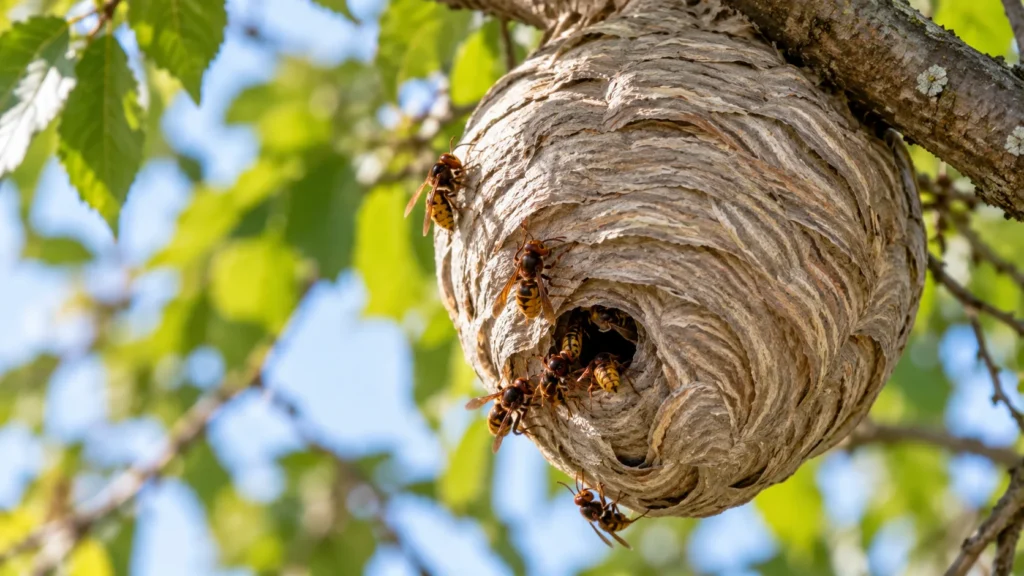
Nest architecture can provide another strong identification clue. Paper wasps commonly construct open, umbrella-like combs where the individual cells remain visible. Yellowjackets generally create enclosed nests with a paper envelope, and their colonies can occur underground or in protected aerial locations.
Hornet Nest Characteristics
Bald-faced hornets build large, enclosed, football-shaped paper nests that are usually suspended from trees, shrubs, or structures. European hornets typically build nests inside protected cavities such as hollow trees, wall spaces, or attics rather than producing the same exposed football-shaped nest.
Wasp Nest Characteristics
Paper wasp nests usually have an open comb with no outer paper envelope. Yellowjacket nests are generally enclosed, and their exact location depends on the species. Some are underground while others use aerial cavities or structures.
Hornets vs Wasps Behavior and Stinging
Both hornets and social wasps can defend their nests when they perceive a threat. The level of defensive behavior varies by species, colony condition, and circumstances. Yellowjackets are particularly well known for defending nests aggressively, while bald-faced hornets also defend their colonies when directly threatened.
Safe Identification Around a Nest
Avoid disturbing or approaching an unidentified nest closely. A nest's location, shape, and the insects entering and leaving it can provide useful clues from a safe distance, but physical handling is unnecessary and can increase the chance of stings.
For an established nest near a doorway, play area, walkway, or other high-traffic location, professional pest management can reduce the need for direct contact.
Hornets vs Wasps Size Comparison
Hornets are generally larger than many common wasps, but size ranges overlap among species. European hornets can reach roughly 1 to 1.4 inches depending on caste, while many yellowjackets measure around 3/8 to 5/8 inch. Paper wasps commonly fall around 1/2 to 1 inch.
Why Size Alone Is Not Enough
An unusually large wasp should not automatically be labeled a hornet. Color pattern, body shape, nest architecture, geographic range, and behavior provide additional evidence.
This is especially important with bald-faced hornets, which can appear large and create substantial nests but are classified as aerial yellowjackets rather than true hornets.
10 Key Facts About Hornets vs Wasps
- Hornets are a type of wasp.
- The term wasp covers many different species and groups.
- European hornets are true hornets established in eastern North America.
- Bald-faced hornets are actually aerial yellowjackets.
- Yellowjackets are commonly black and yellow or black and white.
- Paper wasps are generally more slender and have long dangling legs.
- Paper wasp nests usually have an exposed, open comb.
- Yellowjacket nests generally have an enclosed paper envelope.
- Bees tend to have hairier and more robust bodies than many wasps.
- Nest location, body structure, color, size, and behavior together provide more reliable identification than any single feature.
Conclusion
The main difference between hornets and wasps is classification: hornets are specialized wasps, while the word wasp covers a much broader range of insects. Appearance, size, coloration, nesting style, and behavior can help separate hornets from yellowjackets, paper wasps, and other wasp groups. Bees are a separate group despite sharing several visual characteristics.
Accurate identification is particularly useful when a nest is present because nest architecture can narrow down the possibilities without requiring close contact. Paper wasps generally create exposed combs, yellowjackets create enclosed paper nests, and commonly encountered hornets have their own characteristic nesting habits.
1. Are hornets and wasps the same thing?
Hornets are a type of wasp, but not every wasp is a hornet. The term wasp includes groups such as yellowjackets, paper wasps, solitary wasps, and hornets.
2. Are yellowjackets hornets?
Yellowjackets are wasps rather than true hornets. Bald-faced hornets are particularly confusing because their common name includes hornet, but Penn State classifies them as aerial yellowjackets.
3. Are bees different from wasps and hornets?
Yes. Bees and wasps belong to different groups within Hymenoptera. Bees generally have hairier bodies and commonly collect pollen and nectar, while many wasps are predators or scavengers.
4. Are hornet nests different from wasp nests?
Yes. Nest architecture varies by species. Paper wasps commonly make exposed single-comb nests, while yellowjackets generally construct enclosed paper nests. European hornets commonly use protected cavities.
5. Can hornets and wasps sting more than once?
Yes. Unlike honey bees, female wasps and hornets can generally sting repeatedly because their stingers are not normally left behind after one sting.