
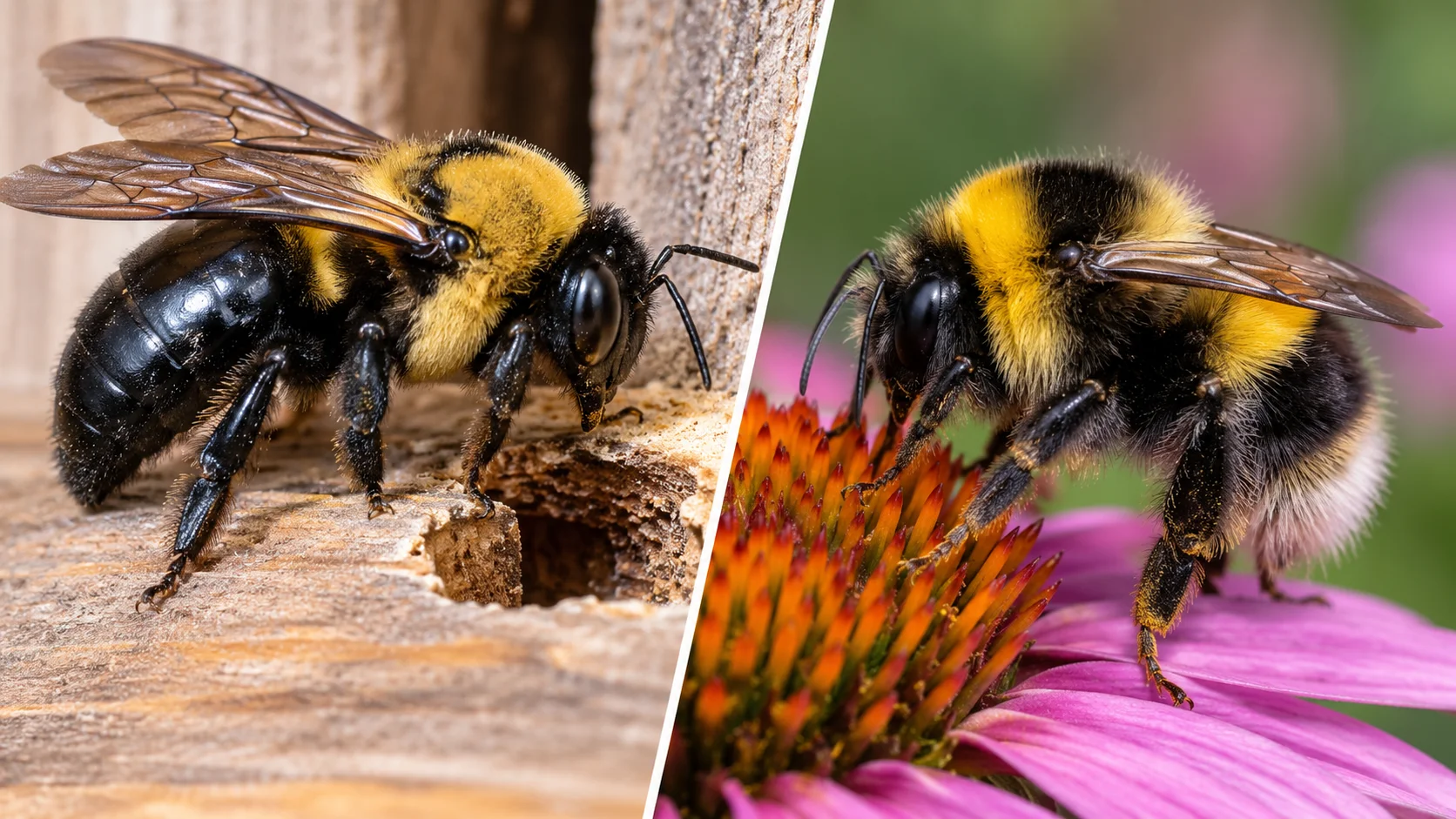
The carpenter bee vs bumble bee comparison can be confusing because both insects are large, robust bees and may have similar black-and-yellow coloration. They can also appear around flowers, gardens, homes, decks, and other outdoor areas during the warmer months.
The most useful identification feature is the abdomen. Carpenter bees generally have a shiny, mostly hairless abdomen, while bumble bees have fuzzy hair covering the abdomen. Their nesting habits are also very different: carpenter bees excavate tunnels in wood, while bumble bees usually establish colonies in underground or other protected cavities.
Understanding these differences can help distinguish a harmless-looking bee visiting flowers from an insect that may be creating tunnels in wooden structures.
Carpenter Bee vs Bumble Bee at a Glance
Carpenter bees and bumble bees belong to different genera and have different lifestyles. Carpenter bees are primarily solitary, whereas bumble bees are social bees that live in colonies.
| Feature | Carpenter Bee | Bumble Bee |
| Body appearance | Large with a shiny, mostly hairless abdomen | Large and noticeably fuzzy |
| Abdomen | Usually shiny black | Covered with hair and often patterned |
| Social behavior | Mostly solitary | Social and colony-forming |
| Nest location | Wood tunnels | Usually underground cavities |
| Wood damage | Can excavate nesting tunnels | Does not normally excavate structural wood |
| Size | About 0.75–1 inch for eastern carpenter bees | Roughly 0.5–1 inch, depending on species and caste |
| Pollen collection | Carries pollen while foraging | Carries pollen on hind legs |
| Male sting | Cannot sting | Male bumble bees cannot sting |
| Female sting | Capable of stinging but generally not aggressive | Females can sting when threatened |
| Main food | Nectar and pollen | Nectar and pollen |
Eastern carpenter bees and bumble bees can overlap considerably in size, making body hair and nesting behavior more reliable than size alone.
Carpenter Bee Identification Features
Carpenter bees are large native bees commonly associated with wooden structures. In the eastern United States, the eastern carpenter bee (Xylocopa virginica) is a familiar species around homes, eaves, decks, fences, and other wooden surfaces.
The abdomen provides one of the clearest visual clues. Carpenter bees have a shiny black abdomen with relatively little hair, while the thorax is covered with yellowish fuzz. Eastern carpenter bees are generally around 0.75 to 1 inch long.
Carpenter Bee Appearance
A carpenter bee may look similar to a bumble bee from a distance because of its large body and fuzzy thorax. A closer view reveals the glossy abdomen, which can appear almost polished or metallic black.
Male eastern carpenter bees commonly have a yellow face, while females have a black face. Males are frequently seen hovering near nesting sites and can appear defensive even though they cannot sting.
Carpenter Bee Size
Eastern carpenter bees are approximately 0.75 to 1 inch long, although size varies among carpenter bee species. Bumble bee queens can reach similar dimensions, which is why size alone is not sufficient for identification.
The combination of large body size, a shiny abdomen, and activity around wooden structures is much more characteristic of carpenter bees.
Bumble Bee Identification Features
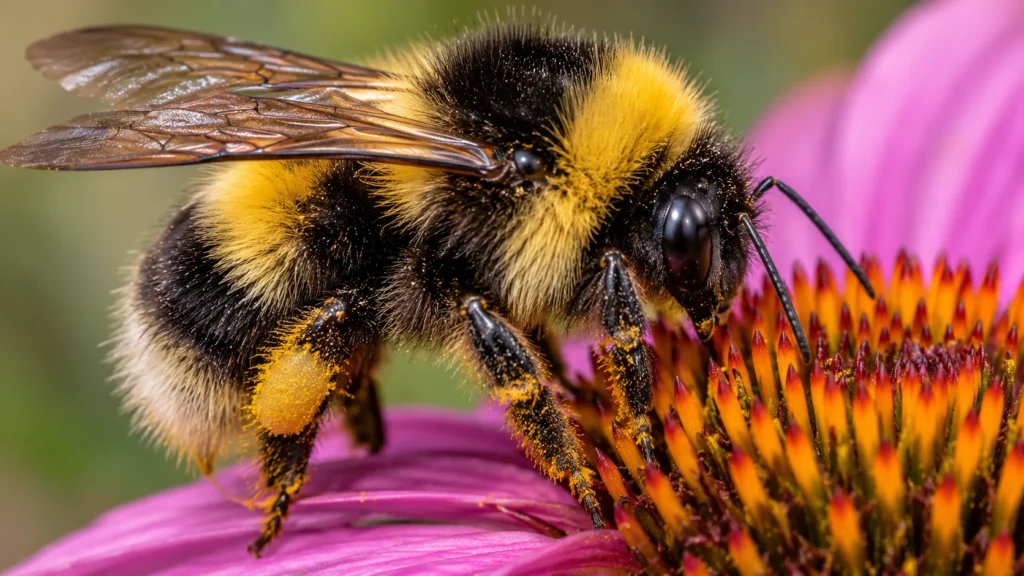
Bumble bees are robust, heavily hairy bees that are important pollinators. Their entire bodies, including the abdomen, are generally covered in dense hair.
Unlike carpenter bees, bumble bees are social. A queen establishes a nest and produces workers that help gather food, care for developing young, and maintain the colony.
Bumble Bee Appearance
Bumble bees often have black and yellow markings, although coloration varies among species. Their fuzzy appearance is one of the easiest features to recognize.
A close-up photograph usually makes the distinction particularly clear because the abdomen of a bumble bee remains hairy rather than appearing smooth and glossy like the abdomen of a carpenter bee.
Bumble Bee Size
Bumble bees range considerably in size. Penn State Extension describes bumble bees as generally about 1/2 to 1 inch long, with queens being substantially larger than workers in many species.
A large bumble bee queen can therefore resemble a carpenter bee in overall size, making the abdomen and nesting location more useful identification clues.
Carpenter Bee vs Bumble Bee Appearance Differences
The easiest visual comparison centers on the abdomen, although the thorax, face, legs, and overall body texture can provide additional clues.
Shiny Abdomen vs Fuzzy Abdomen
A carpenter bee typically has a smooth, shiny black abdomen, while a bumble bee has a fuzzy abdomen covered with dense hairs. This is one of the most dependable field identification features.
Carpenter bees still have considerable hair on the thorax, so seeing a fuzzy upper body does not automatically indicate a bumble bee. The abdomen should receive particular attention.
Body Hair and Pollen
Bumble bees are covered with long hairs that can collect pollen as they forage. Carpenter bees also collect pollen, but their abdomen has much less hair and therefore looks noticeably smoother.
This distinction is particularly helpful in close-up carpenter bee vs bumble bee images.
Carpenter Bee vs Bumble Bee Nesting Habits
Nesting behavior creates one of the strongest differences between these two bees. Carpenter bees excavate their own tunnels in wood, whereas bumble bees generally use existing cavities or sheltered locations.
Carpenter Bee Nest
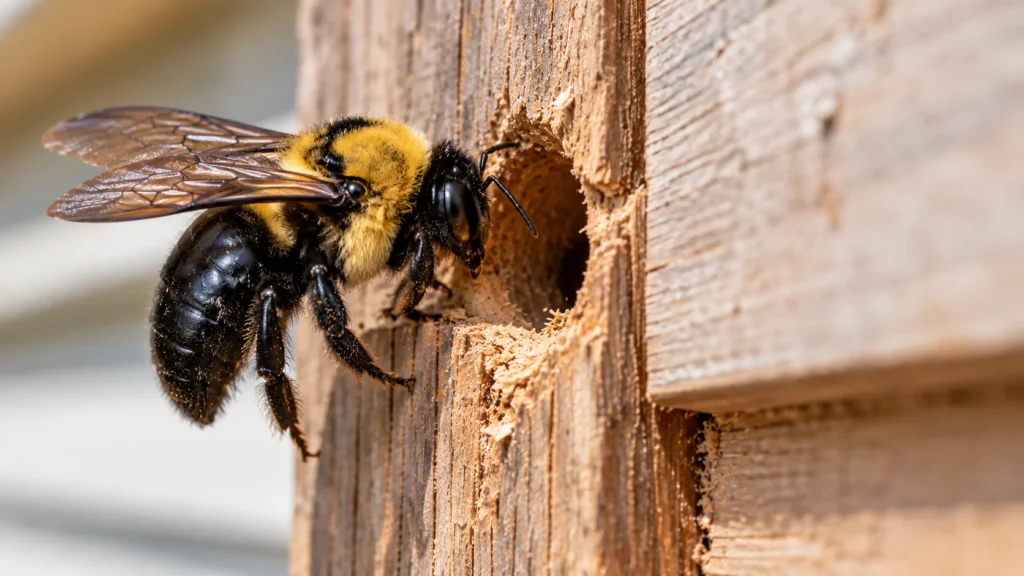
Female carpenter bees create nearly circular entrance holes, commonly around 1/2 inch in diameter, in suitable wood. The initial tunnel extends inward before turning and continuing with the grain of the wood.
Common nesting locations include eaves, rafters, decks, siding, fence posts, doors, railings, and outdoor furniture. Sawdust-like material below an entrance hole can be evidence of active excavation.
Bumble Bee Nest
Bumble bees usually establish nests in underground cavities, including abandoned rodent burrows, although some species use other sheltered cavities. Their nests contain a colony rather than a series of individually excavated wood tunnels.
Bumble bee nests are often concealed and can be difficult to locate.
Carpenter Bee vs Bumble Bee Behavior
Carpnter bees and bumble bees can both appear around flowering plants because both depend on nectar and pollen. Their behavior around homes, however, can look quite different.
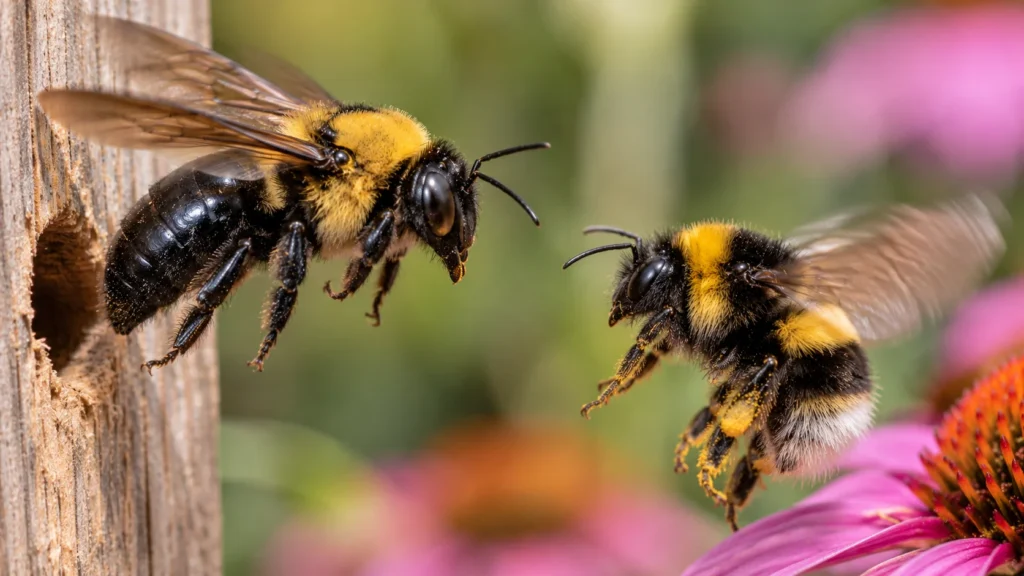
Carpenter bee males often hover near nest entrances and may fly toward people or other objects that enter their territory. Despite this intimidating behavior, males cannot sting. Female carpenter bees can sting but generally do so only when directly threatened or handled.
Bumble bees generally forage between flowers and their nest. They are social insects and defend their colony when sufficiently threatened. e
Carpenter Bee vs Bumble Bee Sting Differences
Both carpenter bees and bumble bees are capable of stinging in certain circumstances, but sex and behavior are important factors.
Male carpenter bees cannot sting, even though they can behave territorially around nesting areas. Female carpenter bees have stingers but are generally docile unless handled or physically threatened.
Female bumble bees can also sting when threatened. Unlike honey bees, bumble bees can generally sting more than once because their stingers are not adapted in the same way as the barbed stinger of a worker honey bee.
Explore more articles:
- Fruit Flies vs Gnats
- Rat vs Mouse
- Bugs That Look Like Flying Termites
- Bugs That Look Like Fleas
- What Do Fleas Look Like?
- Red and Black Bugs That Fly
Carpenter Bee vs Bumble Bee Wood Damage
Carpenter bees do not consume wood as food. Instead, females chew through wood to create tunnels that serve as nesting and brood-rearing chambers.
A single nest may cause limited damage, but repeated use and expansion of tunnels by multiple generations can contribute to deterioration or weakening of wooden components. Moisture intrusion and secondary damage can also develop around nesting areas.
Bumble bees do not normally create this type of structural wood damage because their colonies are generally established in underground or pre-existing cavities.
Carpenter Bee vs Bumble Bee vs Honey Bee
Adding the honey bee to the comparison makes identification easier because honey bees have a more slender body and are generally less fuzzy than bumble bees.
| Identification Feature | Carpenter Bee | Bumble Bee | Honey Bee |
| Overall build | Large and robust | Large and robust | More slender |
| Abdomen | Shiny and mostly hairless | Fuzzy | Hairy with stripes |
| Social structure | Mostly solitary | Social colony | Highly social colony |
| Typical nest | Wood tunnels | Underground/protected cavities | Wax comb in cavities or managed hives |
| Wood excavation | Yes | No | No |
| Pollen collection | Yes | Yes | Yes |
| Common confusion | Bumble bees | Carpenter bees | Bumble bees |
Honey bees are generally more slender than bumble bees, while carpenter bees stand out because of their shiny abdomen and wood-boring nesting behavior.
Carpenter Bee vs Bumble Bee Images and Identification Tips
When identifying a bee from a photograph, the abdomen should be examined before relying on color. Lighting can change how yellow, brown, and black markings appear, while hair coverage and body structure are generally more dependable.
A photograph showing the insect next to its nesting location can provide additional context. A large bee entering a round hole in exposed wood is much more suggestive of a carpenter bee than a bumble bee, while a fuzzy bee emerging from an underground cavity fits the typical bumble bee nesting pattern.
Carpenter Bee Prevention Around Wooden Structures
Carpenter bees are attracted to exposed, unfinished, weathered, or otherwise suitable wood. Maintaining sound finished surfaces can make wooden structures less attractive for nesting.
University of Maryland Extension recommends maintaining finished wood and filling cracks or holes before painting. Non-wood surfaces such as vinyl or aluminum siding can also prevent carpenter bees from excavating those surfaces.
Because carpenter bees are important native pollinators, control is generally most appropriate when their nesting activity is creating a genuine structural concern.
10 Key Carpenter Bee vs Bumble Bee Differences
- Carpenter bees have shiny abdomens, while bumble bees have fuzzy abdomens.
- Bumble bees are social, while carpenter bees are primarily solitary.
- Carpenter bees excavate wood to create nesting tunnels.
- Bumble bees generally nest underground or inside protected cavities.
- Carpenter bees are commonly found around wooden structures such as decks and eaves.
- Bumble bees are commonly associated with flowers and concealed nests.
- Male carpenter bees cannot sting.
- Female carpenter bees can sting but are generally reluctant to do so.
- Bumble bee queens can be similar in size to large carpenter bees.
- Abdomen texture is more reliable than size alone for distinguishing the two groups.
Conclusion
The carpenter bee vs bumble bee difference becomes much easier to recognize once the abdomen and nesting behavior are considered. Carpenter bees typically have a shiny, mostly hairless abdomen and create round tunnels in wood, while bumble bees have fuzzy bodies and generally establish social colonies in underground or other protected cavities.
Size can overlap considerably, especially between carpenter bees and bumble bee queens, so it should not be the primary identification feature. The combination of body hair, abdomen appearance, nesting location, and behavior provides a much more reliable comparison.
Both groups are valuable pollinators. Carpenter bee management is mainly relevant when repeated nesting activity is affecting wooden structures, while concealed bumble bee nests are generally best left undisturbed when they do not create a safety concern.
What is the main difference between a carpenter bee and a bumble bee?
The most noticeable difference is the abdomen. Carpenter bees generally have a shiny, mostly hairless abdomen, while bumble bees have fuzzy abdomens covered with hair.
Are carpenter bees bigger than bumble bees?
Carpenter bees and bumble bees overlap in size. Eastern carpenter bees are approximately 0.75–1 inch long, while bumble bees can range from about 0.5–1 inch depending on species and caste.
Do carpenter bees and bumble bees have the same nests?
No. Carpenter bees excavate tunnels in wood, while bumble bees generally use underground cavities or other sheltered nesting locations.
Can carpenter bees sting?
Female carpenter bees can sting, but they generally do so only when directly threatened or handled. Male carpenter bees cannot sting.
Can bumble bees sting more than once?
Female bumble bees can sting when threatened and can generally sting more than once because their stingers are not barbed in the same way as those of worker honey bees.
What does a carpenter bee hole look like?
A carpenter bee entrance is usually a nearly perfectly circular hole around 1/2 inch in diameter. Coarse sawdust-like material may accumulate below the opening as the bee excavates the tunnel.
What does a bumble bee look like compared with a carpenter bee?
A bumble bee is generally fuzzy across the abdomen, while a carpenter bee has a shiny black abdomen with much less hair. Both can have fuzzy thoraxes and similar overall sizes.
Are carpenter bees and bumble bees beneficial?
Yes. Both are important pollinators. Carpenter bees contribute to pollination through their foraging and buzz-pollination behavior, while bumble bees are important pollinators of many wild plants and crops.
Do carpenter bees eat wood?
No. Carpenter bees excavate wood to create nesting tunnels but obtain their food from flower nectar and pollen.
What should be done when carpenter bees are nesting in wood?
Maintaining finished, painted, or otherwise protected wood can discourage new nesting. When established tunnels are causing structural concerns, the affected wood and nesting activity should be addressed appropriately rather than disturbing the bees unnecessarily.