

Finding red and black bugs that fly around your yard, windows, or inside your home can be confusing because several insects have similar colors and body patterns. The most common identification is often the boxelder bug, a black insect with red or orange markings that frequently gathers on buildings and trees.
However, not every red and black insect is a boxelder bug. Milkweed bugs, red firebugs, and other true bugs can have similar coloration, while their size, markings, wings, host plants, and behavior differ. Correct identification is important before deciding whether treatment is necessary.
This guide explains the most common red and black bugs that fly, how to distinguish them, why they enter houses, and practical ways to prevent unwanted indoor activity.
Boxelder Bugs Are the Most Common Match
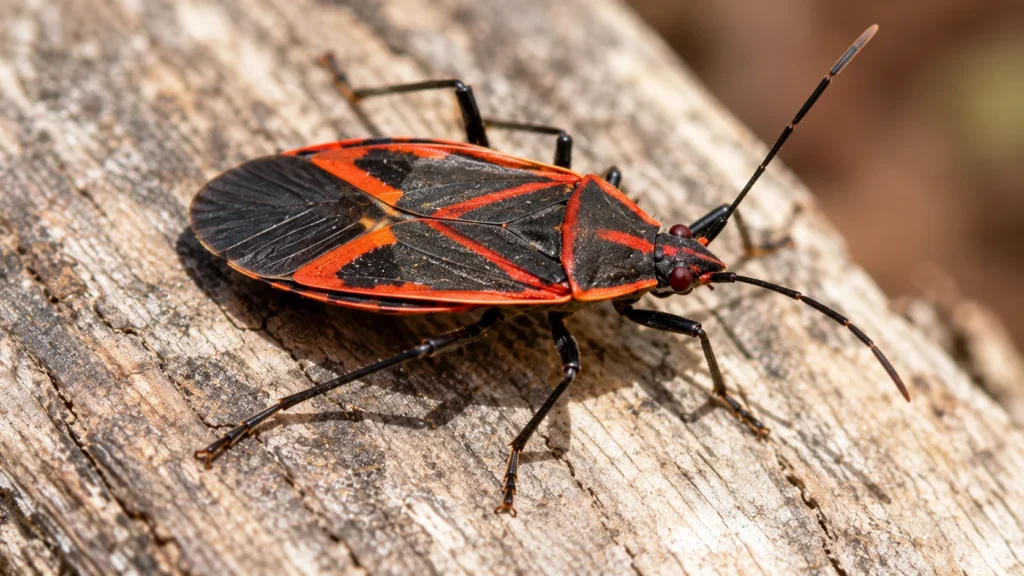
The boxelder bug (Boisea trivittata) is one of the best-known insects fitting the description of black and red bugs that fly. Adults are approximately ½ inch long, have an elongated and somewhat flattened oval body, and show reddish-orange markings against a predominantly black background. Their wings overlap to form an X-shaped pattern when resting.
These insects are associated with boxelder trees and can also feed on other maple species. They become especially noticeable when adults gather in large groups on sunny surfaces or seek protected locations before winter.
Adult Boxelder Bugs Have Distinctive Markings
Adult boxelder bugs are usually black with red or orange lines along the edges and across portions of the thorax and wings. The University of Minnesota describes their wings as forming an X when resting, which is a useful identification feature.
Their body shape, color pattern, and size can separate them from many other red and black insects. Adults also have six legs and two antennae.
Boxelder Nymphs Look Different From Flying Adults
Young boxelder bugs are much smaller and brighter red. They have black legs, antennae, and wing pads, while the abdomen remains prominently red. As they mature, the dark wings develop and gradually cover more of the abdomen.
Because nymphs do not have fully developed wings, tiny red and black bugs that are not flying may represent immature boxelder bugs. A small flying insect with similar coloring may instead be another species or a more developed boxelder.
Red and Black Bugs That Fly Can Include Several Species
Color alone is not enough for reliable identification. Several true bugs have red-and-black patterns, and their appearance can overlap considerably.

Milkweed Bugs Have Red, Black, and Sometimes White Markings
Milkweed bugs are another group that can be mistaken for boxelder bugs. The large milkweed bug (Oncopeltus fasciatus) is reddish-orange with a prominent black band and large black patches. Adults generally measure about ½ to ¾ inch long.
They are strongly associated with milkweed because they feed primarily on seeds and other plant material. Their presence around milkweed therefore provides an important clue that the insect may not be a boxelder bug.
Red Firebugs Have a Different Body Pattern
The red firebug (Pyrrhocoris apterus) is another red-and-black true bug. Utah State University describes adults as about ¼ to ½ inch long, with vibrant red and black coloration and generally shortened wings. They are associated with grass, leaf litter, trees, and buildings and commonly feed on plant seeds.
Unlike fully winged boxelder bugs, many red firebugs have shortened wings and are not strong flyers. This distinction is useful when comparing a crawling red-and-black insect with a genuinely flying one.
Red and Black Bugs That Fly in House Areas
When these insects appear indoors, the surrounding circumstances can provide valuable identification clues. Boxelder bugs are particularly well known for entering homes, garages, sheds, and other structures as temperatures fall.
Boxelder bugs overwinter as adults in protected locations. In autumn, they may gather on warm, sunny surfaces and then move toward cracks and crevices around buildings.
Windows and Exterior Walls Can Reveal an Entry Point
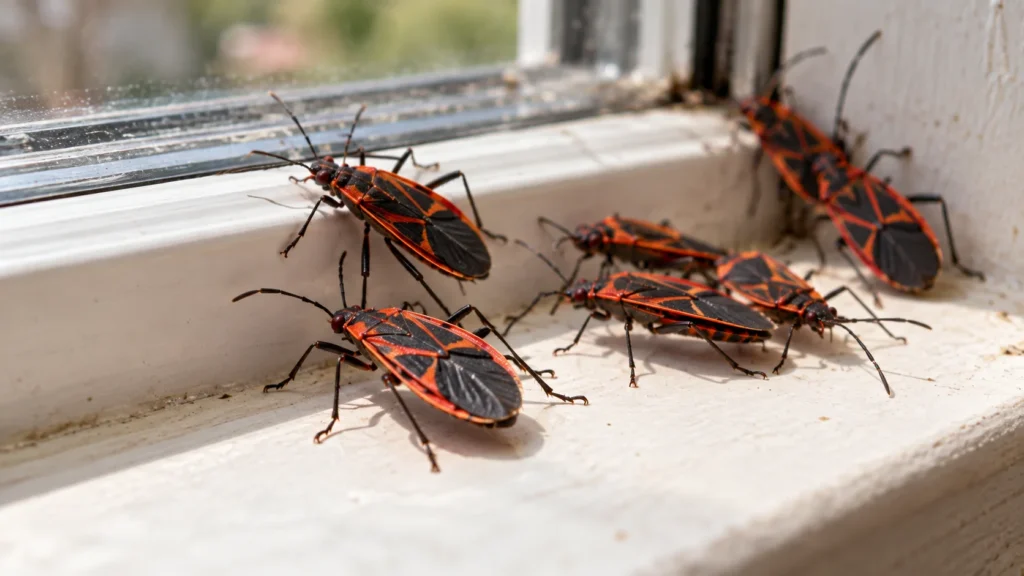
Large numbers around sunny exterior walls, windows, doors, or siding can indicate boxelder bug activity. They may eventually find small openings around frames, screens, foundations, and other structural gaps.
Once indoors, they generally remain a nuisance rather than becoming a damaging household pest. Their presence is more closely related to seasonal shelter-seeking behavior than to an indoor food source.
Indoor Clusters Are Common During Seasonal Changes
Boxelder bugs are often noticed inside during fall and again when overwintering adults become active in spring. They can remain hidden in wall voids and other protected spaces and later emerge when temperatures become favorable.
This seasonal pattern helps distinguish them from insects that spend their entire life cycle inside homes.
Tiny Red and Black Bugs Need Careful Identification
The phrase tiny red and black bugs that fly can describe several insects, but size alone does not establish the species.
Young boxelder bugs are very small and bright red, but their lack of fully developed wings means they should not normally be confused with flying adults. As they mature, their bodies become increasingly black and their wings develop.
Other small red-and-black insects may include plant-associated true bugs. Their host plant, body shape, wing development, and markings can provide more reliable clues than color alone.
Small Size Does Not Always Mean a Young Boxelder Bug
A small adult insect can belong to an entirely different species. Milkweed bugs and other true bugs can have red-and-black adults that resemble smaller boxelder bugs.
For difficult identifications, a clear photograph showing the insect from above, along with its approximate size and location, is much more useful than color alone.
Large Red and Black Bugs Can Also Be Boxelder Bugs
The large red and black bugs that fly seen around homes are frequently adult boxelder bugs. Adults generally measure around ½ inch, with some sources reporting approximately ½ to ⅝ inch.
Their elongated body and contrasting red-orange markings make them relatively distinctive once the characteristic wing pattern is recognized.
Body Shape Helps Separate Similar Insects
Boxelder bugs have a somewhat flattened, elongated oval body. Their black wings contain red or orange lines, while the area immediately behind the head contains prominent markings.
Milkweed bugs tend to have stronger red-orange areas and bold black patches, while red firebugs have a different pattern and often shorter wings. These structural differences can be more dependable than general color.
Boxelder Bugs Gather Around Their Host Trees
Boxelder bugs receive their common name from the trees they commonly use. Adults feed on boxelder seeds and developing plant material, and they can also use certain maple trees.
Female boxelder trees are particularly important because they produce the winged seeds that boxelder bugs use as a food resource. Eggs may be laid on trunks, branches, leaves, or bark crevices associated with suitable host trees.
Warm Sunny Surfaces Encourage Congregation
In autumn, boxelder bugs often gather on surfaces warmed by sunlight. South-facing and other sunny areas of buildings can become congregation sites before the insects move toward protected overwintering locations.
This behavior explains why homeowners may suddenly see dozens or hundreds of red-and-black insects on exterior walls without having an established indoor breeding population.
Red and Black Flying Bugs Usually Do Not Pose a Serious Threat
Boxelder bugs are primarily considered nuisance pests. They are not known for routinely biting people, although their piercing-sucking mouthparts can occasionally puncture skin when an insect is handled, potentially causing minor irritation.
They can also produce an unpleasant odor when crushed or disturbed. Their fecal material may leave reddish-orange stains on light-colored fabrics and other surfaces.
Their Main Indoor Problem Is Nuisance Activity
Large indoor groups can be unpleasant, particularly around windows, walls, curtains, and other visible areas. They are not generally considered a major structural pest or a serious household health threat.
Avoiding unnecessary crushing can also reduce staining and odor. Vacuum removal is commonly recommended for insects that have already entered living spaces.
Prevention Works Better Than Indoor Elimination
For recurring boxelder bug activity, exclusion is an important part of management. Sealing openings can reduce the number of insects that reach indoor overwintering sites.
Recommended measures include repairing damaged screens, sealing cracks and crevices around windows and doors, and installing door sweeps on exterior entrances.
Vacuuming Can Remove Indoor Groups
A vacuum can provide temporary relief when boxelder bugs are already inside. After collection, the vacuum bag should be removed or otherwise managed so the insects cannot escape back into the building.
Avoid deliberately killing large numbers of boxelder bugs inside wall voids because accumulated dead insects can provide food for dermestid beetles and create another pest issue.
Explore more articles:
- Fruit Flies vs Gnats
- Rat vs Mouse
- Bugs That Look Like Flying Termites
- What Do Fleas Look Like?
- Bugs That Look Like Fleas
10 Key Facts About Red and Black Bugs That Fly
- Boxelder bugs are one of the most common red-and-black insects associated with this description.
- Adult boxelder bugs are usually about ½ inch long.
- Their black wings have distinctive red or orange markings.
- Resting boxelder wings form an X-shaped pattern.
- Boxelder nymphs are smaller, red, and lack fully developed wings.
- Milkweed bugs can resemble boxelder bugs but are strongly associated with milkweed.
- Red firebugs have vibrant red-and-black coloration and generally shortened wings.
- Boxelder bugs commonly gather on warm, sunny building surfaces in fall.
- Boxelder bugs are primarily nuisance pests rather than serious household threats.
- Sealing cracks, repairing screens, and using a vacuum indoors can help reduce boxelder bug activity.
Conclusion
Red and black bugs that fly are not necessarily one single insect species. Boxelder bugs are a particularly common match, especially when the insects have black bodies, red-orange markings, elongated oval shapes, and an association with boxelder or maple trees.
Other possibilities include milkweed bugs and red firebugs, which can look similar but have different markings, wing development, host plants, and behavior. Careful identification based on size, body pattern, wings, location, and host vegetation provides a much more reliable result than color alone.
When boxelder bugs enter a house, exclusion is usually more useful than aggressive indoor treatment. Sealing cracks, repairing screens, installing door sweeps, and removing indoor insects with a vacuum can help limit seasonal invasions.
What are the most common red and black bugs that fly?
Boxelder bugs are a common match, but milkweed bugs and other red-and-black true bugs can look similar. Identification should include body markings, size, wings, and the surrounding environment.
Are red and black flying bugs dangerous?
Many of the insects fitting this description are nuisance species rather than dangerous household pests. Boxelder bugs are primarily nuisance insects and are not known to routinely bite people.
Can boxelder bugs fly?
Yes. Adult boxelder bugs have fully developed wings and can fly. Their nymphs are wingless or have developing wing pads and cannot fly like adults.
Why are red and black bugs entering my house?
Boxelder bugs commonly enter buildings in fall while seeking protected places to overwinter. Cracks, crevices, window frames, doors, foundations, and other openings can provide entry routes.
What are tiny red and black bugs around my windows?
Tiny red-and-black insects around windows can have several identities. Young boxelder bugs are small and red with black features, while other plant-associated bugs may have similar coloring. A close photograph and size comparison are useful for identification.
What are large red and black bugs that fly?
Large red-and-black flying insects around buildings are often adult boxelder bugs, particularly when they have black bodies with red-orange lines and are approximately ½ inch long.
How can red and black bugs be kept out of the house?
Repair window and door screens, seal cracks and crevices around exterior openings, and install door sweeps. These exclusion measures reduce opportunities for boxelder bugs to enter and overwinter indoors.