
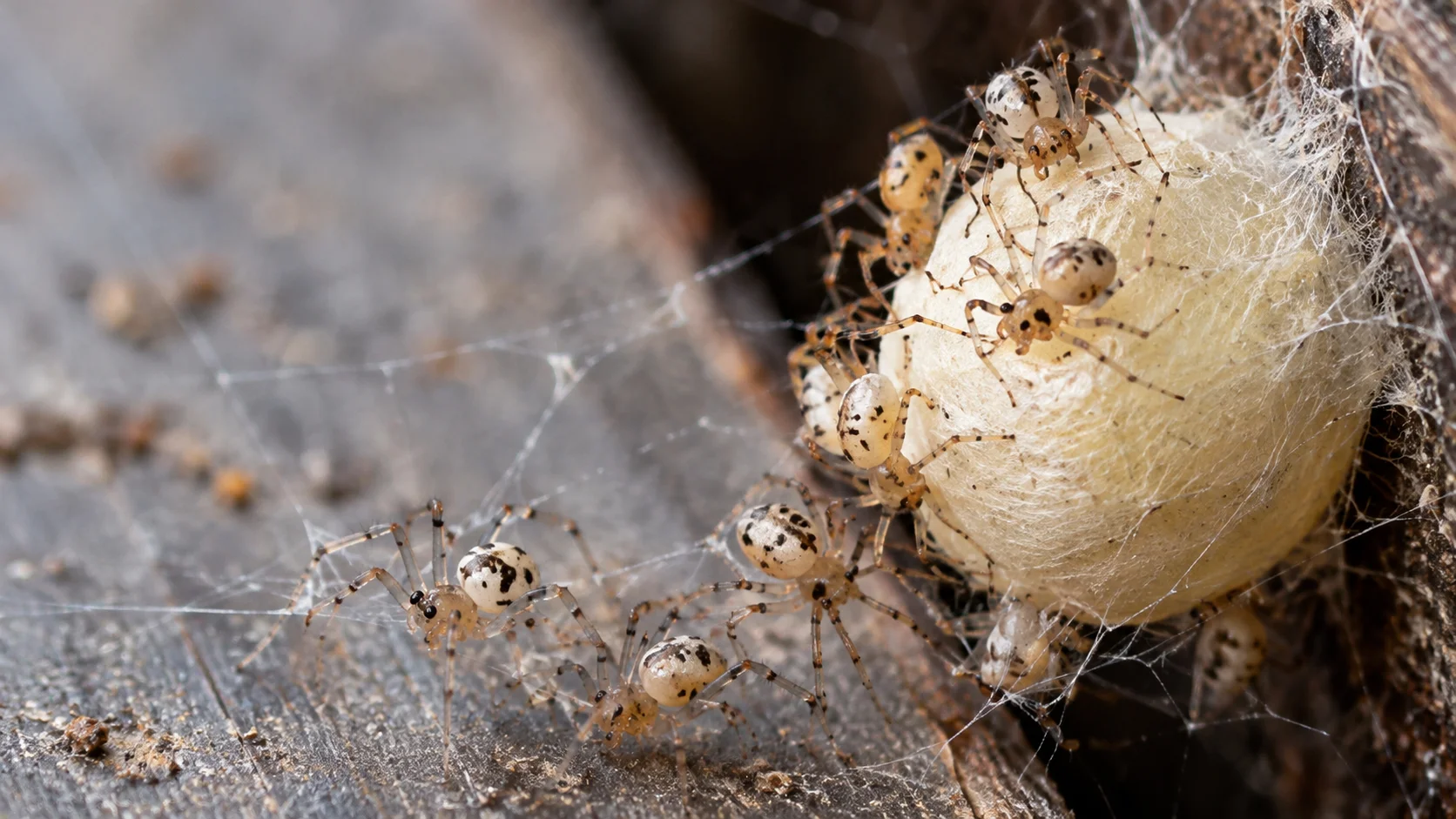
Baby black widows, also called black widow spiderlings, look very different from mature female black widows. Newly hatched spiderlings are usually pale, with tan or light-colored legs and a mostly white abdomen marked with small dark spots. As they grow and molt, their bodies gradually become darker and develop the familiar black widow pattern.
The exact appearance can vary by species and developmental stage. Western black widow spiderlings, for example, develop from pale and patterned young spiders into darker juveniles before females eventually acquire the glossy black appearance associated with adults. So,let's understand what do baby black widows look like?
Baby Black Widow Appearance
Young black widows are extremely small spiders with eight legs, a cephalothorax, and an abdomen. Unlike adult female black widows, young spiders usually have a combination of pale tan, white, gray, orange, or reddish markings.
UC IPM describes newly emerged western black widow spiderlings as having tan legs and a tan cephalothorax, while the abdomen is mostly white with several black spots.
Pale Body and Dark Markings
Newly hatched spiderlings can look almost white or pale because their bodies have not yet developed the dark pigmentation of an adult female. Small black spots can appear on the abdomen, while the legs remain relatively light.
As the spider grows, the abdominal background changes toward olive-gray or tan. White longitudinal and diagonal markings become more noticeable during the juvenile stages.
White, Orange, and Red Patterns
Juvenile black widows can have striking contrasting markings. Depending on age, the abdomen may show white borders, orange or reddish areas, and dark spots.
The markings gradually change through successive molts. In immature females, the white stripes become narrower and the overall body becomes darker as the spider approaches adulthood.
What Baby Black Widows Look Like as They Grow
Black widow spiderlings do not remain the same color throughout their development. They undergo repeated molts, and each molt allows the growing spider to develop a more adult-like appearance.
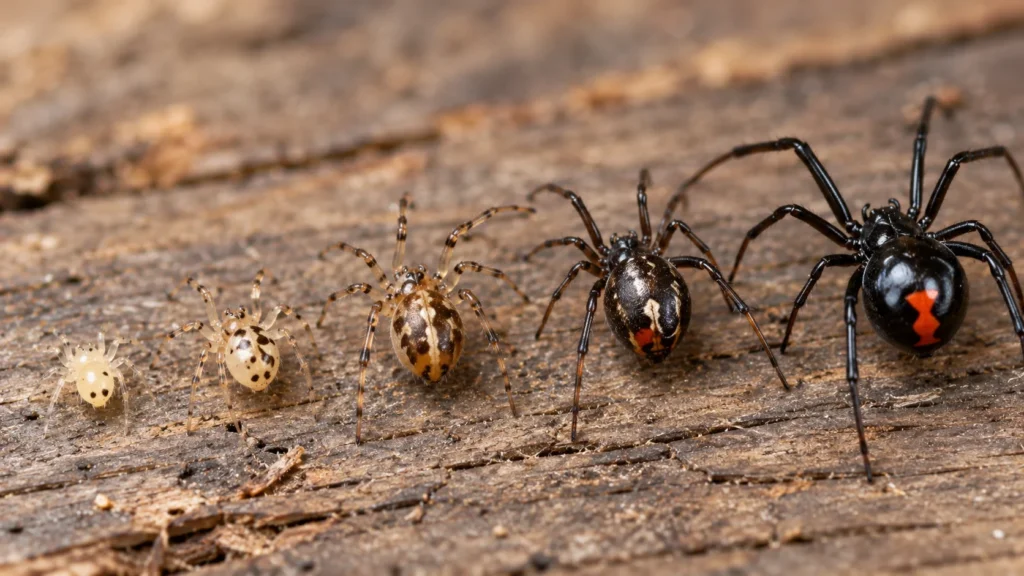
The progression is particularly noticeable in females. Their pale and patterned abdomen gradually becomes darker, while the markings associated with mature black widows become more defined.
Newly Hatched Spiderlings
Newly hatched spiderlings are generally very pale and remain close to their egg sac for a short period. Their bodies can have a mostly white abdomen with small black markings and relatively pale legs.
UC IPM describes western black widow spiderlings immediately after emergence as having tan legs and a tan cephalothorax with a mostly white abdomen containing black spots.
Intermediate Juvenile Stage
As the spiderlings mature, the abdomen develops an olive-gray or tan background with a white stripe running lengthwise along the top. Diagonal markings can also develop along the sides.
These patterns make immature black widows look considerably different from adult females. They can also resemble other widow species, which makes identification based only on color less reliable.
Older Juvenile Females
Older immature females become progressively darker with each molt. The white markings become thinner, while the abdomen moves toward the solid dark coloration associated with mature females.
The red or orange abdominal marking also changes during development. The structure that eventually becomes the familiar hourglass begins as a pale shield-like marking and becomes increasingly orange-red through later molts.
Baby Black Widow Size
Black widow spiderlings are much smaller than adult females when they first emerge. Their exact size changes rapidly as they feed and molt, so there is no single size that applies to every baby black widow.
The important identification feature is their developmental appearance rather than a specific measurement. Adult western black widow females reach roughly 1/2 inch in body length, while immature spiders remain substantially smaller until they complete their molts.
Tiny Spiderlings Near the Egg Sac
Immediately after hatching, many spiderlings remain clustered around the egg sac. UC IPM notes that they later disperse by producing silk and using air currents to travel away from their original location, a behavior known as ballooning.
This means a group of extremely tiny pale spiders around an egg sac can be an important indication of recently hatched widow spiderlings.
Baby Black Widow Egg Sac
The egg sac provides another useful clue when identifying young black widows. Western black widow egg sacs are generally yellowish and teardrop-shaped, with a tapered upper portion and a fuller lower portion.
The sac has a tough, well-defined silk covering rather than the loose cotton-like appearance of some other spider egg sacs. A western black widow female can produce multiple egg sacs during her lifetime.
Spiderlings Emerging From the Sac
After hatching, young black widows initially remain together. UC IPM images document clusters of western black widow spiderlings around their egg sac.
The young spiders eventually disperse, with some using silk threads to move away from the original web. This natural dispersal can make spiderlings appear in several nearby locations after emergence.
Baby Black Widows Compared With Adult Females
The difference between juvenile and adult female black widows can be dramatic. Mature females are typically shiny black with a red or orange marking on the underside of the abdomen, while juveniles have much more visible pale striping and spotting.
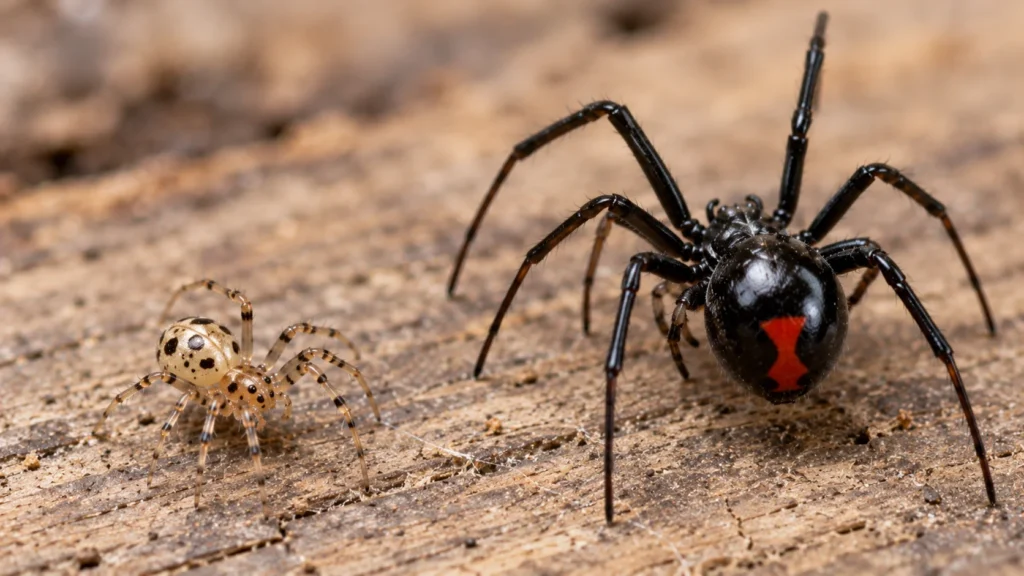
| Feature | Baby or Juvenile Black Widow | Adult Female Black Widow |
| Body color | Pale, tan, olive-gray, or darkening | Usually shiny black |
| Abdominal markings | White, orange, red, and dark patterns | Primarily black |
| Abdomen | Smaller and patterned | Rounded and bulbous |
| Hourglass | Developing from a pale marking | Usually red or orange |
| Legs | Often banded or lighter | Generally dark |
| Size | Very small | About 1/2 inch body length in western black widow |
| Appearance | Mottled and striped | Mostly solid black |
The adult female's red hourglass is located on the underside of the abdomen, and its shape can vary considerably between individuals.
Baby Black Widows and Male Black Widows
Young female black widows can resemble males during earlier developmental stages. Male black widows remain much smaller than females and retain juvenile-like coloration after reaching maturity.
USU Extension describes males as pale brown with white markings, while immature females have pale brown to black bodies with white to orange banding.
Similarities Between Juveniles and Males
Both can have pale bodies, light-colored abdominal markings, and banded patterns rather than the solid black appearance of an adult female.
Species, developmental stage, body proportions, and abdominal markings should all be considered when distinguishing them.
Baby Black Widows Compared With Brown Widows
Immature black widows can be confused with brown widows because both can have pale and dark abdominal markings. Color alone is therefore not always sufficient for identification.
UC IPM provides several distinguishing characteristics, including differences in the abdominal spots, white markings, and the developing hourglass pattern. Brown widow egg sacs also have prominent silk protuberances that give them a distinctive textured appearance.
Important Identification Differences
Immature western black widows generally have small elliptical black spots associated with their lateral abdominal stripes and continuous white markings on the front of the abdomen. Brown widows tend to have larger, more squared spots and different abdominal patterning.
Because widow species can be difficult to distinguish at juvenile stages, photographs should be compared with reliable identification references rather than relying on one color or marking.
Explore more articles:
- Fruit Flies vs Gnats
- Rat vs Mouse
- Bugs That Look Like Flying Termites
- Bugs That Look Like Fleas
- What Do Fleas Look Like?
- Wood Ants vs Termites
- What Are Centipedes Attracted To?
- What Do Drain Flies Look Like
Baby Black Widow Habitat
Black widows generally prefer quiet, sheltered locations rather than exposed areas with frequent human activity. Common habitats include holes, cracks, wood piles, clutter, building foundations, outbuildings, garages, and other protected spaces.
USU Extension notes that black widows commonly use dark, undisturbed locations and can occur around foundations, rock piles, wood piles, water or irrigation boxes, and exterior lighting.
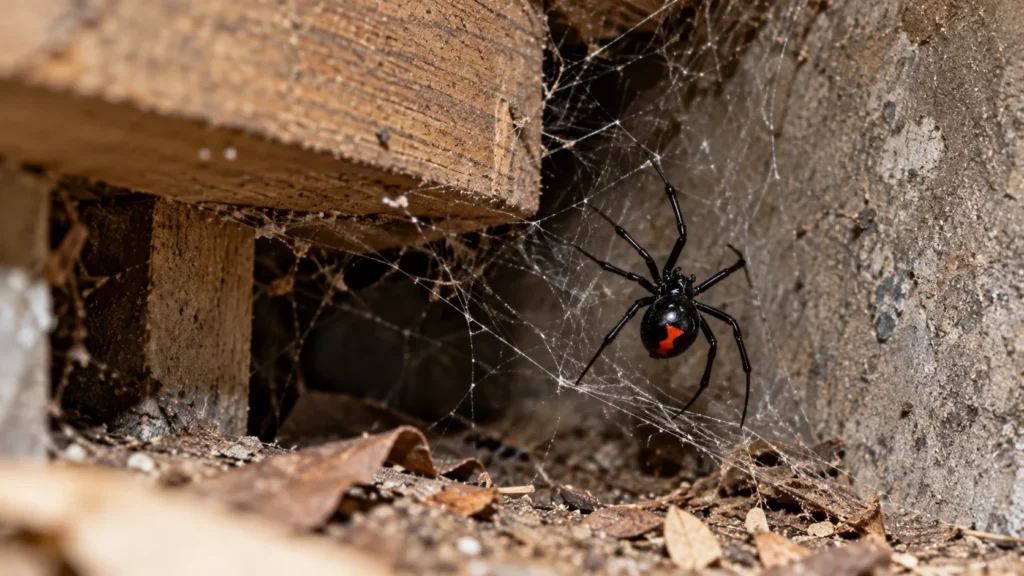
Protected Areas Around Buildings
Garages, sheds, storage areas, crawl spaces, and piles of materials can provide suitable shelter. Reducing clutter and sealing cracks can reduce available hiding and nesting locations.
Black widows are generally more associated with sheltered exterior or structural spaces than with active living areas inside a home.
Black Widow Safety
Black widow identification deserves caution because mature females can deliver medically significant bites. UC IPM reports that the larger immature females and adult females are capable of biting through human skin and injecting enough venom to cause a painful reaction.
Young spiderlings should therefore not be handled simply because they appear small or pale. Avoid reaching directly into a suspected web or egg-sac area, particularly in dark storage spaces, garages, sheds, or wood piles.
Safe Handling Practices
Useful precautions include:
- Avoid touching unfamiliar spiderlings.
- Do not disturb an egg sac with bare hands.
- Wear gloves when moving stored materials.
- Use caution around wood piles and clutter.
- Inspect dark storage areas before reaching inside.
- Keep children away from suspected widow webs.
- Reduce clutter around buildings.
- Seal cracks and crevices where practical.
- Use tools rather than bare hands when moving debris.
- Seek medical advice promptly after a suspected black widow bite, especially if significant symptoms develop.
Ten Quick Facts About Baby Black Widows
- Baby black widows are called spiderlings.
- Newly hatched spiderlings can be very pale.
- Their abdomens may initially appear mostly white.
- Small black spots can occur on the abdomen.
- Juveniles develop white, tan, orange, and reddish markings.
- Female spiderlings become progressively darker after successive molts.
- The adult female eventually develops the characteristic black appearance.
- The red or orange hourglass develops gradually.
- Spiderlings may disperse using silk threads and air currents.
- Juvenile black widows can be difficult to distinguish from some other widow species.
Conclusion
Baby black widows look very different from mature female black widows. Newly hatched spiderlings can be almost white, with pale legs and small dark spots on the abdomen. As they grow, their bodies become tan, olive-gray, and eventually darker, while white, orange, and reddish markings change through successive molts.
The developing pattern, egg sac, habitat, and spider's growth stage are all useful identification clues. Because juvenile widow spiders can resemble other species, reliable identification is particularly important when a suspected black widow is found around a home.
What do baby black widows look like?
Baby black widows are tiny spiderlings that can have pale or tan bodies, light legs, and mostly white abdomens with small black spots. Their markings become darker and more complex as they molt and grow.
What do baby black widows look like?
Newly hatched western black widows can appear almost white, while older juveniles develop tan, olive-gray, white, orange, and reddish markings. The appearance changes considerably before a female reaches adulthood.
What do black widows look like as a baby?
Young black widows usually do not look like the shiny black adult female. They are patterned and may have white stripes, dark spots, and pale or reddish markings on the abdomen.
Do baby black widows have a red hourglass?
The characteristic adult marking develops gradually. In the youngest spiders, the area where the hourglass eventually appears begins as a pale shield-like marking and changes toward orange-red through successive molts.
Are baby black widows dangerous?
Black widow spiderlings should not be handled. UC IPM reports that only larger immature females and adult females are capable of biting through human skin and injecting enough venom to cause a painful reaction.
What does a baby black widow egg sac look like?
Western black widow egg sacs are generally yellowish and teardrop-shaped, with a tough, well-defined silk covering. Newly hatched spiderlings may remain clustered around the sac before dispersing.