
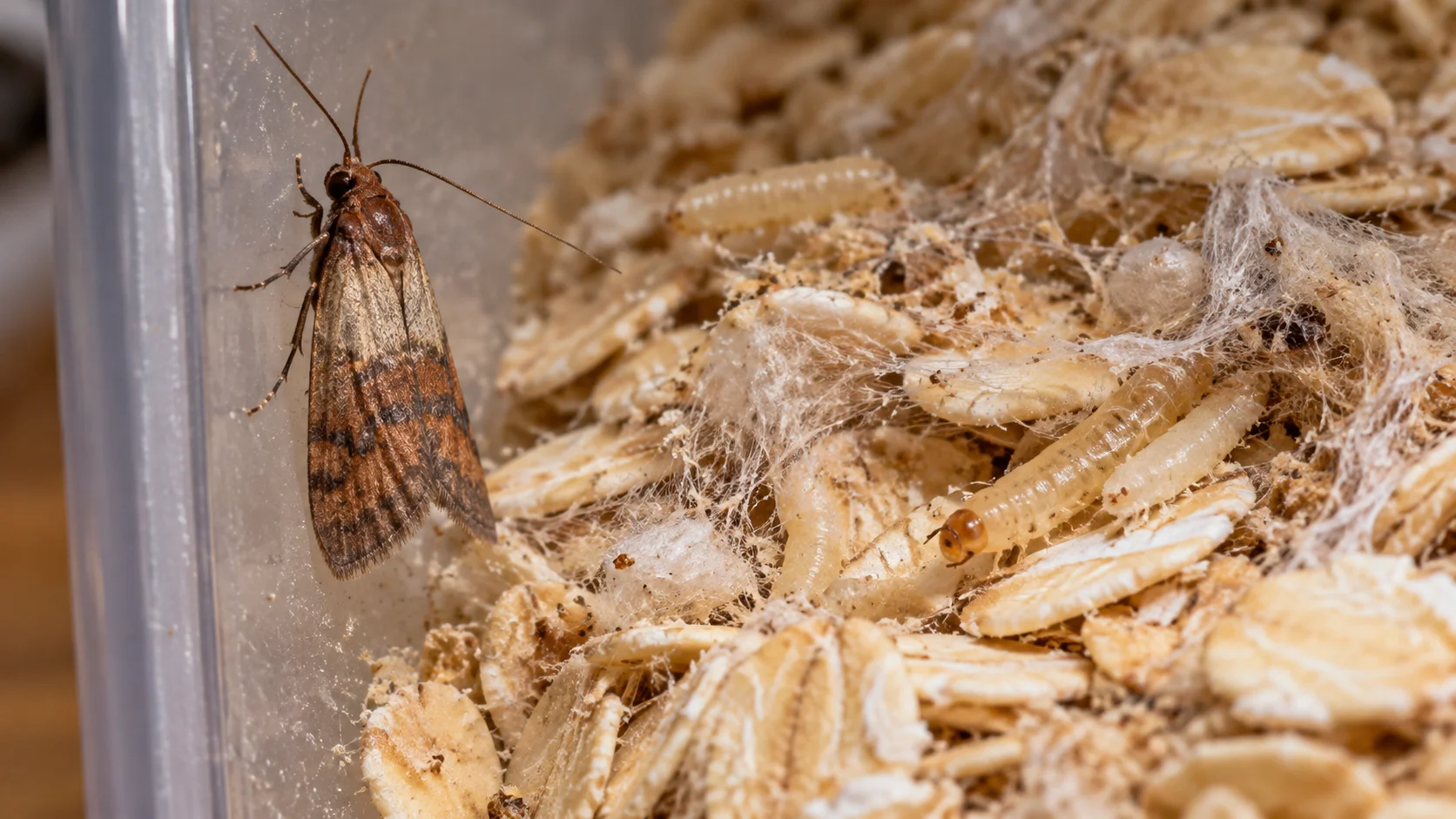
A pantry moth is a small stored-food pest that infests dry foods kept in kitchens, cupboards, and pantries. The name commonly refers to moths that develop in stored products, with the Indianmeal moth (Plodia interpunctella) being one of the most common pantry moths found in homes.
Pantry moth infestations usually begin when eggs or very young larvae enter the home in contaminated food packaging. The larvae feed on a wide range of dry products, while adult moths are mainly associated with reproduction and do not feed.
Recognizing the adult moth, larvae, webbing, and other signs can help locate the infested food before the insects spread to additional packages.So, let's understand, what is a pantry moth?
Pantry Moth Identification and Appearance
The Indianmeal moth is a small moth with distinctive two-toned wings. Adults are generally around 1/2 to 5/8 inch in wingspan, with the inner portion of the forewings pale gray or tan and the outer portion reddish-brown or copper-colored.
When resting, the wings are folded or held over the body, making the moth look relatively narrow. Adult moths are frequently noticed flying around kitchens, particularly in the evening or at night.
Adult Pantry Moth Features
Typical identification characteristics include:
- Small adult moth
- About 1/2 to 5/8 inch wingspan
- Pale gray or tan inner wing area
- Reddish-brown or copper-colored outer wings
- Grayish head and thorax
- Roof-like wing position while resting
- Zigzag or fluttering flight when disturbed
- Adult moths commonly appear around kitchens and pantries
The distinctive reddish-copper wing pattern makes Indianmeal moths easier to separate from many other household moths. However, identifying the actual insect is important because several different moth and beetle species can infest stored foods.
What a Pantry Moth Looks Like in the Home
Pantry moths may be seen flying around kitchens, cupboards, dining areas, garages, or other rooms connected to stored food. Adult moths can travel away from the original food source, so the location of a flying moth does not necessarily identify the infested package.
University of Minnesota Extension notes that adults may be attracted to lights, while mature larvae can leave food packages and crawl onto walls and ceilings before pupating.
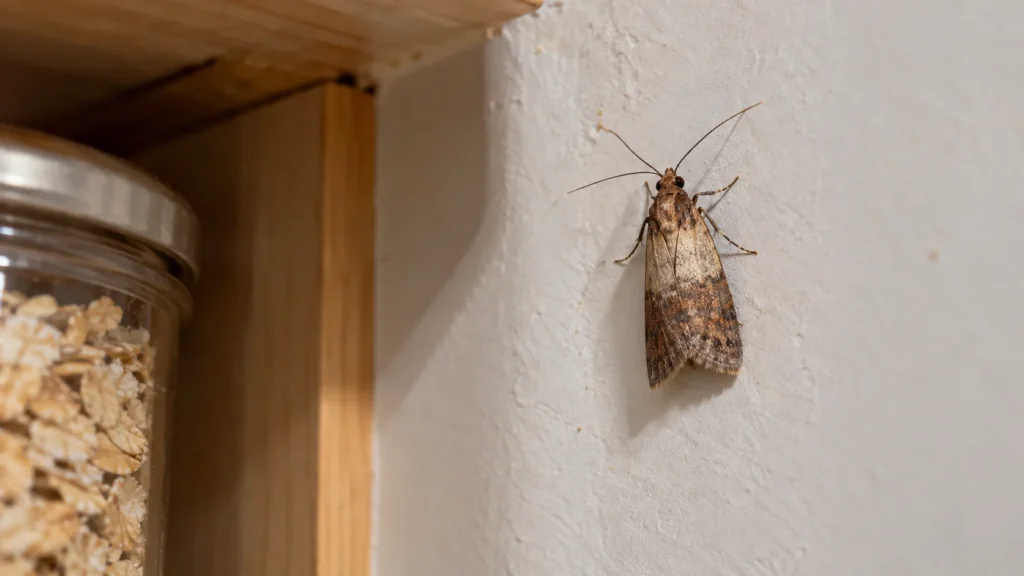
Moths on Walls and Ceilings
Finding small moths resting on walls or ceilings is a common sign of pantry moth activity. Mature larvae may also crawl considerable distances after leaving their food source to find a protected location for pupation.
This behavior can make an infestation appear to be coming from the walls or ceiling even when the actual source is a cereal box, bag of grains, pet food, birdseed, dried fruit, or another stored product.
Pantry Moth Larvae and Webbing
The larval stage causes most of the direct food contamination. Indianmeal moth larvae are usually whitish, cream-colored, yellowish, greenish, or pinkish and have a distinct brown head. Mature larvae reach roughly 1/2 inch in length.
As they move and feed, larvae produce silk that can form visible threads or webbing throughout an infested food product. The presence of webbing is one of the most useful signs of a pantry moth infestation.
Pantry Moth Caterpillars
Young larvae are extremely small and may initially be difficult to notice. As they grow, they become more obvious and can sometimes be seen crawling through food or outside the original package.
Mature larvae frequently leave the food and wander across shelves, walls, ceilings, and other nearby surfaces before forming a cocoon.
Silk Webbing in Stored Food
Webbing can appear as thin silk threads, clumps, or dense tangled material within food. Contaminated products may also contain frass, cast skins, insect bodies, and other debris.
A package containing unexplained webbing or clumped grains should be treated as potentially infested and inspected carefully.
The Pantry Moth Life Cycle
The pantry moth has a complete metamorphosis consisting of egg, larva, pupa, and adult stages. The duration of each stage depends heavily on temperature, food availability, and other environmental conditions.
Under favorable household conditions, the egg-to-adult cycle can be completed in roughly six to eight weeks, although development can be considerably slower under unfavorable conditions.
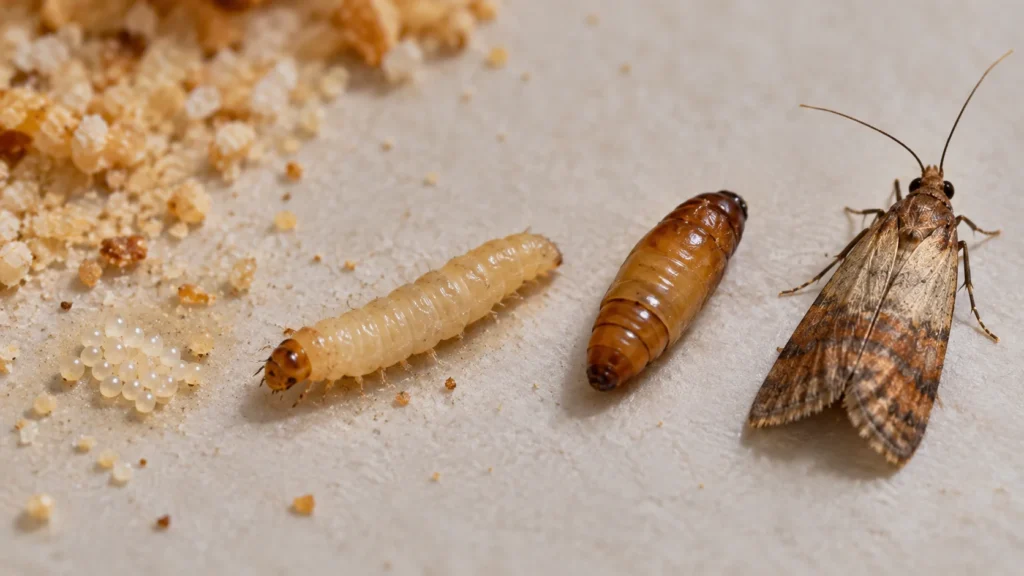
Egg Stage
Female Indianmeal moths lay eggs on or near suitable food sources. Depending on conditions and the source, a female can produce dozens to several hundred eggs.
The eggs are extremely small and may be difficult to see without magnification. UF/IFAS reports that eggs can hatch in several days under warm conditions, while cooler conditions can extend development.
Larval Stage
After hatching, the larvae begin feeding on susceptible stored products. This is the primary feeding and damaging stage.
The larvae produce silk as they move through the food and eventually leave the food source to find a suitable place for pupation. Their wandering behavior is why caterpillars may appear far from the package that originally supported their development.
Pupal Stage
The mature larva forms a silken cocoon in a protected location. Cocoons may occur in cracks, corners, beneath shelves, along walls, or near the junction of walls and ceilings.
Because pupation can occur away from the food, removing only visible larvae does not necessarily eliminate every developmental stage.
Adult Stage
Adult moths emerge from the pupal stage and reproduce. They do not feed on stored food, so the contamination and feeding damage associated with pantry products comes primarily from the larvae.
Virginia Tech Extension reports that adults generally live for about one to two weeks, although lifespan varies with environmental conditions.
Explore more articles:
- Fruit Flies vs Gnats
- Rat vs Mouse
- Bugs That Look Like Flying Termites
- Bugs That Look Like Fleas
- What Do Fleas Look Like?
- Wood Ants vs Termites
- What Are Centipedes Attracted To?
- Pictures of Termites
Pantry Moth Lifespan and Development
The adult pantry moth lifespan is relatively short, but the complete life cycle can continue much longer because the insect spends most of its development as an egg, larva, or pupa.
Virginia Tech gives an approximate six-week egg-to-adult cycle under suitable conditions, while UF/IFAS documents a much broader potential range of 27 to 305 days depending on environmental conditions.
This variation explains why pantry moth activity can persist for weeks or longer after the first adult moth is noticed.
Factors That Affect Development
Development can change according to:
- Temperature
- Humidity
- Food quality
- Food availability
- Seasonal conditions
- Larval nutrition
- Indoor heating
- Population density
Warm, favorable conditions generally allow pantry moths to develop more quickly, while cooler conditions can substantially slow their life cycle.
Foods Pantry Moths Commonly Infest
Pantry moth larvae can develop in many types of dry stored foods. Common targets include cereals, grains, flour, pasta, dried fruit, nuts, spices, chocolate, seeds, birdseed, and dry pet food.
Common Pantry Food Sources
Particular products worth inspecting include:
- Breakfast cereal
- Flour and baking mixes
- Rice and grains
- Pasta
- Dried fruit
- Nuts
- Seeds
- Spices
- Chocolate
- Candy
- Birdseed
- Dry pet food
- Animal feed
- Dried herbs
- Decorative dried plant materials
An infestation may begin in one package and spread to other susceptible products stored nearby.
How Pantry Moths Enter Homes
Pantry moths are often introduced through food products rather than entering through windows or doors. Eggs or early-stage larvae can be present in contaminated products before the package reaches a household.
Contaminated Food Packaging
Packages made from thin cardboard, paper, or plastic may not provide complete protection from pantry moth larvae. NPIC notes that larvae can chew through plastic bags and thin cardboard, allowing infestations to spread between stored products.
Bulk grains, dried fruits, cereals, pet foods, and birdseed deserve particular attention when inspecting newly purchased products.
Signs of a Pantry Moth Infestation
Adult moths are only one possible sign. Infested food may contain silk webbing, larvae, clumped food particles, cast skins, or frass.
A useful inspection should include both opened and unopened packages because infestation can occur before food is brought into the home. University of Maryland Extension recommends carefully checking dry packaged foods and nearby stored products when pantry moths are observed.
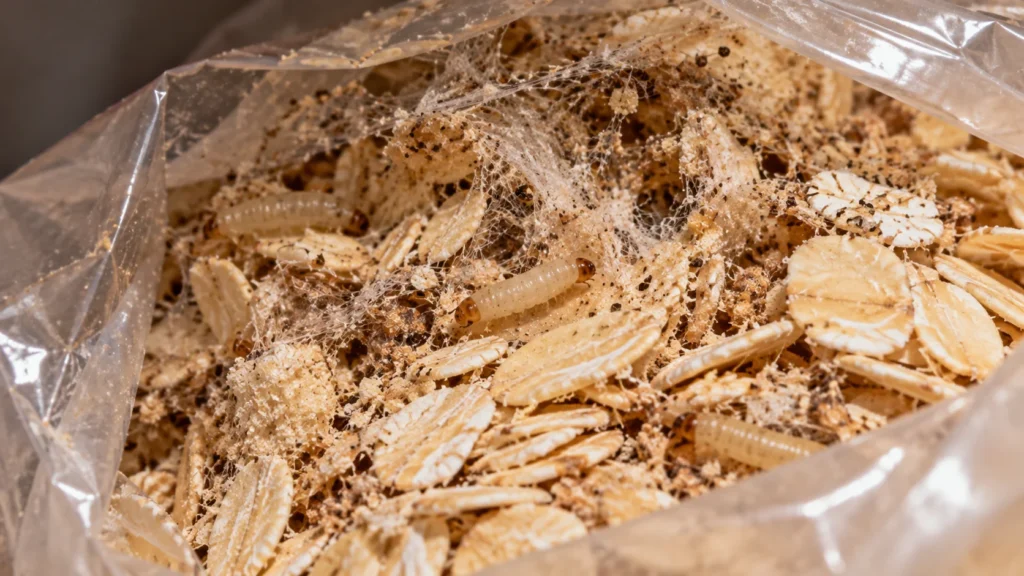
Important Warning Signs
Look for:
- Small reddish-brown moths around the kitchen
- Caterpillars inside dry food
- Larvae crawling on walls or ceilings
- Silk webbing in food
- Clumped grains or flour
- Frass or insect droppings
- Cocoons in cracks and corners
- Damaged food packaging
- Moths appearing repeatedly around lights
- Infested birdseed or pet food
Pantry Moth Prevention and Control
The most important control step is finding and removing the infested food source. Spraying adult moths alone does not address eggs, larvae, or pupae developing elsewhere in the pantry.
Discard visibly infested food and thoroughly vacuum pantry shelves, cracks, corners, and other areas where food debris may accumulate. Remaining dry foods should be transferred into tightly sealed glass, metal, or heavy plastic containers.
Pheromone traps can also help monitor Indianmeal moth activity, particularly after an infestation has been discovered. They should be considered a monitoring tool rather than a substitute for removing the infested food.
Ten Essential Pantry Moth Facts
- Pantry moths are stored-food pests.
- Indianmeal moths are among the most common pantry moths.
- Adults have distinctive reddish-copper wing markings.
- Adult moths are small and usually have a wingspan around 1/2 to 5/8 inch.
- Larvae are the primary feeding stage.
- Mature larvae are roughly 1/2 inch long.
- Pantry moth larvae produce silk webbing in food.
- Larvae may leave food and crawl onto walls or ceilings.
- Adults have a relatively short lifespan.
- Removing infested food is central to controlling an infestation.
Conclusion
A pantry moth is a small stored-product pest that commonly develops in dry foods kept inside kitchens and cupboards. The Indianmeal moth is particularly recognizable by its pale inner wings and reddish-copper outer wing sections, while its larvae are whitish or lightly colored caterpillars with brown heads.
The complete life cycle includes egg, larva, pupa, and adult stages, and the larvae are responsible for feeding damage and much of the visible contamination. Finding webbing, caterpillars, clumped food, or wandering larvae should prompt a careful inspection of all susceptible stored products.
What is a pantry moth?
A pantry moth is a moth that infests stored food products. The Indianmeal moth is one of the most common pantry moths found in homes and can develop in cereals, grains, dried fruit, nuts, spices, pet food, and other dry products.
What is the life cycle of a pantry moth?
The life cycle consists of four stages: egg, larva, pupa, and adult. Under favorable conditions, Indianmeal moths can complete the cycle in roughly six to eight weeks, although environmental conditions can make development considerably faster or slower.
What is the lifespan of a pantry moth?
Adult Indianmeal moths generally live for about one to two weeks, although lifespan varies with temperature and other conditions. The entire life cycle lasts considerably longer because most development occurs before adulthood.