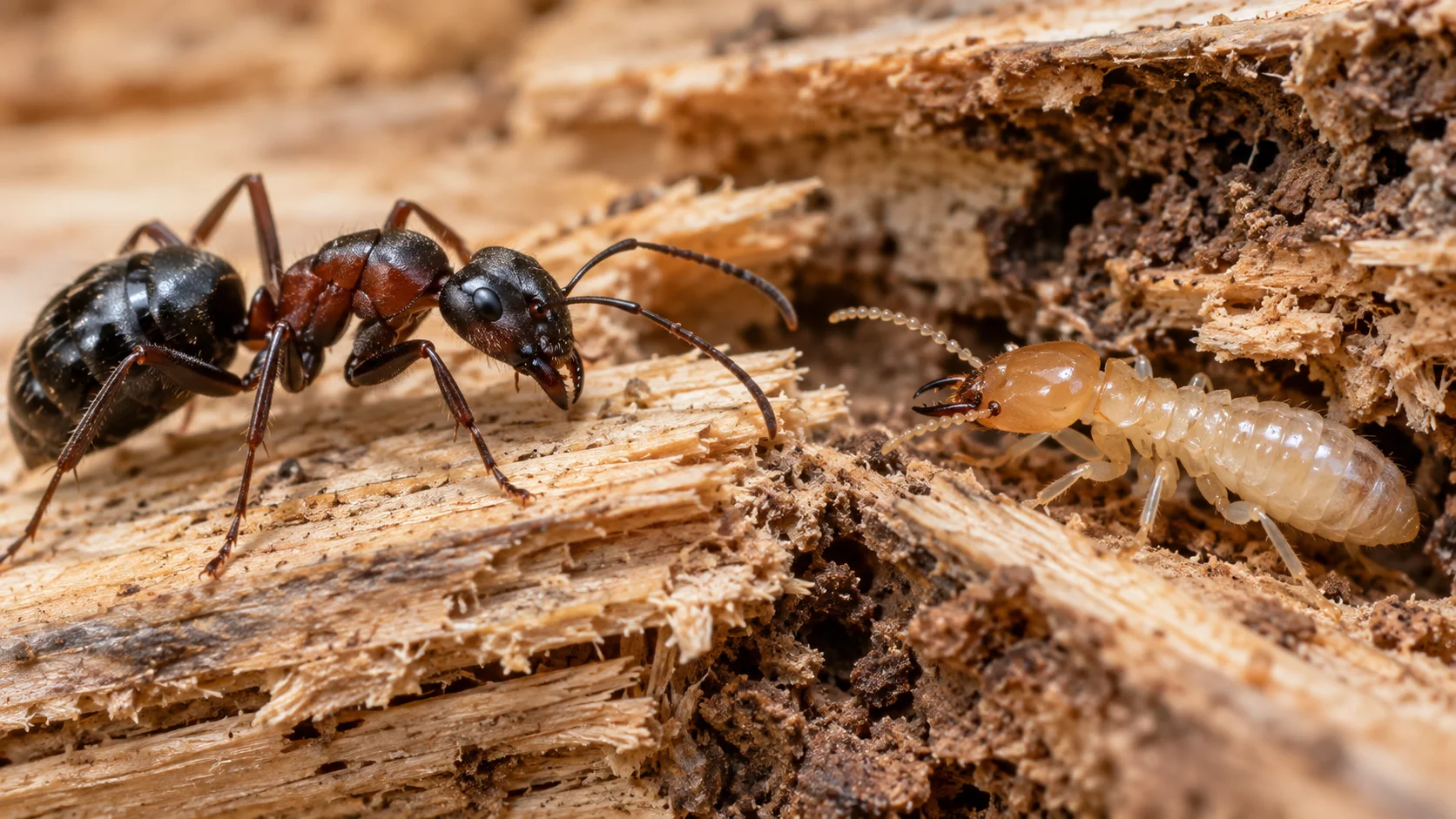
The wood ants vs termites comparison is important because both insects can be associated with wooden structures and may be mistaken for one another. Carpenter ants, often called wood ants, excavate wood to create nesting galleries, while termites actually consume cellulose-containing materials such as wood.
Their physical appearance also differs. Carpenter ants have a narrow waist and elbowed antennae, while termites have a broad waist and straight, bead-like antennae. Their damage patterns and waste materials provide additional clues when insects themselves are difficult to locate.
Recognizing these differences can help homeowners understand whether they are dealing with carpenter ants, termites, or another wood-damaging pest.
Wood Ants vs Termites at a Glance
Although both pests can affect structures, their biology and relationship with wood are very different. Carpenter ants excavate wood for shelter, whereas termites feed on wood and other cellulose-based materials.
| Feature | Wood/Carpenter Ants | Termites |
| Body color | Usually black, brown, or reddish-black | Workers usually creamy white; swarmers darker |
| Waist | Narrow and constricted | Broad and relatively straight |
| Antennae | Elbowed | Straight and bead-like |
| Workers | Dark and visible | Pale and usually hidden |
| Wood use | Excavated for nesting | Consumed as food |
| Galleries | Smooth and clean | Often contain soil or mud-like material |
| Waste | Coarse wood particles/frass | Drywood species produce pellet-like frass |
| Wings | Front wings longer than hind wings | Four wings approximately equal in length |
| Moisture association | Often linked with damp or decaying wood | Subterranean species commonly maintain soil/moisture connections |
| Nesting | Wood, wall voids, trees, insulation, cavities | Soil, wood, wall spaces, depending on species |
Carpenter ants and termites both live in colonies, but their identification features and damage patterns are sufficiently different to distinguish them with careful inspection.
Wood Ant Identification Features
The term wood ants can refer broadly to ants associated with wood, but carpenter ants in the genus Camponotus are the major structural concern in this comparison. They are among the larger ants encountered around homes and wooden structures.
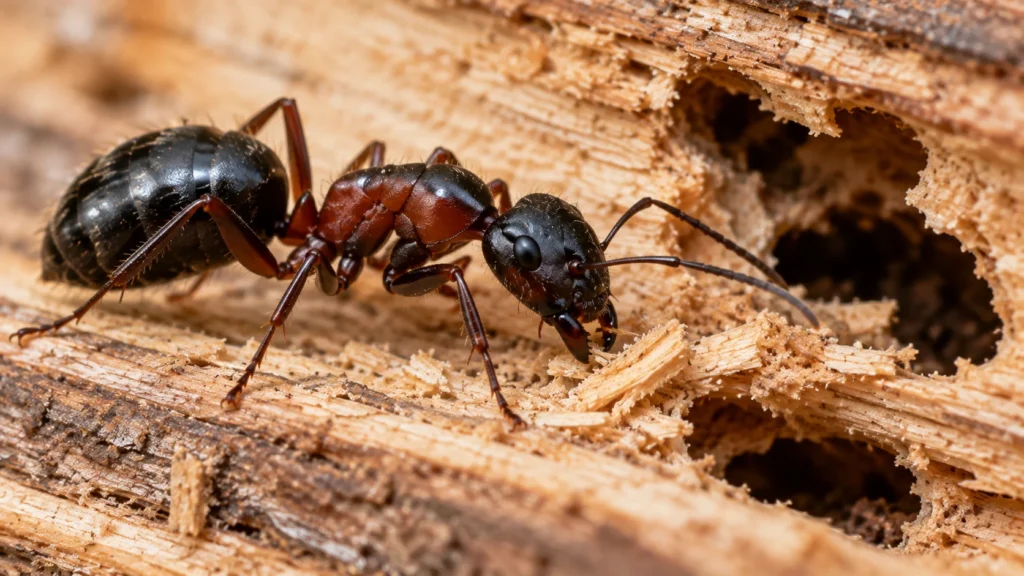
Workers are generally dark-colored and may range from roughly 1/4 to 1/2 inch long depending on species. Carpenter ants have a narrow waist, elbowed antennae, and a rounded thorax when viewed from the side.
Carpenter Ant Appearance
Carpenter ants may be black, brown, reddish-black, or combinations of these colors. Their bodies have a noticeable constriction between the thorax and abdomen, unlike termites.
Winged carpenter ants can be confused with termite swarmers because both emerge as reproductive insects. The wings provide a useful distinction: carpenter ants have a longer front pair and shorter hind pair.
Wood-Eating Ants vs Termites
Despite the common association with wood, carpenter ants do not eat wood. They chew and remove wood while constructing tunnels and galleries for nesting.
Their diet consists of sources such as insects, proteins, sweets, and honeydew. Wood is therefore a nesting material rather than their primary food source.
Termite Identification Features
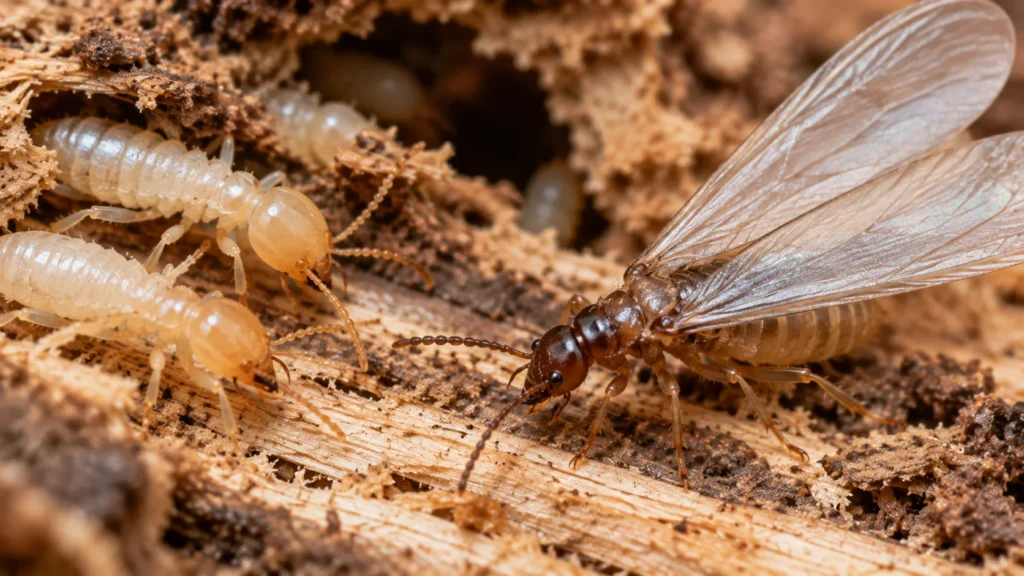
Termites have a more rectangular body shape, a broad waist, and straight antennae. Worker termites are generally pale or creamy white and tend to remain concealed inside soil, wood, or colony structures.
Eastern subterranean termite workers are approximately 1/8 to 1/4 inch long, while reproductive termites are darker and winged.
Termite Worker Appearance
Workers are usually the caste responsible for feeding on wood and maintaining the colony, but they are rarely encountered in exposed areas because they avoid light.
A pale, soft-bodied insect discovered inside damaged wood or a mud-covered gallery is more consistent with termite activity than carpenter ant activity.
Termite Swarmer Appearance
Winged termites, known as swarmers or alates, are darker than workers. They have four wings that are approximately equal in length and shape.
Termite swarmers are often confused with winged carpenter ants. Straight antennae, a broad waist, and equal-length wings are key termite characteristics.
Carpenter Ants vs Termites Wood Damage
Wood damage can provide valuable evidence when the insects are hidden. The two pests create distinctly different types of galleries.
Carpenter ants generally excavate smooth, clean-sided galleries. They remove the wood material rather than consuming it, leaving coarse particles or debris near the nest. Termite galleries, particularly those created by subterranean termites, may contain soil-like material and can leave wood hollowed internally.
Carpenter Ant Damage Signs
Carpenter ant galleries often have a smooth, sandpaper-like appearance because the ants clean the tunnels as they excavate them. Coarse sawdust-like material may accumulate beneath openings or near the nest.
Carpenter ants are particularly associated with damp, decaying, or moisture-compromised wood. Persistent leaks, poor drainage, condensation, and other moisture problems can create favorable nesting conditions.
Termite Damage Signs
Termite-damaged wood can contain runways and passages coated with earth-like material. With prolonged activity, the interior may become extensively hollowed.
Subterranean termites can also construct earth-colored shelter tubes between soil and wooden structures. These tubes provide protected routes between the colony and feeding sites.
Carpenter Ant Termite Droppings and Frass
The material found near damaged wood can help distinguish the pests, but terminology can be confusing because both carpenter ants and termites can leave waste or excavation debris.
Carpenter ants produce coarse, fibrous wood particles as they excavate galleries. These particles can contain pieces of wood and other debris from the nest.
Drywood termites produce a very different type of material. Their fecal pellets are small, hard, gritty, and characteristically six-sided. These pellets are pushed out of the colony through tiny kick-out holes and may accumulate in small piles that resemble sawdust or coffee grounds.
Carpenter Ant Frass
Carpenter ant frass is usually more irregular and fibrous than termite pellets. It may include coarse sawdust, insect remains, and other debris removed from the nest.
The presence of coarse material near smooth galleries is therefore a useful clue toward carpenter ant activity, especially when combined with sightings of large dark ants.
Drywood Termite Frass
Drywood termite pellets are much more uniform. They are generally six-sided and gritty, and they can range from light tan to nearly black.
Small piles below tiny openings in wooden surfaces are a characteristic sign of drywood termites.
Wood Ants vs Termites Pictures and Visual Identification
A photograph can be useful for preliminary identification, but body structure should be examined instead of relying only on color.
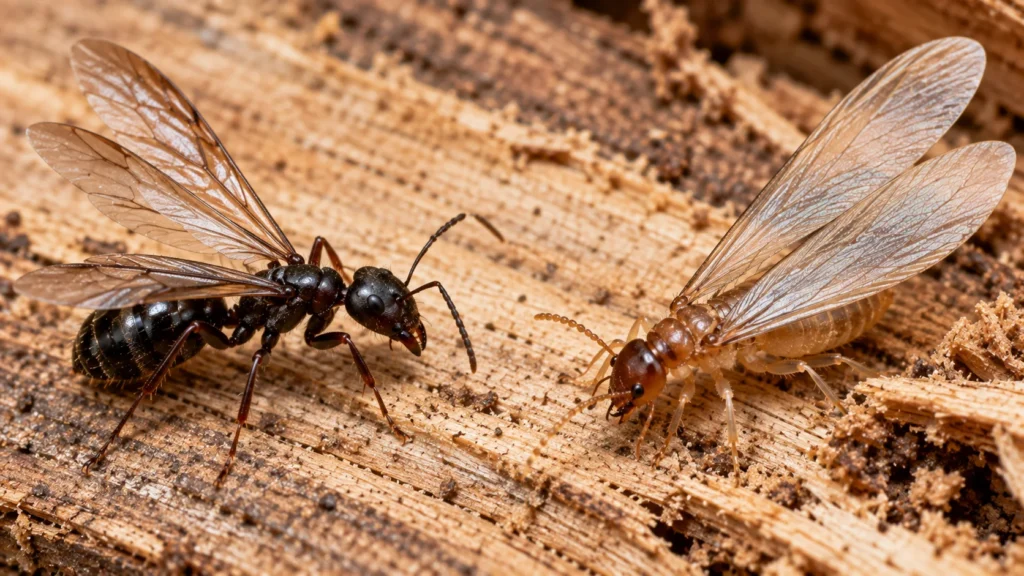
Carpenter ants have elbowed antennae, a constricted waist, and unequal wing lengths when winged. Termites have straight antennae, a broad waist, and four wings that are approximately equal in length.
Black Wood Ants vs Termites
Black carpenter ants can look especially similar to dark termite swarmers. Their color alone is therefore not enough for identification.
A black insect with a clearly narrow waist and elbowed antennae is more consistent with a carpenter ant. A dark swarmer with a broad waist, straight antennae, and equal-length wings is more consistent with a termite.
Wood Ants vs Termites Nesting Habits
Carpenter ants can establish nests in damp or decaying wood, trees, stumps, wall voids, attic spaces, insulation, and other protected cavities. They may have a parent colony outdoors and satellite nests inside buildings.
Subterranean termites typically maintain colonies associated with soil and can travel through shelter tubes to reach wooden structures. Drywood termites differ because their colonies can remain within relatively dry wood without a soil connection.
Carpenter Ant Nest Locations
Common carpenter ant locations include:
- Moist or decaying structural wood
- Tree stumps and roots
- Roof and attic areas affected by leaks
- Spaces around sinks and plumbing
- Wall voids
- Hollow doors
- Insulation
- Window areas
- Firewood
- Landscape timber
Moisture problems are an important factor because carpenter ants frequently take advantage of wood that has already been weakened by decay or water exposure.
Termite Nest Locations
Subterranean termites commonly remain connected to soil and may reach buildings through foundations, cracks, utility penetrations, and shelter tubes.
Drywood termites can establish colonies directly inside suitable wooden components, making their signs different from those of subterranean termites.
Explore more articles:
- Fruit Flies vs Gnats
- Rat vs Mouse
- Bugs That Look Like Flying Termites
- Bugs That Look Like Fleas
- What Do Fleas Look Like?
- What Are Moths Attracted To?
Carpenter Ants vs Termites Control Considerations
Correct identification should come before treatment because carpenter ants and termites require different management strategies.
For carpenter ants, locating the nest, correcting moisture problems, replacing severely damaged wood, and removing conditions that support nesting are important steps. University of Minnesota Extension notes that professional assistance is often appropriate because nests can be hidden inside walls, ceilings, subfloors, or other inaccessible spaces.
Termite management depends on the species and infestation location. Subterranean termite problems may involve soil, foundations, shelter tubes, and structural wood, while drywood termite management addresses colonies within wood. Professional inspection can help determine the appropriate approach.
10 Key Differences Between Wood Ants and Termites
- Carpenter ants do not eat wood; termites feed on wood and other cellulose materials.
- Carpenter ants have narrow waists; termites have broad waists.
- Carpenter ant antennae are elbowed; termite antennae are straight and bead-like.
- Carpenter ants have unequal wing lengths; termite wings are approximately equal in length.
- Carpenter ant workers are usually dark; termite workers are usually pale or creamy white.
- Carpenter ant galleries are generally smooth and clean.
- Subterranean termite galleries may contain soil-like material.
- Carpenter ants can leave coarse, fibrous wood debris near galleries.
- Drywood termites produce distinctive six-sided fecal pellets.
- Moisture-damaged wood commonly provides favorable nesting conditions for carpenter ants.
Conclusion
The wood ants vs termites distinction depends on more than simply seeing insects around wooden structures. Carpenter ants excavate wood to create nesting galleries, while termites consume wood as a food source. Their body structures, waste materials, galleries, and nesting habits provide several reliable identification clues.
A narrow waist, elbowed antennae, dark body, and smooth galleries point toward carpenter ants. A broad waist, straight antennae, pale workers, mud-like material, shelter tubes, or distinctive drywood termite pellets can indicate termite activity.
Because both pests can cause significant problems under certain conditions, accurate identification is important before selecting a treatment strategy.
Are wood ants the same as termites?
No. Wood ants such as carpenter ants are ants that excavate wood for nesting, while termites are separate insects that consume wood and other cellulose-containing materials.
Do carpenter ants eat wood?
No. Carpenter ants remove wood while constructing galleries and tunnels, but their food includes insects, proteins, sweets, and honeydew.
What do carpenter ant droppings look like?
Carpenter ant excavation debris generally appears as coarse, fibrous sawdust-like material and may contain other nest debris.
What do termite droppings look like?
Drywood termite droppings are small, hard, gritty pellets with a characteristic six-sided shape. They may collect beneath tiny kick-out holes in infested wood.
Can carpenter ants cause wood damage?
Yes. Carpenter ants excavate galleries in wood, and extensive or long-term activity can weaken structural wood. They are particularly associated with damp or moisture-damaged areas.
What does termite-damaged wood look like?
Termite-damaged wood may contain hollowed passages and galleries. Subterranean termite galleries can be coated or packed with earth-like material, while drywood termite galleries can occur within relatively dry wood.
Are black ants in wood always carpenter ants?
No. Several ant species can be dark-colored, so color alone does not establish carpenter ant identification. Body structure, size, nesting location, and damage evidence should also be considered.
Can winged carpenter ants look like termites?
Yes. Winged carpenter ants and termite swarmers can look similar. Carpenter ants have elbowed antennae, narrow waists, and unequal wing lengths, while termites have straight antennae, broad waists, and wings of approximately equal length.
Do termites leave sawdust?
Drywood termite pellets can resemble sawdust or coffee grounds, but they are actually hard fecal pellets with a characteristic shape. Carpenter ants, in contrast, produce fibrous wood debris while excavating their galleries.
What should be done after finding wood-damaging insects?
The insect and damage should be identified first, followed by inspection for moisture problems, hidden nests, shelter tubes, galleries, or other evidence. Professional inspection is particularly useful when activity is inside structural wood or inaccessible areas.