
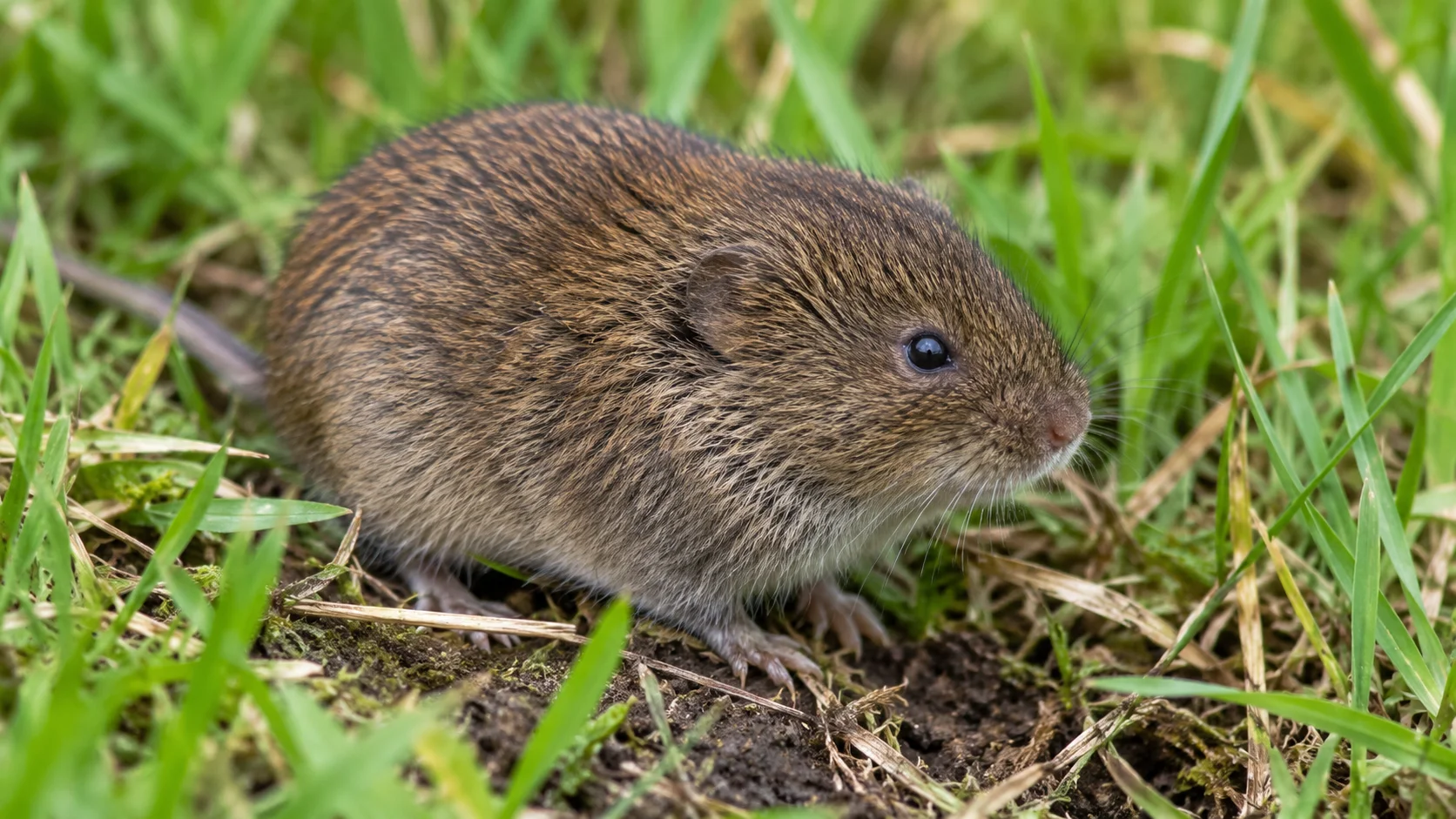
A vole is a small, stocky rodent commonly found in grassy areas, gardens, yards, orchards, and landscapes. Voles are often called meadow mice or field mice, but they are not the same animal as ordinary house mice. Their short tails, small partially hidden ears, compact bodies, and blunt faces make them recognizable once you know the main features.
Voles can become troublesome when their populations increase because they feed on vegetation, roots, bulbs, and bark and can create runways through lawns and garden beds. Some species spend more time below ground, while others create obvious surface runways. Correct identification is important because vole damage can easily be confused with damage caused by moles, mice, shrews, or other rodents.
What Is a Vole Animal
A vole is a small mammal belonging to the rodent group and is closely related to other arvicoline rodents. Voles have compact bodies, short legs, short tails, small eyes, and small ears that may be partly concealed by fur. Their coloring commonly ranges from brown to gray, although appearance varies among species.
Different vole species occupy different habitats, including meadows, grasslands, forests, gardens, orchards, wetlands, and agricultural areas. Their behavior also differs by species, with some producing visible surface runways and others spending more time in shallow underground tunnels.
Vole characteristics
These physical and behavioral traits help separate a vole from similar-looking small mammals.
- Stocky, compact body
- Short legs
- Short tail compared with the body
- Small eyes
- Small or partially hidden ears
- Blunt-looking snout
- Brown, gray, or mixed brown-gray fur
- Mouse-like feet
- Primarily herbivorous feeding habits
- Strong tendency to use vegetation for cover
Explore more articles:
- Fruit Flies vs Gnats
- Rat vs Mouse
- Bugs That Look Like Flying Termites
- Bugs That Look Like Fleas
- What Do Fleas Look Like?
- Wood Ants vs Termites
- What Are Centipedes Attracted To?
- What Do Drain Flies Look Like
- What Do Baby Black Widows Look Like?
What Does a Vole Look Like
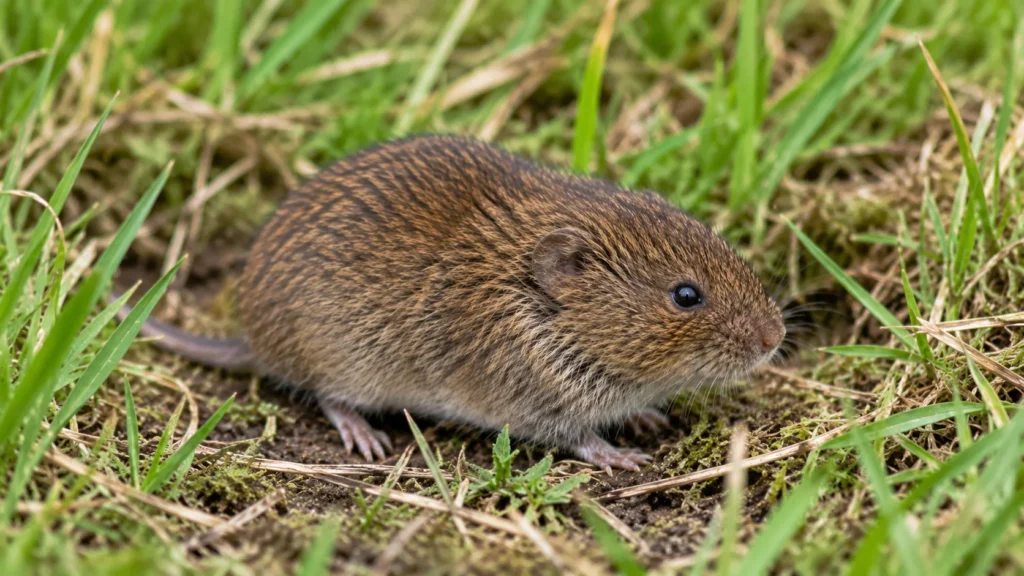
An adult vole generally looks like a heavier, shorter-tailed mouse. Meadow voles in North America commonly measure around 3.5 to 5 inches in body length, with the tail adding additional length. Their bodies are usually brown or gray, and their ears and eyes are relatively inconspicuous.
The exact appearance depends on the species. Woodland or pine voles can have especially short tails and reduced external ears because of their partly subterranean lifestyle, while meadow voles are more adapted to moving through surface vegetation.
Vole identification features
Look for a combination of body shape, tail length, fur color, and habitat rather than relying on a single characteristic.
- Compact body
- Rounded body profile
- Short tail
- Short legs
- Small rounded eyes
- Small ears
- Blunt nose
- Dense brown or gray fur
- Mouse-like feet
- Ground-level activity
Vole vs Mouse
Voles and mice can look remarkably similar, but they have several useful differences. Voles generally have stockier bodies, shorter tails, smaller eyes, and smaller ears than typical mice. They also spend much more of their time around vegetation rather than behaving like indoor house mice.
Voles are mainly plant feeders, consuming grasses, stems, seeds, roots, bulbs, and bark. House mice are more generalized feeders and are much more strongly associated with buildings. Purdue Extension specifically notes that meadow voles are often called meadow mice or field mice but are not the same animals as mice found inside homes.
Mouse and vole differences
The following features make field identification easier when the animal is visible only briefly.
- Voles have stockier bodies
- Voles usually have shorter tails
- Voles have smaller eyes
- Voles have smaller ears
- Voles have blunt facial profiles
- Mice generally look more slender
- Mice usually have more prominent ears
- Mice commonly have longer-looking tails
- Voles strongly favor vegetation
- Voles are usually associated with outdoor ground cover
Vole vs Mole
A vole and a mole are very different animals despite their similar names. Voles are rodents and primarily eat plant material, while moles are insectivorous mammals adapted for digging and feeding on soil organisms such as earthworms and grubs.
Their damage patterns are also different. Voles commonly create narrow surface runways through grass and vegetation, whereas moles produce raised soil ridges and mounds as they excavate underground tunnels. Purdue Extension identifies this surface-versus-subterranean pattern as one of the clearest distinctions.
Mole and vole damage differences
Identifying the damage before choosing a control method can prevent treatment of the wrong animal.
- Voles are rodents
- Moles are insectivorous mammals
- Voles eat vegetation
- Moles primarily eat soil invertebrates
- Vole runways are often visible at ground level
- Mole tunnels commonly create raised ridges
- Vole damage can include bark chewing
- Mole activity commonly produces soil mounds
- Voles have mouse-like feet
- Moles have enlarged digging forefeet
Vole Holes, Tunnels, and Runways
Vole holes are usually associated with shallow burrows, vegetation, and protected ground-level areas. Meadow voles often create interconnected surface runways through grass, while other species can remain mostly below ground. describes well-traveled runways connecting burrow openings as one of the clearest signs of vole activity.
Unlike a classic mole mound, a vole runway usually does not produce a large pile of excavated soil. Woodland voles can be more subterranean and may create shallow tunnels with small soil piles, making their activity harder to recognize.
Common signs around vole holes
Inspect the surrounding vegetation and soil for several signs occurring together.
- Narrow surface runways
- Small burrow openings
- Flattened grass
- Clipped vegetation
- Vole droppings
- Gnawed plant stems
- Gnawed bark
- Damaged roots
- Small tunnels beneath vegetation
- Nesting material made from grass
Vole Damage to Lawns, Plants, and Trees
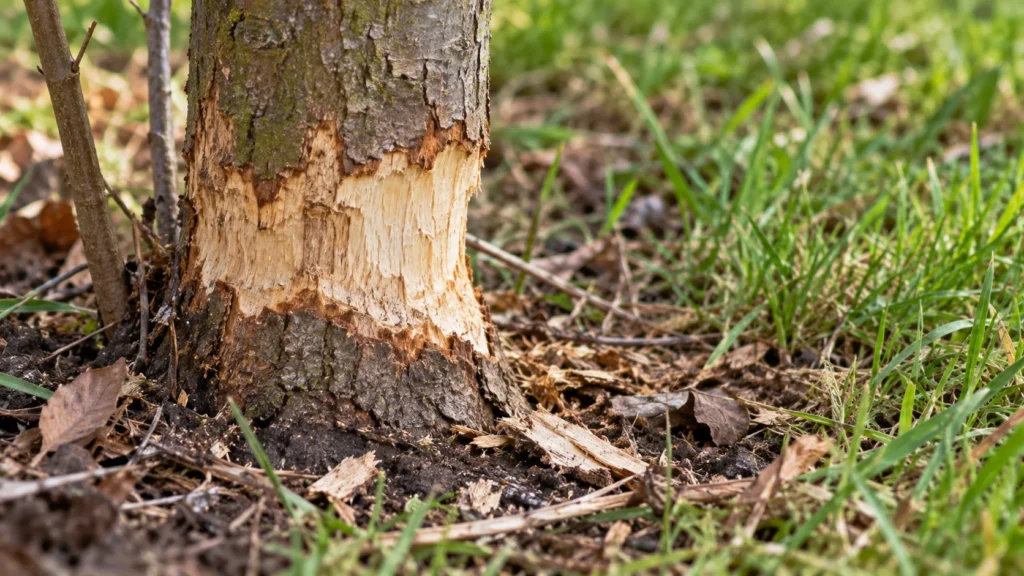
Voles can damage lawns, gardens, ornamental plants, fruit trees, and other vegetation. Their surface runways may create an unattractive appearance, while feeding on roots or bark can cause much more serious consequences for plants.
Tree damage is particularly important because complete girdling can interrupt the movement of water and nutrients. reports that vole girdling can kill trees when the damage completely surrounds the trunk or roots.
Signs of vole damage
Fresh damage is easier to identify when several indicators appear together.
- Gnaw marks near plant bases
- Missing bark
- Girdled trunks
- Damaged roots
- Chewed bulbs
- Damaged vegetables
- Clipped grass
- Surface runways
- Droppings along runways
- Weak or declining young trees
Types of Voles
There are numerous vole species worldwide, and the species found in a particular area depends on geography and habitat. Commonly discussed North American examples include the meadow vole, woodland or pine vole, and prairie vole. Water voles represent a different group associated with aquatic or wetland habitats in parts of Europe and Asia.
The meadow vole is especially widespread in grassy habitats and is well known for producing surface runways. Woodland or pine voles are more closely associated with shallow underground movement and can cause root damage that is difficult to detect.
Common vole types
Species differ in appearance, habitat, and the type of damage they produce.
- Meadow vole
- Woodland vole
- Pine vole
- Prairie vole
- Water vole
- European water vole
- Common vole
- Prairie-associated vole species
- Forest-associated vole species
- Wetland-associated vole species
Vole Control and Removal
Effective vole control begins with habitat modification. Dense grass, weeds, heavy mulch, fallen vegetation, and other ground cover provide food and protection, allowing populations to increase without being easily noticed.
recommends reducing dense vegetation and combining habitat modification with exclusion, trapping, or carefully managed baiting when necessary. For small infestations around homes and gardens, trapping can be a practical option.
Practical vole control methods
Use several compatible measures instead of depending on a single repellent or treatment.
- Mow grass regularly
- Reduce dense ground cover
- Remove excessive weeds
- Keep plant bases clear
- Avoid deep mulch around trunks
- Remove fallen vegetation
- Protect young trees with hardware cloth
- Place traps in active runways
- Monitor fresh damage
- Use pesticides only according to their labels
Vole Traps and Repellents
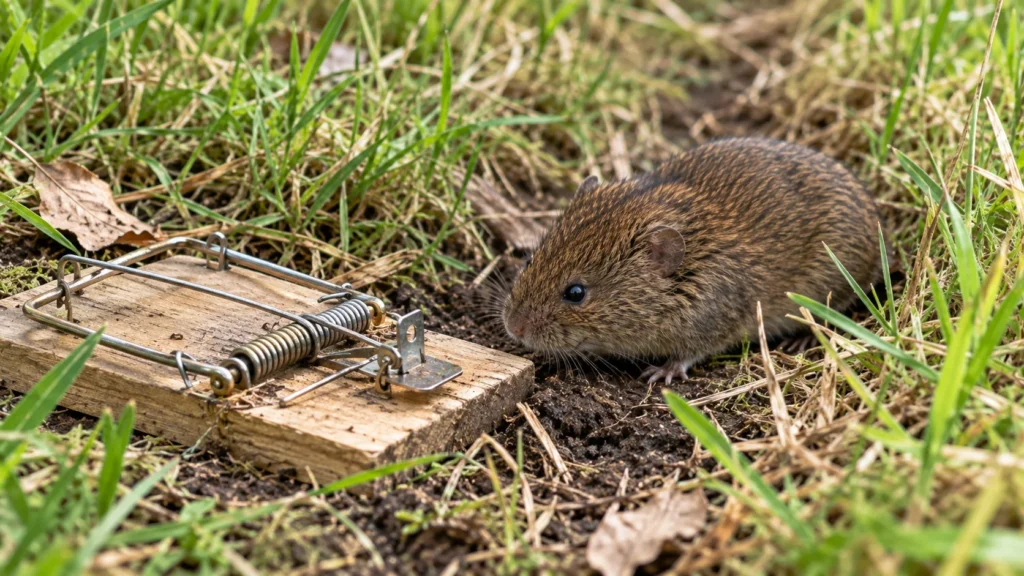
For small populations, mouse-sized snap traps can be effective when positioned directly in active vole runways. recommends placing traps perpendicular to the runway with the trigger end positioned in the travel path.
Commercial repellents are available, but university extension guidance indicates that their effectiveness can be inconsistent. Repellents are better treated as one component of a broader management plan rather than the only control method.
Safe control practices
Correct placement and protection from unintended exposure are important when using traps or pesticides.
- Confirm vole activity first
- Use appropriately sized traps
- Place traps in active runways
- Keep traps away from children
- Protect pets from traps
- Monitor traps regularly
- Remove captured animals appropriately
- Follow pesticide labels
- Prevent bait access by nontarget animals
- Contact a professional for severe infestations
10 Important Vole Facts
These key facts summarize the identification, behavior, damage, and management information most useful to homeowners and gardeners.
- Voles are rodents.
- Voles are often called meadow mice.
- Voles are not the same as house mice.
- Voles commonly have short tails.
- Voles have compact, stocky bodies.
- Many vole species primarily eat plant material.
- Meadow voles can create visible surface runways.
- Voles can damage tree bark and roots.
- Moles and voles cause different types of landscape damage.
- Habitat modification is an important part of long-term vole control.
Conclusion
Voles are small rodents that can be difficult to notice until their runways, burrows, feeding damage, or bark chewing become obvious. Their compact bodies, short tails, small ears, and preference for grassy or vegetated environments help distinguish them from mice and other small mammals. Correct identification is especially important when deciding between vole, mole, and other pest-control methods.
The most effective vole control combines habitat modification, monitoring, plant protection, exclusion, and trapping when appropriate. Reducing dense vegetation and protecting vulnerable plants can make the property less suitable for voles, while professional wildlife or pest-control assistance can help when populations are extensive or damage is severe.
1. What is a vole?
A vole is a small rodent with a compact body, short legs, small eyes and ears, and a relatively short tail. Many species live in grasslands, gardens, forests, orchards, and other vegetated environments.
2. What does a vole look like?
A vole generally resembles a stocky, short-tailed mouse. Its fur is commonly brown or gray, its ears are small, and its eyes are less prominent than those of many mice.