
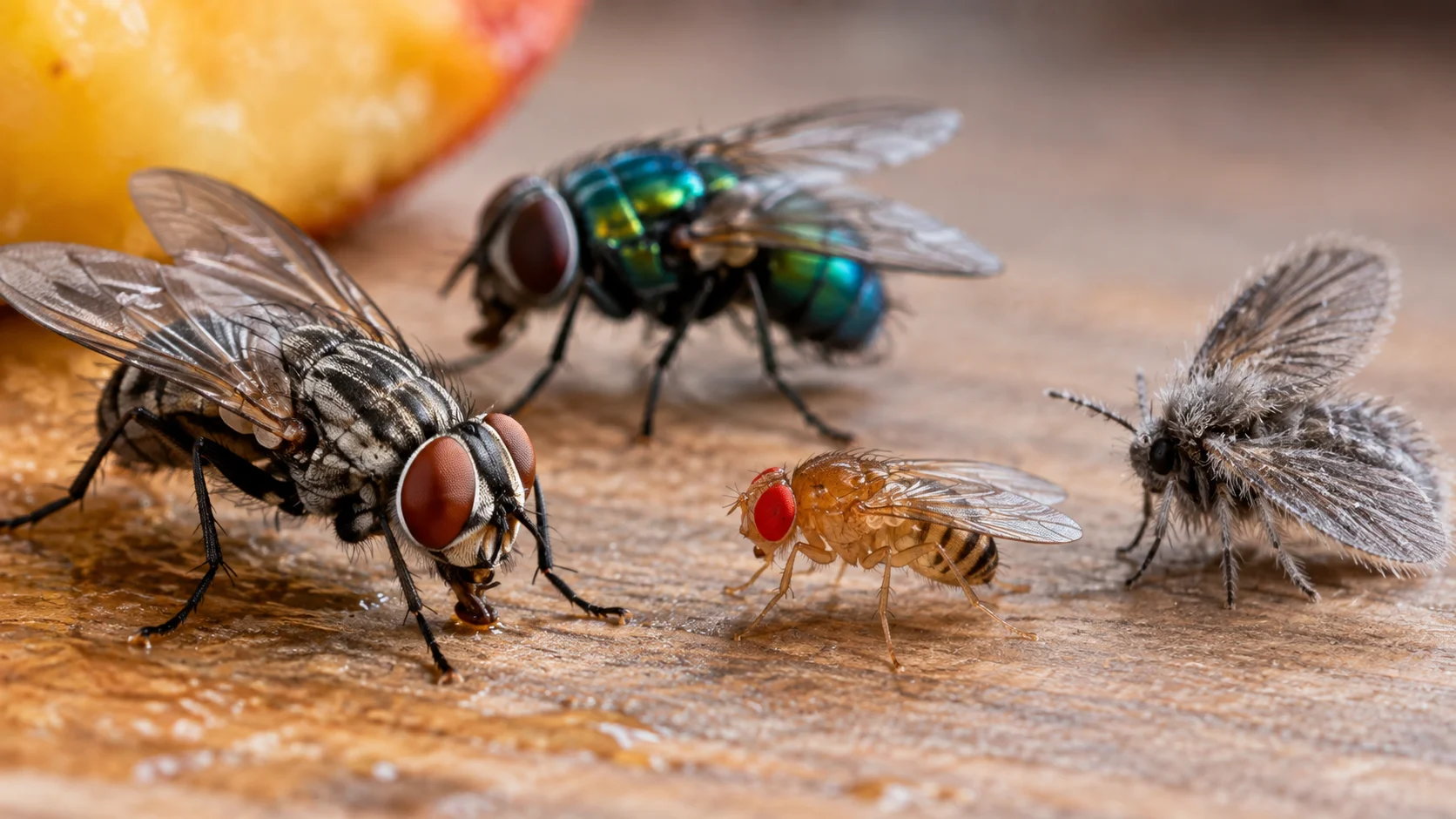
There are thousands of fly species, and they vary widely in size, color, habitat, feeding behavior, and importance to people. Some are common household pests, while others are associated with livestock, gardens, waterways, garbage, or decaying organic material.
The types of flies found around a home can include house flies, fruit flies, drain flies, blow flies, cluster flies, and several other small species. Biting flies such as stable flies, horse flies, deer flies, and black flies are more commonly associated with people, pets, or livestock outdoors.
For identification, body color and size are useful starting points, but the location where the fly is found and what it is attracted to often provide equally important clues.
Main Types of Flies
Flies belong to the order Diptera, meaning true flies have one functional pair of wings. This distinguishes them from insects such as bees and wasps, which have two pairs. Many fly species have large compound eyes and specialized mouthparts adapted to their particular food source.
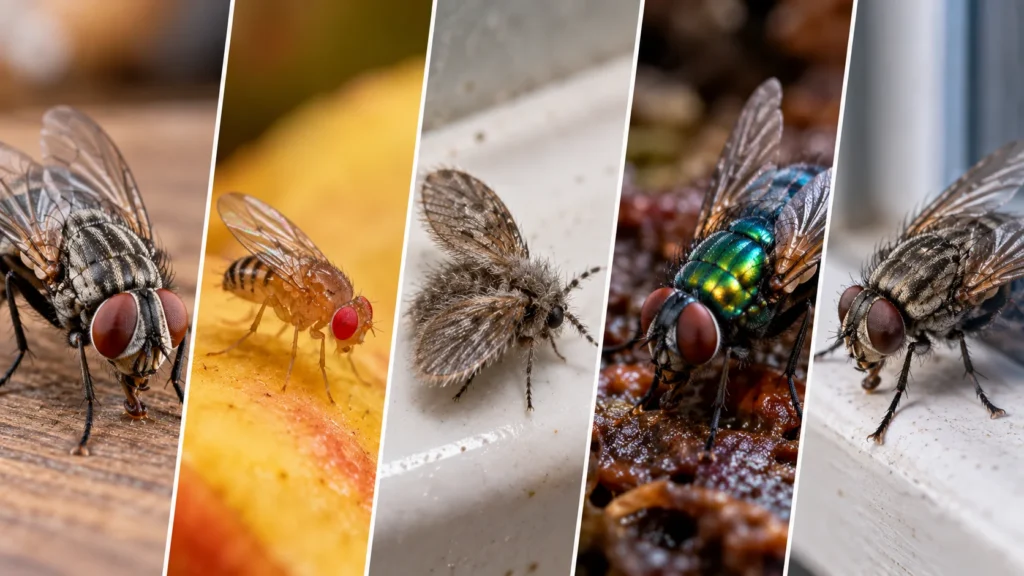
The following groups include many of the most commonly encountered flies around homes, businesses, gardens, farms, and outdoor areas.
House Flies
The house fly (Musca domestica) is one of the most familiar household flies. Adults are dull gray, about 1/6 to 1/4 inch long, and have four narrow black stripes on the thorax.
House flies are associated with garbage, feces, manure, and moist decaying organic material. They do not bite, but they can mechanically carry disease-causing organisms from contaminated material to food and surfaces.
Fruit Flies
Fruit flies are among the tiny types of flies in kitchens. Common fruit flies in the genus Drosophila are approximately 1/16 to 1/8 inch long, with tan bodies, darker abdomens, and often red eyes.
They are attracted to fermenting fruits and vegetables, sugary liquids, beverage containers, garbage, and other moist organic material. Ripening or overripe produce can quickly support a fruit fly population.
Drain Flies
Drain flies, also called moth flies, are very small, dark, hairy flies. Their fuzzy wings give them a moth-like appearance, and they are commonly seen resting near sinks, showers, and drains.
Their larvae develop in the gelatinous organic material that accumulates inside drains and other consistently wet areas. Cleaning the breeding site is therefore more important than simply killing the adults.
Blow Flies
Blow flies are commonly called blue bottle flies or green bottle flies because many species have metallic blue, green, or copper-colored bodies. They generally measure around 1/4 to 1/2 inch long.
They are strongly associated with decaying animals, garbage containing meat, excrement, and other decomposing material. A sudden appearance of numerous blow flies indoors can sometimes indicate a dead animal in a wall void, attic, chimney, or another inaccessible location.
Cluster Flies
Cluster flies are grayish-black and about 3/8 to 1/2 inch long. They have short yellowish hairs on the thorax and are particularly noticeable around homes during fall and spring.
Unlike house flies, cluster flies do not normally reproduce inside buildings. Adults may enter structures to shelter and can become a nuisance when large numbers gather.
Types of Small Flies
Small flies can be difficult to identify because several unrelated species are only a few millimeters long. Their breeding location is often more useful than their size.
Fruit flies are commonly found around fermenting produce, while drain flies are associated with wet organic buildup in drains. Other tiny flies may come from houseplants, garbage, compost, or outdoor vegetation.
Tiny Flies in the Kitchen
Tiny flies suddenly appearing in a kitchen are commonly associated with fruit, vegetables, beverage containers, trash, or damp organic material. Fruit flies are especially likely when fermenting food is present.
A useful identification step is to inspect produce, recycling containers, garbage disposals, sink drains, and other moist areas rather than focusing only on the adult flies.
Tiny Flies in the Bathroom
Small fuzzy flies around bathroom sinks, tubs, and drains are often drain flies. Their hairy bodies and moth-like wings distinguish them from the smoother appearance of fruit flies.
Persistent drain fly activity generally indicates that organic buildup is present somewhere in a drain or plumbing-related breeding site.
Types of Flies That Bite
Not every fly is capable of biting people. House flies, fruit flies, blow flies, and cluster flies do not use piercing mouthparts to take blood meals.
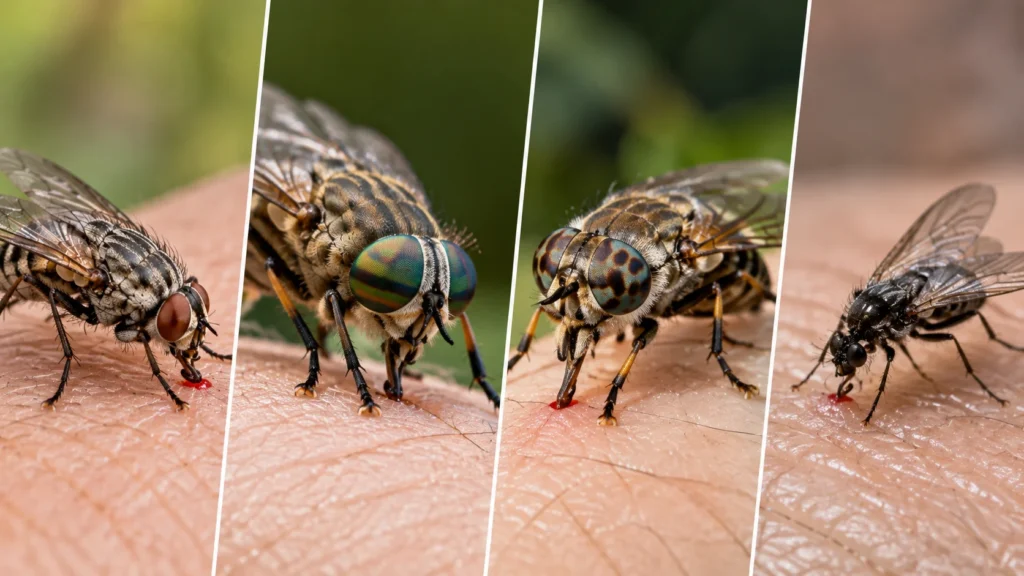
Several other fly groups, however, are important biting pests.
Stable Flies
Stable flies are approximately 1/4 inch long and are sometimes called biting house flies. Both males and females feed on blood and can inflict painful bites on people, horses, cattle, and other warm-blooded animals.
They are commonly associated with animal facilities and moist organic material such as manure, soiled bedding, and rotting vegetation.
Horse Flies
Horse flies are large, stout biting flies that can reach roughly 1 inch in length. They are strong daytime fliers and are commonly associated with wetlands, swamps, and other moist environments where their larvae develop.
Female horse flies require blood meals for egg production and can deliver painful bites.
Deer Flies
Deer flies are related to horse flies and are also active during daylight. They are generally smaller and can be persistent around people and animals near wet habitats.
Like horse flies, their larvae develop in moist environments, while adults seek blood meals from suitable hosts.
Black Flies
Black flies are very small, gnat-like flies, with some species around 1/16 inch long. They are associated with flowing water during their immature stages and can become significant biting pests around people and animals.
Types of Flies Found Around Homes
Different types of flies can appear indoors for very different reasons. Identifying the source is usually more useful than treating every fly as the same pest.
Common House Flies
House flies are commonly associated with garbage, animal waste, manure, and other moist organic material. Keeping waste contained and removing breeding material can reduce their numbers.
Fruit Flies
Fruit flies commonly appear around kitchens when ripe or fermenting produce and liquids are available. Refrigerating or discarding overripe produce and cleaning containers can eliminate important breeding sources.
Drain Flies
Drain flies are particularly associated with bathrooms, kitchens, floor drains, and plumbing areas. Their presence usually points toward accumulated organic material and moisture rather than a problem with food.
Cluster Flies
Cluster flies may enter homes through openings and sheltered spaces, particularly during cooler seasons. They are nuisance pests and do not normally reproduce inside homes.
Explore more articles:
- Fruit Flies vs Gnats
- Rat vs Mouse
- Bugs That Look Like Flying Termites
- Bugs That Look Like Fleas
- What Do Fleas Look Like?
- Wood Ants vs Termites
Types of Flies With Different Colors
Color can provide a useful clue, but it should not be used as the only identification feature because lighting and species variation can make similar flies appear different.
Green Flies
Green bottle flies are generally metallic green or greenish-blue members of the blow fly family. Their coloration is often one of their most recognizable features.
They are commonly associated with decomposing animal material, garbage, and other organic sources.
Black Flies
The term black fly can refer to small dark flies in the family Simuliidae. They are typically tiny and may resemble gnats. Their larvae develop in flowing water, and adults can bite during daylight.
Gray Flies
House flies, cluster flies, face flies, and several other species can appear gray. Identification therefore requires additional characteristics such as stripes, hair, body shape, size, and habitat.
Types of Flies Associated With Cattle and Other Animals
Livestock can encounter several specialized fly pests, and each species tends to occupy a particular part of the animal or farm environment.
Stable flies feed on blood and commonly attack the legs. Face flies feed on secretions around the eyes and face without taking blood meals. Horn flies are blood-feeding pasture flies that commonly remain on the backs, sides, and bellies of cattle.
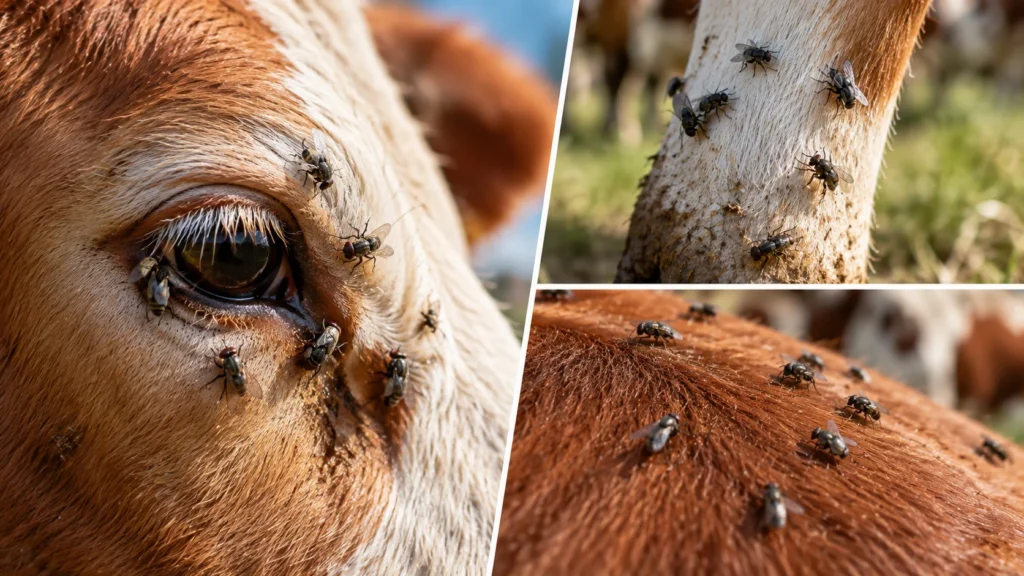
Managing manure, spilled feed, bedding, rotting vegetation, and other breeding materials is an important part of reducing fly pressure around livestock.
Types of Fly Fishing Flies
The phrase types of flies for fly fishing refers to artificial fly patterns rather than biological species of true flies. These artificial flies imitate aquatic insects, baitfish, terrestrial insects, and other food sources for fish.
Dry Flies
Dry flies are designed to float on or near the water surface and often imitate adult insects or terrestrial insects. Their use is especially associated with trout feeding at the surface.
Nymph Flies
Nymph patterns are fished below the surface and imitate immature aquatic insects such as mayflies, stoneflies, and other organisms. Nymphing is widely used because trout frequently feed below the surface.
Streamers
Streamers are larger artificial flies intended to imitate baitfish, leeches, crayfish, or other substantial prey. They are commonly fished with movement designed to attract predatory fish.
Emergers
Emerger patterns imitate aquatic insects moving from their immature underwater stage toward the adult stage. They are generally fished in or just below the surface film.
Different Types of Flies and Their Names
The following groups represent some of the most useful names to recognize when identifying flies around homes and outdoor areas:
| Fly type | Typical appearance | Common association |
| House fly | Gray with four dark thoracic stripes | Garbage, manure, buildings |
| Fruit fly | Tiny, tan/brown, often red-eyed | Fermenting fruit and liquids |
| Drain fly | Tiny, dark, fuzzy | Drains and wet organic buildup |
| Blow fly | Metallic blue, green, or copper | Decaying animals and waste |
| Cluster fly | Grayish-black with yellowish hairs | Homes in fall and spring |
| Stable fly | Gray, house-fly-like | Livestock, manure, bedding |
| Horse fly | Large and stout | Wetlands and animals |
| Deer fly | Medium-sized biting fly | Wet habitats and animals |
| Black fly | Tiny, dark, gnat-like | Flowing water and hosts |
| Face fly | Gray with dark thoracic stripes | Cattle and horses |
These groups have different habitats and feeding behaviors, so identifying the breeding or feeding source is an important part of fly identification.
Types of Flies in Different U.S. Regions
Fly species occur throughout the United States, but local abundance varies with climate, habitat, season, and available breeding material. California, Texas, Florida, Michigan, Ohio, and Wisconsin can all have different local fly communities.
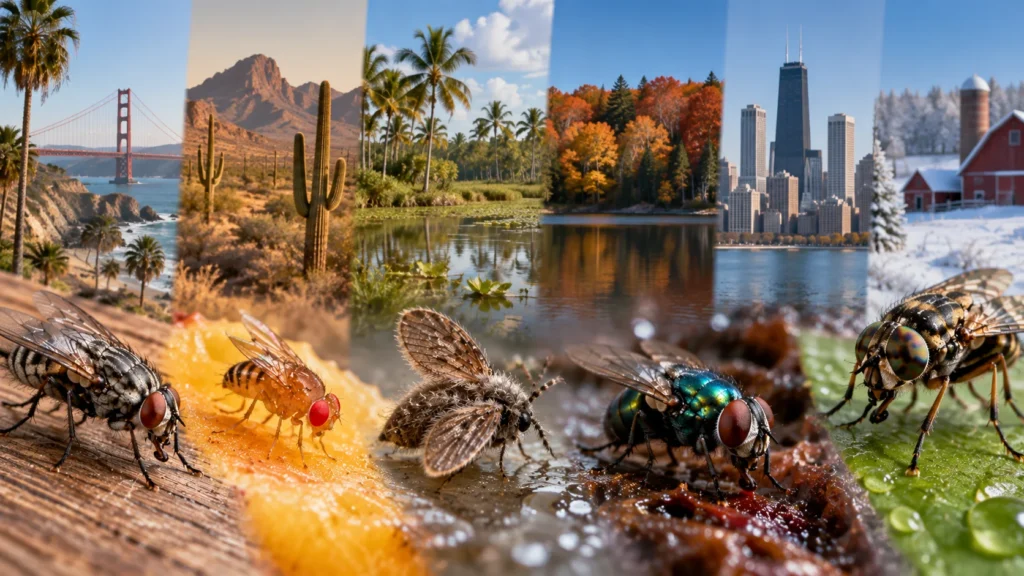
A fly found in a home in California may therefore require different identification considerations from one found around livestock or wetlands in another state. Regional extension resources and local insect identification services can provide more precise species information.
Dangerous Types of Flies
Most flies encountered inside homes are nuisance pests rather than insects that actively attack people. House flies can mechanically transfer disease-causing organisms because of their association with contaminated material, while fruit and drain flies are primarily nuisance pests.
Biting flies such as stable flies, horse flies, deer flies, and black flies can cause painful bites and may be more significant around livestock or outdoor activities.
10 Important Facts About Different Types of Flies
- House flies are gray and typically have four dark stripes on the thorax.
- Fruit flies are extremely small and are commonly attracted to fermenting fruits and liquids.
- Drain flies have hairy bodies and wings that give them a fuzzy, moth-like appearance.
- Blow flies can have metallic green, blue, or copper bodies.
- Cluster flies commonly enter homes during cooler seasons.
- Stable flies bite people and livestock and feed on blood.
- Horse flies and deer flies are larger daytime biting flies.
- Black flies are tiny and associated with flowing water during their immature stages.
- Face flies do not bite but commonly feed around the faces of cattle and horses.
- Dry flies, nymphs, streamers, and emergers are artificial fly-fishing categories, not biological species of flies.
Conclusion
The types of flies found around homes, kitchens, bathrooms, farms, gardens, and outdoor areas can look surprisingly similar, but their habits provide useful identification clues. House flies are associated with waste and decaying organic material, fruit flies with fermenting produce, drain flies with wet drains, and blow flies with decomposing animal material.
Biting species such as stable flies, horse flies, deer flies, and black flies behave differently and are more commonly encountered around livestock, wetlands, vegetation, and outdoor environments.
The term fly is also used in fly fishing to describe artificial patterns such as dry flies, nymphs, streamers, and emergers. These are fishing lures rather than biological fly species. Understanding the difference makes it easier to interpret the many meanings associated with the keyword types of flies.
How many types of flies are there?
There are many thousands of fly species worldwide. The term includes a very large group of true flies within the order Diptera, ranging from tiny fruit flies to large horse flies.
What are the most common types of flies in a house?
Common household flies include house flies, fruit flies, drain flies, and cluster flies. Blow flies and other species can also enter buildings depending on the available food or breeding source.
What are the tiny types of flies in a kitchen?
Fruit flies are common tiny kitchen flies, especially around ripe or fermenting fruit, vegetables, sugary liquids, and trash.
What are the tiny flies in a bathroom?
Drain flies are common tiny flies found around bathroom sinks, showers, and drains. Their bodies and wings are covered with fine hairs, creating a fuzzy appearance.
Which types of flies bite?
Stable flies, horse flies, deer flies, black flies, and several other groups can bite people or animals. House flies and fruit flies do not take blood meals.
What are green flies?
Green bottle flies are metallic green members of the blow fly family. They are commonly associated with decaying animal material, garbage, and other decomposing organic matter.
What are the largest common types of flies?
Horse flies and some related large biting flies can reach around 1 inch in length. Their size is substantially greater than common house flies and fruit flies.
What are the common types of fly fishing flies?
Common artificial fly categories include dry flies, nymphs, emergers, and streamers. These patterns imitate different types of aquatic insects or other prey.
What are the most common types of flies around cattle?
Stable flies, house flies, face flies, and horn flies are important fly groups associated with cattle. Their feeding behavior and preferred locations on the farm differ by species.
Are all flies dangerous?
No. Many flies are primarily nuisance insects. Some can contaminate food or mechanically transfer microorganisms, while biting flies can cause painful bites and irritation. The potential significance depends on the fly species and circumstances.