
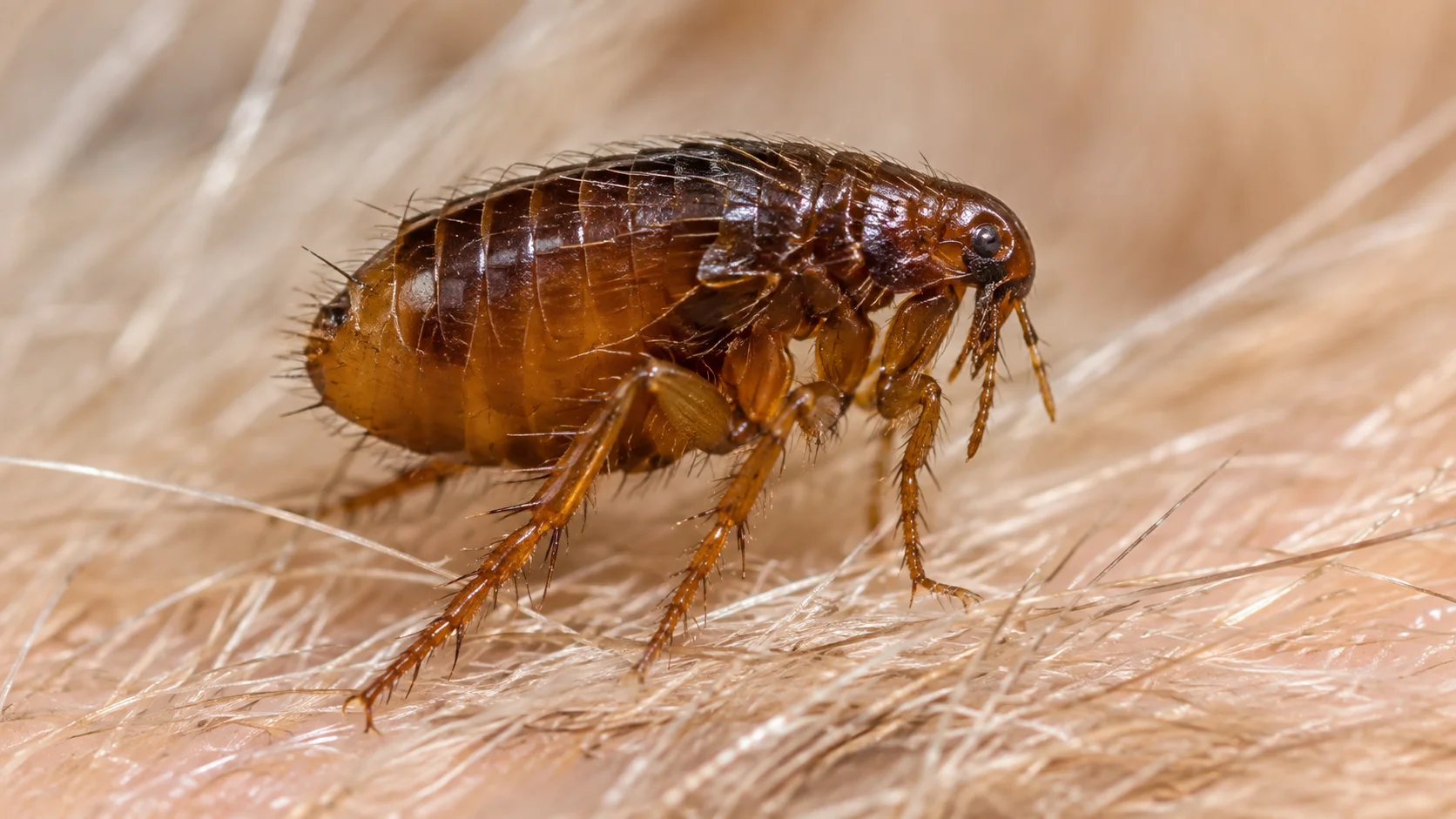
There are thousands of flea species worldwide, but only a relatively small number commonly affect people, pets, or public health. Fleas are tiny, wingless insects adapted for feeding on blood, and their flattened bodies and powerful hind legs allow them to move efficiently through fur and jump between hosts. The CDC reports more than 2,500 flea species worldwide and more than 300 species in the United States.
The cat flea (Ctenocephalides felis) is the species most commonly associated with household infestations in North America. Dog fleas, human fleas, Oriental rat fleas, ground squirrel fleas, sticktight fleas, and chigoe fleas are other important species or groups with different hosts, distributions, and behaviors.
Major Types of Fleas Found on People and Animals
Different types of fleas vary in their preferred hosts, appearance, geographic distribution, and medical importance. Some are primarily associated with domestic pets, while others depend on rodents, birds, wildlife, or humans.
Cat Fleas
The cat flea (Ctenocephalides felis) is the most common flea associated with cats and dogs in many regions, including North America. Despite its name, it is not restricted to cats and can feed on dogs, humans, and several wild or domestic mammals.
Adult cat fleas are reddish-brown to dark brown, laterally compressed, wingless, and roughly 1–4 mm long. Their flattened bodies help them move through animal fur, while their enlarged hind legs are specialized for jumping.
Dog Fleas
The dog flea (Ctenocephalides canis) is a genuine flea species distinct from the cat flea. It primarily uses dogs as hosts but can also feed on other mammals, including people.
Dog fleas look extremely similar to cat fleas, and distinguishing the two species usually requires microscopic examination of anatomical characteristics. In North America, many flea infestations on dogs are actually caused by cat fleas rather than dog fleas.
Human Fleas
The human flea (Pulex irritans) is associated primarily with humans but can also feed on other mammals. It is less commonly encountered in highly industrialized areas than the cat flea.
Human fleas are small, laterally compressed insects that lack the prominent combs found on Ctenocephalides species. Their bites can cause itchy skin reactions, although the presence of flea bites does not by itself establish which flea species is responsible.
Oriental Rat Fleas
The Oriental rat flea (Xenopsylla cheopis) is strongly associated with rodents, particularly rats. It is especially important from a public-health perspective because it is a major vector of Yersinia pestis, the bacterium responsible for plague.
This flea is generally about 1.5–4 mm long and lacks the genal and pronotal combs present in cat and dog fleas.
Ground Squirrel Fleas
The ground squirrel flea (Oropsylla montana) is another medically important flea in the United States. It is associated with rodents such as ground squirrels and has particular relevance in western regions where plague circulates among wild rodent populations.
Its importance is therefore more closely connected with wildlife and rodent exposure than with ordinary household flea infestations.
Sticktight Fleas
The sticktight flea (Echidnophaga gallinacea) is associated with birds and mammals and can affect poultry, squirrels, and other animals. Unlike the typical jumping behavior of household cat fleas, adult sticktight fleas can remain attached to their host for extended periods.
People who have close contact with infested birds or poultry can also be exposed.
Chigoe Fleas
The chigoe flea (Tunga penetrans) is a distinctive flea species associated with tropical and subtropical environments. Unlike ordinary household fleas, the female chigoe flea can burrow into the skin of its host.
This species is therefore biologically and medically different from the cat flea commonly found on household pets.
Flea Identification Features
Identifying different types of fleas can be difficult because many species are extremely small and have similar reddish-brown or dark coloration. Species-level identification often requires magnification and examination of specific anatomical structures.
Adult Flea Characteristics
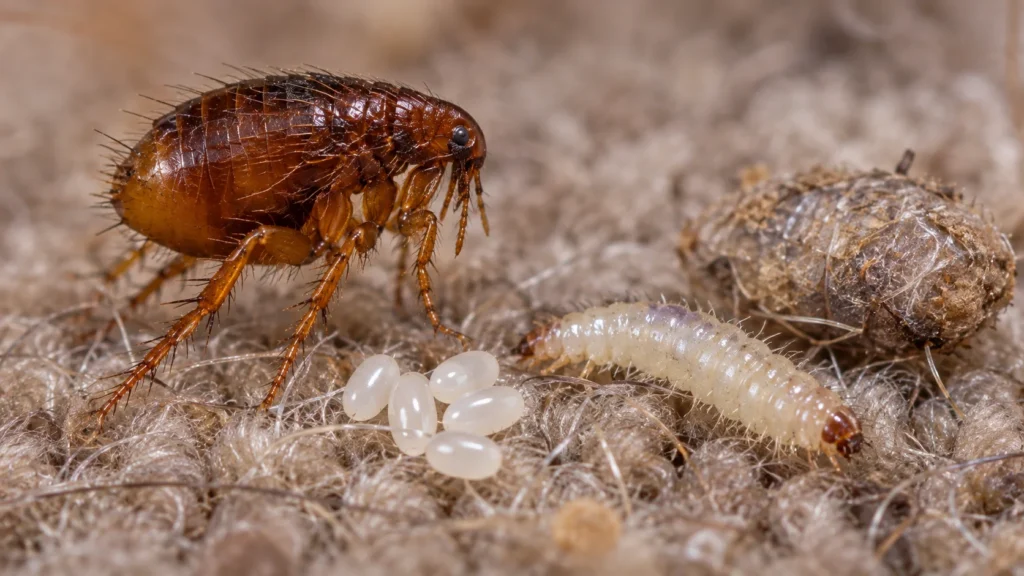
Most adult fleas share several recognizable features:
- Wingless body
- Laterally compressed shape
- Small size
- Reddish-brown to dark coloration
- Six legs
- Enlarged hind legs
- Piercing and sucking mouthparts
- Body structures adapted for moving through fur or feathers
Adult fleas generally measure only a few millimeters, making them difficult to identify accurately with the naked eye.
Flea Eggs, Larvae, and Pupae
Flea identification should also account for immature stages. Fleas have a complete life cycle consisting of egg, larva, pupa, and adult. Eggs are generally laid on the host but fall into the surrounding environment, where larvae develop.
Flea larvae are small, pale, worm-like organisms without legs and do not feed on blood. They develop in protected environmental locations such as carpeting, cracks, furniture, bedding, and areas where an infested animal rests.
Types of Fleas on Dogs and Cats
Dogs and cats can host several flea species, but the cat flea is the dominant household flea in many areas. The common name of the flea does not always correspond to the animal carrying it.
Fleas Commonly Found on Dogs
Dogs can host:
- Cat fleas
- Dog fleas
- Human fleas
- Certain wildlife-associated fleas
- Regional rodent or wildlife fleas
The cat flea is particularly important because it readily feeds on dogs even though its common name refers to cats.
Fleas Commonly Found on Cats
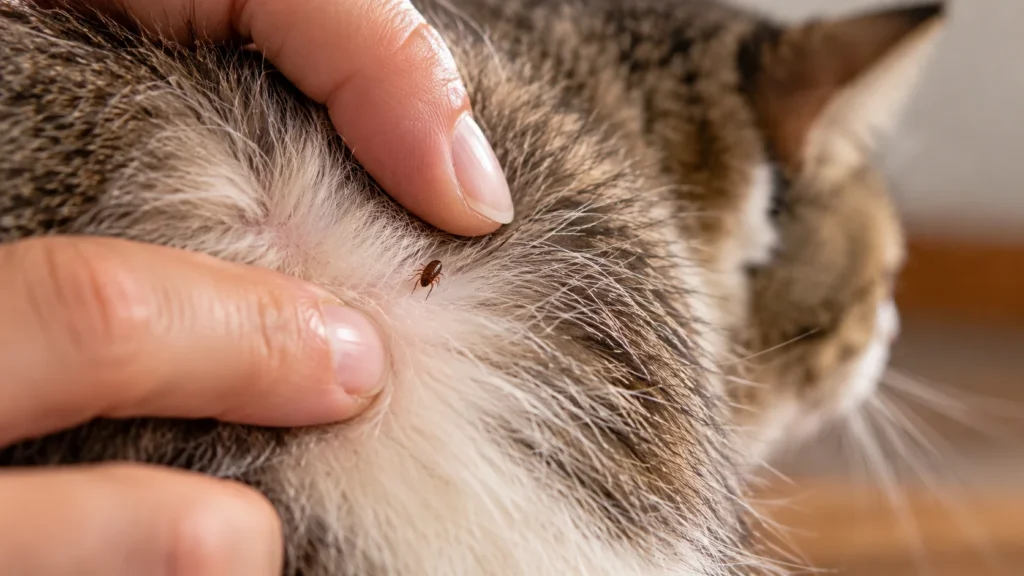
Cats are particularly susceptible to cat fleas, which can reproduce successfully in homes and surrounding environments. Fleas can also move between cats, dogs, wildlife, and people when hosts share the same environment.
Finding fleas on a cat therefore does not automatically mean that the infestation is limited to the animal. Eggs, larvae, and pupae can develop in the surrounding environment.
Types of Fleas That Bite Humans
Several flea species can feed on humans. The CDC specifically identifies the cat flea, dog flea, human flea, ground squirrel flea, and Oriental rat flea among fleas relevant to human health in the United States.
People can also be bitten by cat fleas when an infested pet is present or when emerging adult fleas encounter a person. Fleas detect potential hosts through cues such as body heat, movement, vibrations, and breathing.
Flea Bites Can Cause Itching and Irritation
Flea saliva can trigger an immune response, producing itchy red spots or welts. Some pets can develop flea allergy dermatitis, while people may experience varying degrees of irritation.
Certain flea species can also participate in the transmission of pathogens or parasites. The CDC lists flea-associated diseases and infections including plague, murine typhus, and cat-scratch disease.
Types of Fleas in Houses
The cat flea is the flea most commonly associated with household infestations. Adults usually feed on pets or other warm-blooded hosts, while immature stages develop in the environment.
Fleas Can Develop in Carpets and Bedding
Flea eggs fall from an infested animal into areas where that animal rests. Larvae can then develop in carpets, rugs, bedding, cracks, furniture, and other protected locations.
This explains why treating only an animal may not completely resolve a household infestation. Environmental stages can continue developing and produce new adult fleas.
Pets Are an Important Source of Household Fleas
Dogs and cats can introduce fleas after contact with infested animals or environments. Outdoor exposure, wildlife, and untreated pets can all contribute to recurring flea activity. The CDC recommends regular flea checks and veterinary guidance for appropriate flea-control products.
Regional Flea Types in Texas, Florida, and Other Areas
Flea species and their importance vary by geography because different regions contain different wildlife hosts and environmental conditions.
Fleas in Texas
Texas can have several flea species because both domestic animals and wildlife provide suitable hosts. The cat flea is important around homes and pets, while rodent-associated fleas have public-health relevance in appropriate settings. The CDC notes that most U.S. murine typhus cases are reported from California, Texas, and Hawaii.
Fleas in Florida
Florida's warm climate can support flea activity for much of the year. Household infestations are commonly associated with cats and dogs, while wildlife can provide additional hosts and sources of exposure.
Fleas in New Zealand and Other Regions
Flea species vary considerably outside North America. A flea encountered in New Zealand, Australia, Europe, or another country should not automatically be assumed to be the same species commonly found in the United States.
Geographic location, host animal, habitat, and microscopic characteristics can all contribute to accurate species identification.
Explore more articles:
- Fruit Flies vs Gnats
- Rat vs Mouse
- Bugs That Look Like Flying Termites
- Bugs That Look Like Fleas
- What Do Fleas Look Like?
Fleas and Ticks Are Different Parasites
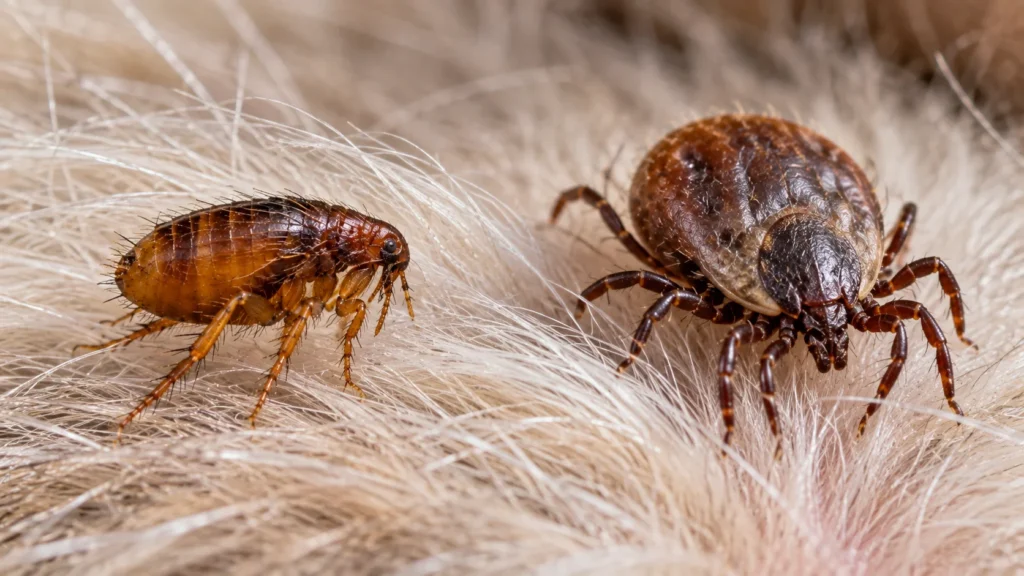
Fleas and ticks are sometimes grouped together because both can feed on blood, but they are biologically different organisms.
Fleas are wingless insects with six legs as adults and laterally compressed bodies. Ticks are arachnids related to spiders and have eight legs as adults. Fleas primarily move by jumping, while ticks typically crawl and attach to hosts.
Flea and Tick Problems Can Occur Together
Dogs and cats can encounter both fleas and ticks, particularly when they spend time outdoors. A parasite-control program should therefore be selected with the animal's lifestyle and local risks in mind.
Veterinarians can recommend appropriate products for pets, while environmental control may be necessary when an established household flea infestation is present.
Sand Fleas and Beach Fleas Need Careful Identification
The term sand flea is used for several unrelated organisms. Some beach-dwelling creatures commonly called sand fleas are actually small crustaceans rather than true fleas.
The chigoe flea (Tunga penetrans), however, is a genuine flea species and is sometimes associated with the term sand flea. It has a distinctive life cycle involving penetration of the skin by the female.
This distinction is important because not every jumping organism found around beaches or sand is an actual flea.
How to Identify Different Fleas More Accurately
A reliable identification should consider more than the common name. Flea species can be extremely similar in appearance, particularly cat fleas and dog fleas.
Useful Identification Details
Record the following characteristics when examining a suspected flea:
- Approximate body length
- Body color
- Whether the insect has wings
- Body shape
- Host animal
- Location where it was found
- Whether it jumps
- Presence or absence of combs
- Geographic location
- Whether the specimen came from a pet, wildlife, bedding, carpet, or outdoor area
For definitive species identification, microscopic examination may be required. The CDC's diagnostic resources distinguish species using detailed structures of the head, legs, and body.
10 Key Facts About Types of Fleas
- There are more than 2,500 flea species worldwide.
- More than 300 flea species occur in the United States.
- The cat flea (Ctenocephalides felis) is the most common household flea in many areas.
- Cat fleas can infest cats, dogs, humans, and other mammals.
- The dog flea (Ctenocephalides canis) is a different species from the cat flea.
- The human flea (Pulex irritans) is less commonly encountered in industrialized areas.
- The Oriental rat flea is an important vector of plague.
- Fleas have four main life stages: egg, larva, pupa, and adult.
- Flea larvae do not feed on blood and commonly develop in the environment around host resting areas.
- The term sand flea can describe different organisms, so beach fleas should not automatically be classified as true fleas.
Conclusion
There are many different types of fleas, but only a smaller group commonly affects household pets, people, or public health. Cat fleas are particularly important because they can infest both cats and dogs and readily persist in homes. Dog fleas, human fleas, Oriental rat fleas, ground squirrel fleas, sticktight fleas, and chigoe fleas have different host relationships and biological characteristics.
Correct identification matters because flea species differ in their preferred hosts, geographic distribution, behavior, and health significance. When fleas are found on a dog or cat, treating the animal and addressing the surrounding environment are both important parts of effective control. Veterinary guidance is recommended when selecting flea-control products for pets.
Are there different types of fleas?
Yes. Scientists have identified more than 2,500 flea species worldwide, with more than 300 occurring in the United States. Only a relatively small number commonly affect humans, pets, or public health.
How many types of fleas are there?
There are more than 2,500 described flea species worldwide. Approximately 300 or more occur in the United States, depending on the taxonomic source and geographic definition.
What are the most common types of fleas on dogs?
Cat fleas are the most common fleas associated with dogs in many parts of North America. True dog fleas also exist, but they are less commonly encountered in many North American household infestations.
What are the main types of fleas on cats?
The cat flea is the primary flea species associated with domestic cats. Other flea species can occur depending on geographic location, wildlife exposure, and environmental conditions.
Can different types of fleas bite humans?
Yes. Cat fleas, dog fleas, human fleas, Oriental rat fleas, ground squirrel fleas, and some other species can feed on humans.
Are cat fleas and dog fleas the same?
No. The cat flea is Ctenocephalides felis, while the dog flea is Ctenocephalides canis. They are different species and are extremely similar in appearance, making microscopic identification useful.
What type of flea is most common in houses?
The cat flea is the species most commonly associated with household flea infestations, particularly where dogs or cats are present.
What are the different types of fleas with pictures?
Common flea identification resources typically illustrate the cat flea, dog flea, human flea, and Oriental rat flea because these species have important relationships with people, pets, rodents, or public health. The CDC provides diagnostic images and species information for several medically important fleas.
What types of fleas are found in Texas?
Texas can have household cat fleas as well as other flea species associated with domestic animals and wildlife. Flea species of public-health importance also occur in the region, including vectors associated with murine typhus and rodent hosts.
What types of fleas are found on dogs and cats?
Dogs and cats can host cat fleas, while dogs can also host true dog fleas and other regionally occurring flea species. Cat fleas are particularly important because they readily feed on both dogs and cats.