
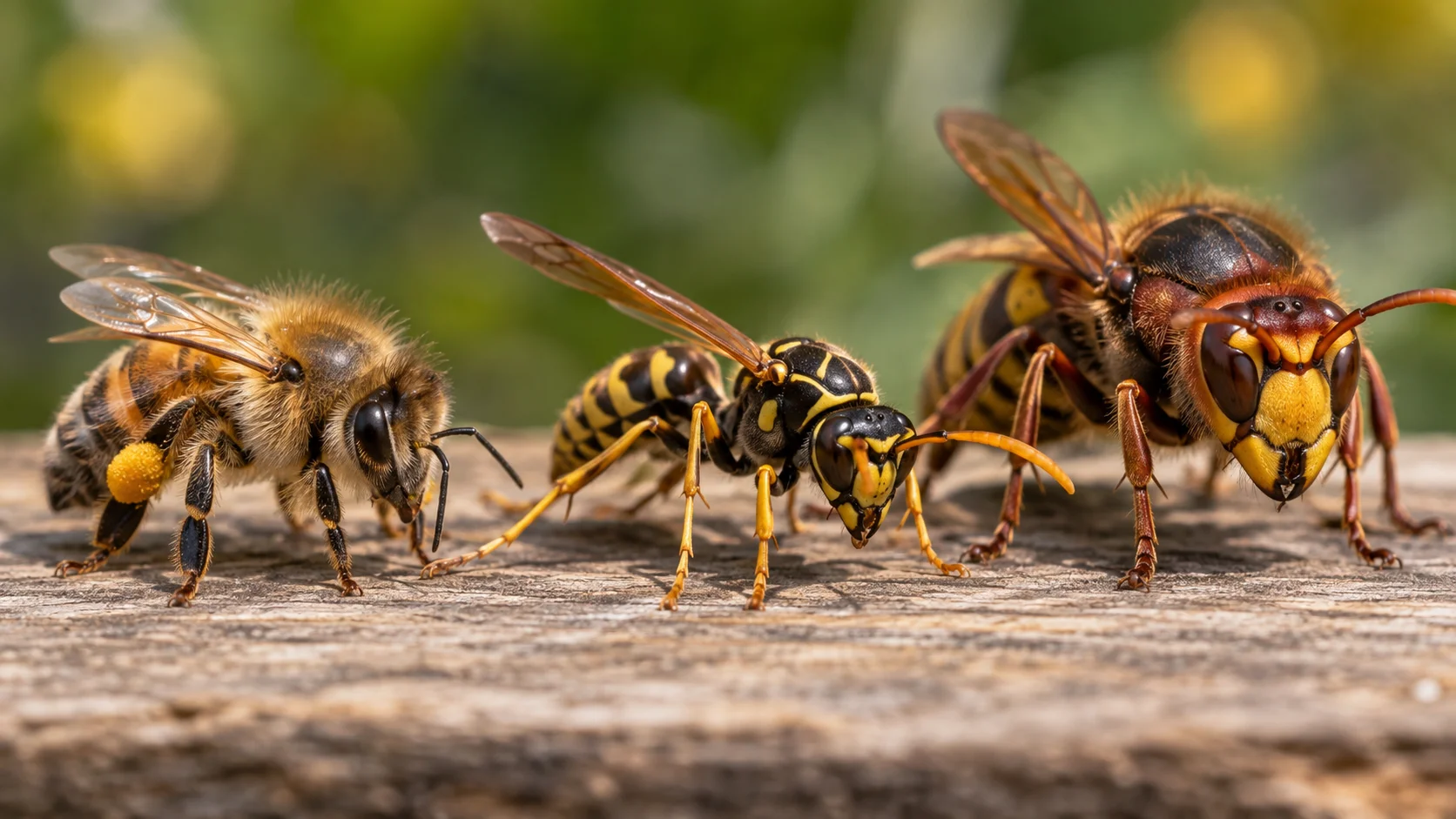
The terms bee, wasp, and hornet are often used interchangeably, but these insects have important differences in appearance, nesting behavior, feeding habits, and defensive behavior. A close look at body hair, waist shape, wings, coloration, and nest structure can provide useful identification clues.
Bees are generally recognized by their hairy bodies and pollen-collecting structures, while many wasps have smooth bodies and noticeably narrower waists. Hornets are actually a specialized group of wasps rather than a completely separate insect group.
Understanding these distinctions is especially useful when identifying an insect around a home, garden, picnic area, wall cavity, or nest.
Bee vs Wasp vs Hornet at a Glance
Although individual species vary considerably, the basic differences can be summarized by body structure, hair, feeding habits, and nesting.
| Feature | Bees | Wasps | Hornets |
| Body | Usually hairy | Usually smooth | Usually smooth |
| Waist | Less narrow | Narrow | Narrow |
| Main food | Nectar and pollen | Insects, nectar, or other foods depending on species | Primarily insects and other animal food for young |
| Wings | Two pairs | Two pairs | Two pairs |
| Pollen collection | Common | Generally absent | Absent |
| Typical appearance | Fuzzy or hairy | Slender and smooth | Larger, robust wasp-like body |
| Nest types | Wax comb, cavities, underground sites | Paper, mud, ground, cavities, depending on species | Usually paper nests |
| Sting | Species-dependent | Many can sting repeatedly | Can sting repeatedly |
Bees and wasps both have two pairs of wings, but bees are generally hairier and are adapted for collecting pollen. Wasps are typically smoother and have slender bodies.
Bee Identification Features
Bees include thousands of species with substantial variation in size, color, and body shape. Honey bees and bumble bees are among the most familiar examples, but many native bees look quite different from the classic yellow-and-black honey bee.
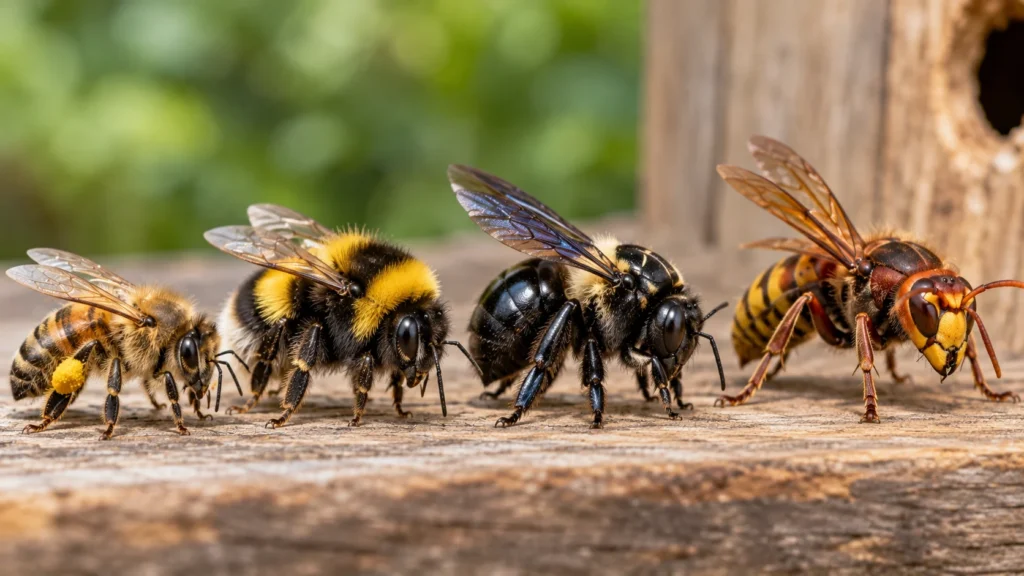
Honey Bee vs Hornet
Honey bees are relatively slender, hairy insects with golden-brown coloration and darker abdominal stripes. Workers are commonly about 1/2 to 5/8 inch long. They collect pollen and nectar and can establish nests inside suitable cavities, including wall voids.
Hornets have a smoother appearance and generally more substantial bodies. European hornets, for example, can reach around 1 to 1.5 inches depending on caste and have brown, yellow, and dark markings.
Bumble Bee vs Hornet
Bumble bees are stout and heavily hairy, commonly measuring about 3/8 to 3/4 inch, with queens sometimes reaching approximately 1 inch. Their bodies are typically black and yellow or black and orange.
A hornet generally looks smoother and more elongated than a bumble bee. The difference becomes especially noticeable when the insects are photographed side by side.
Carpenter Bee vs Hornet
Carpenter bees can appear large and intimidating because of their size and hovering behavior around buildings. Unlike bumble bees, carpenter bees have a shiny, mostly hairless upper abdomen, while bumble bees have a fully hairy abdomen.
Carpenter bees also excavate nests in wood, whereas hornets construct paper nests rather than creating wooden galleries.
Wasp Identification Features
Wasps represent a much broader group than hornets. Some are social and defend colonies, while many solitary wasps spend most of their lives hunting insects or spiders and rarely bother people.
Wasp vs Bee
The easiest visual distinction is usually the amount of body hair. Bees tend to have noticeable hair, especially around the thorax and legs, while wasps generally have smooth, shiny bodies with relatively few hairs. Bees may also carry visible pollen on their hind legs.
Wasps commonly have a more pronounced narrow waist, although body shape differs among species.
Wasp vs Hornet
A hornet is a type of wasp, so these categories overlap biologically. True hornets belong to the genus Vespa, while the broader wasp group includes yellowjackets, paper wasps, and many solitary wasps.
Size and body build can help with everyday identification, but common names can cause confusion. For example, the insect commonly called the bald-faced hornet is actually an aerial yellowjacket rather than a true Vespa hornet.
Hornet Identification Features
True hornets are social wasps with relatively large, robust bodies. In the United States, the European hornet (Vespa crabro) is the only true hornet established nationally according to University of Maryland Extension.
Bald-Faced Hornet Appearance
The bald-faced hornet is mostly black with white markings on the face and abdomen. Workers are generally around 5/8 to 3/4 inch long, while queens are larger.
Despite its common name, this insect belongs to Dolichovespula and is technically an aerial yellowjacket. It builds an enclosed paper nest, commonly in trees, shrubs, or around structures.
European Hornet Appearance
European hornets are larger than typical yellowjackets, with workers commonly around 3/4 to 1 inch and queens reaching approximately 1.2 to 1.4 inches. Their coloration includes brown, yellow, and dark markings.
Their nests are made from paper-like material and may occur in protected cavities or other suitable locations.
Bee vs Wasp vs Hornet Size
Size can provide a useful first clue, but it should not be used by itself because different species overlap in size.
Honey bees are commonly around 1/2 to 5/8 inch long, while bumble bees may range from roughly 3/8 to 3/4 inch, with queens reaching about 1 inch.
Yellowjackets generally range from about 3/8 to 5/8 inch according to University of Minnesota Extension, while European hornet workers can approach 1 inch and queens are larger.
Explore more articles:
- Fruit Flies vs Gnats
- Rat vs Mouse
- Bugs That Look Like Flying Termites
- Bugs That Look Like Fleas
- What Do Fleas Look Like?
Bee Hive vs Wasp Nest vs Hornet Nest
Nest architecture can be one of the most useful identification clues because different groups construct very different structures.
Bee Hive
Honey bees construct wax comb made from hexagonal cells. Colonies may occupy hollow trees, wall cavities, or other protected spaces.
Bumble bees use different nesting locations and commonly occupy abandoned burrows or other sheltered cavities rather than constructing the large exposed wax structures associated with managed honey bee colonies.
Wasp Nest
Paper wasps construct open-comb nests with visible cells, often underneath eaves or other protected structures. Yellowjackets commonly construct enclosed paper nests, including nests underground or inside wall cavities.
Hornet Nest
European hornets and aerial yellowjackets construct paper nests using chewed wood fibers mixed with saliva. Bald-faced hornet nests are usually enclosed and grayish, while European hornet nests may occur in protected cavities.
Bee Sting vs Wasp Sting vs Hornet Sting
Stinging behavior varies by species, circumstances, and whether an insect is defending its nest. A bee or wasp encountered while foraging does not necessarily behave like an insect whose colony has been disturbed.
Honey bee workers have barbed stingers and generally sting once before dying. Many wasps and hornets have smooth stingers and can sting repeatedly. Bald-faced hornets, for example, can sting repeatedly when defending their nests.
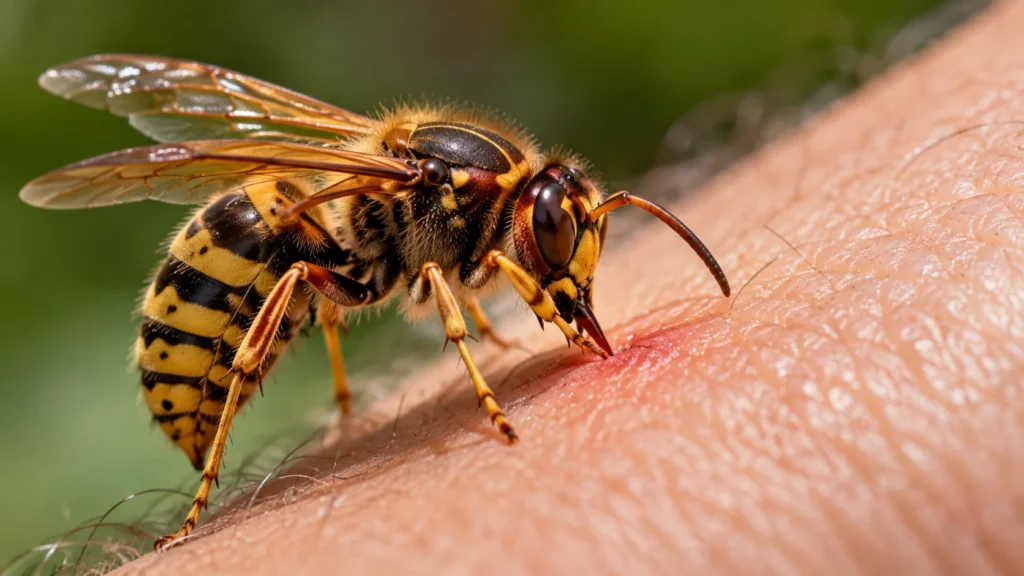
Stings can cause localized pain, redness, and swelling. Some people can experience serious allergic reactions, so difficulty breathing, swelling of the throat or tongue, dizziness, or other signs of anaphylaxis require immediate emergency medical attention.
Bee vs Wasp vs Hornet Feeding Habits
Bees primarily obtain food from flowers, collecting nectar and pollen. Pollen is especially important because it provides protein and other nutrients used in raising young.
Many wasps hunt insects or spiders, while yellowjackets may also scavenge human food, garbage, meat, and sugary substances.
Hornets are predatory wasps that capture insects and spiders to feed developing young. Adult social wasps may also consume sugary liquids and other food sources depending on species and season.
Bee vs Wasp vs Hornet Nest Locations
Nesting location can provide valuable supporting evidence when an insect is difficult to identify.
Honey bees may establish colonies inside tree cavities or wall voids. Bumble bees commonly use underground or protected cavities.
Yellowjackets may nest underground, inside wall cavities, or in enclosed aerial nests. Paper wasps commonly build open nests beneath eaves and other protected structures. Hornets and aerial yellowjackets may construct large paper nests in trees or on buildings.
Bee vs Wasp vs Hornet Stings and Nest Safety
A visible nest should not be disturbed simply to confirm its identity. Social wasps and hornets can defend their colonies when they perceive a threat, and nest disturbance can trigger defensive behavior.
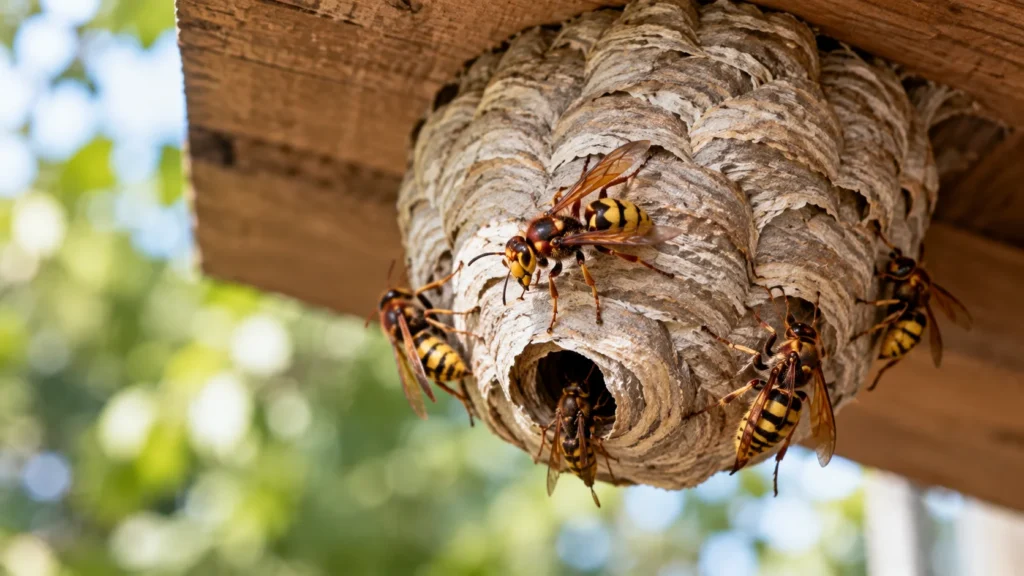
If a nest is close to a doorway, play area, workplace, or another high-traffic location, professional identification and removal can reduce the risk of multiple stings. People with known severe sting allergies should take particular care around active nests.
10 Key Differences Between Bees, Wasps, and Hornets
- Bees are generally hairier than wasps and hornets.
- Wasps usually have smoother bodies with fewer visible hairs.
- Hornets are a specialized type of wasp, not an entirely separate insect group.
- True hornets belong to the genus Vespa.
- Bald-faced hornets are technically aerial yellowjackets, despite their common name.
- Honey bees commonly carry pollen on specialized structures on their hind legs.
- Yellowjackets commonly scavenge human food and garbage.
- Bumble bees are stout and heavily hairy, making them visually distinct from many wasps.
- Honey bee hives use wax comb, while many wasps and hornets build paper nests.
- Nest disturbance can trigger defensive behavior in social bees, wasps, and hornets.
Conclusion
The bee vs wasp vs hornet comparison becomes much easier when several characteristics are considered together. Body hair, waist shape, wing structure, size, coloration, food sources, and nest architecture can all help separate these insects.
Honey bees and bumble bees generally have noticeably hairy bodies, while most wasps and hornets have smoother bodies and narrower waists. Hornets are part of the broader wasp group, and common names such as bald-faced hornet can be misleading because that insect is actually an aerial yellowjacket.
When identification involves an active nest, especially near people or inside a building, avoiding disturbance and using reliable identification information is safer than approaching the colony for a closer look.
What is the main difference between a bee and a wasp?
Bees are generally hairier and have structures adapted for collecting pollen, while wasps are usually smoother and have narrower waists.
Is a hornet a type of wasp?
Yes. True hornets are a specialized group of wasps in the genus Vespa. The broader wasp category includes many other groups, including yellowjackets and paper wasps.
What is the difference between a honey bee and a hornet?
Honey bees are smaller, hairy, golden-brown insects that collect pollen and nectar. European hornets are larger, smoother-bodied wasps with brown, yellow, and dark markings.
Are bald-faced hornets actually hornets?
Despite their common name, bald-faced hornets are technically aerial yellowjackets in the genus Dolichovespula, rather than true hornets in the genus Vespa.
Which insects have the narrowest waist?
Wasps generally have a more noticeably narrow waist than bees. The degree of constriction varies among wasp groups and species.
What does a bee hive look like compared with a wasp nest?
Honey bee colonies use wax comb, while many social wasps build nests from paper-like material made from chewed wood fibers and saliva.
Can wasps and hornets sting more than once?
Many wasps and hornets can sting repeatedly because their stingers are not barbed like the worker honey bee's stinger.
What does a bumble bee look like compared with a hornet?
Bumble bees are typically stout and very hairy, often with black and yellow or orange markings. Hornets generally have smoother, more robust wasp-like bodies.
What does a carpenter bee look like compared with a hornet?
Carpenter bees are large bees with a shiny, mostly hairless upper abdomen, whereas hornets have smooth wasp-like bodies and do not excavate wood to create their nests.
What should be done around an active bee, wasp, or hornet nest?
Avoid disturbing the nest and keep people and pets away from the immediate area. For nests in high-traffic areas or locations that require removal, professional identification and control can reduce sting risk.