
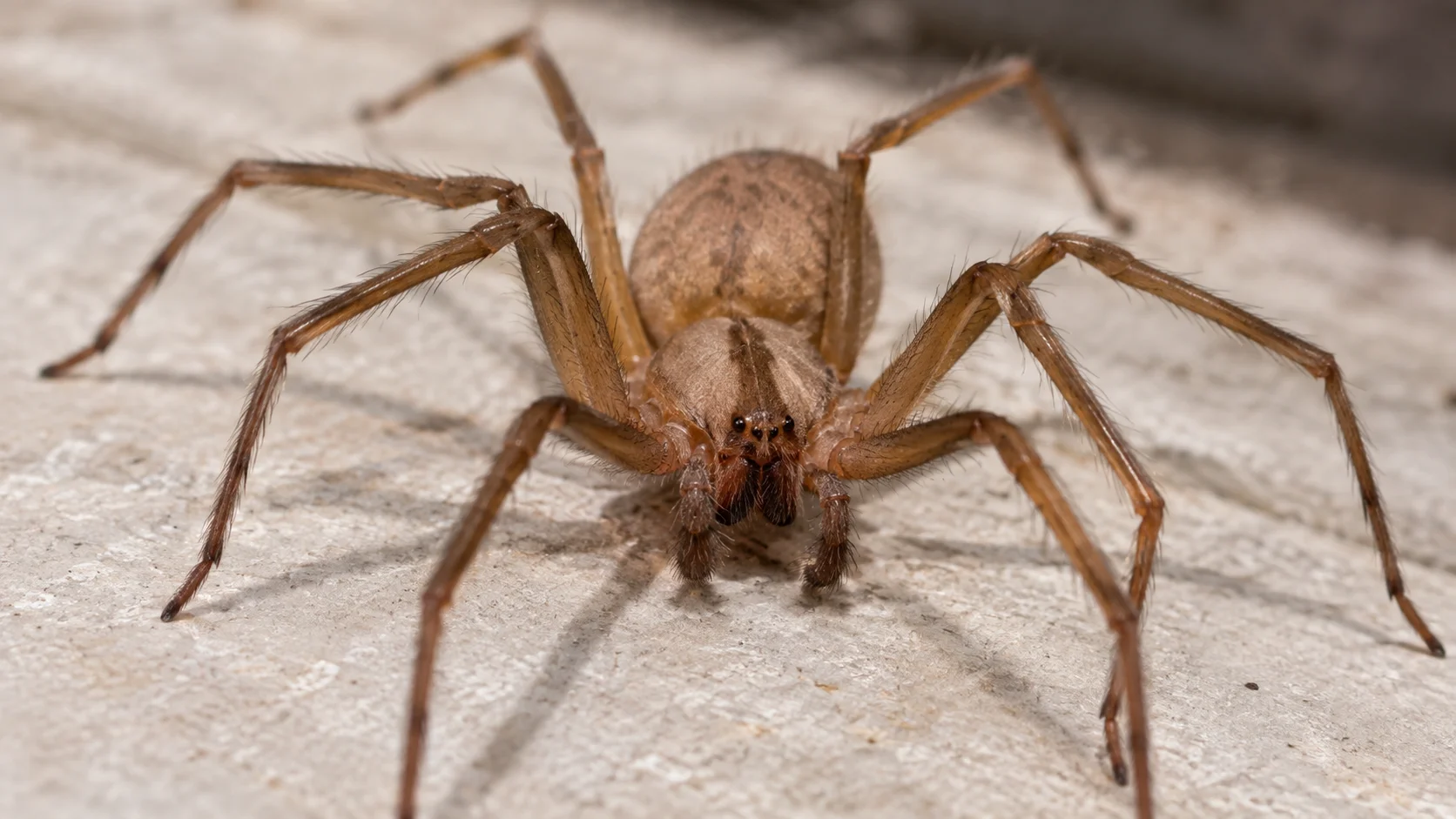
A picture of brown recluse spider can help with identification, but appearance alone is not always enough to confirm the species. Brown recluse spiders (Loxosceles reclusa) are small brown spiders recognized by several combined characteristics, including a six-eye arrangement, uniformly colored legs, and a dark violin-shaped marking on the cephalothorax.
The brown recluse is primarily associated with parts of the south-central and Midwestern United States. It commonly hides in dark, dry, undisturbed locations such as closets, boxes, woodpiles, attics, wall spaces, and areas beneath stored objects.
Because many harmless spiders are incorrectly identified as brown recluses, a reliable identification should consider eye arrangement, body size, leg markings, abdomen color, habitat, and geographic range, rather than relying only on the violin-shaped mark.
Brown Recluse Spider Picture and Main Identification Features
A typical brown recluse spider picture shows a tan to dark-brown spider with long, slender legs and a relatively plain abdomen. Its body is small, while the legs make the spider appear considerably larger. MedlinePlus gives a general overall size of about ¼ to ¾ inch, while identification references often measure the body separately from the legs.
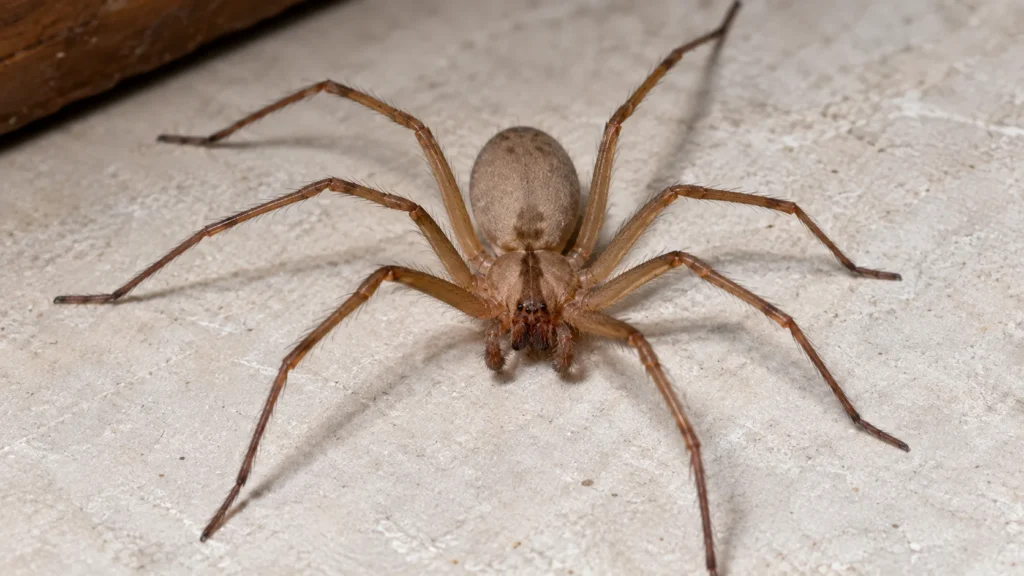
The Violin-Shaped Marking
The dark violin or fiddle-shaped marking is located on the cephalothorax, the body section where the legs attach. The narrow portion of the marking points backward toward the abdomen.
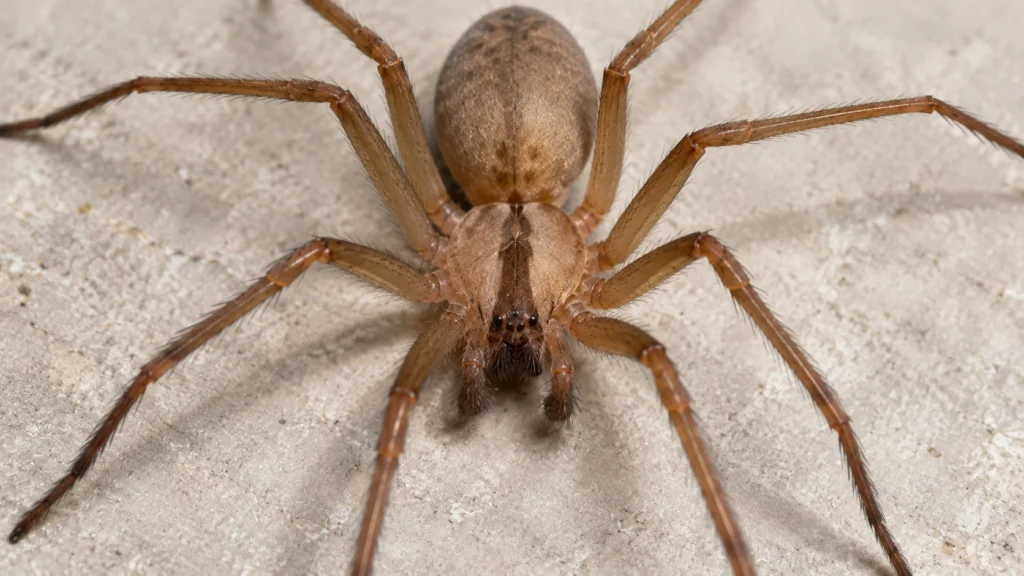
However, the violin marking should not be used by itself for identification. UC Riverside specifically warns that many ordinary spiders have markings that people interpret as violins. The eye pattern is a more useful feature when examined closely.
The Six-Eye Pattern
One of the most important characteristics of a brown recluse is its six eyes arranged in three pairs. There is one pair toward the front and one pair on each side. Most familiar spiders have eight eyes arranged differently.
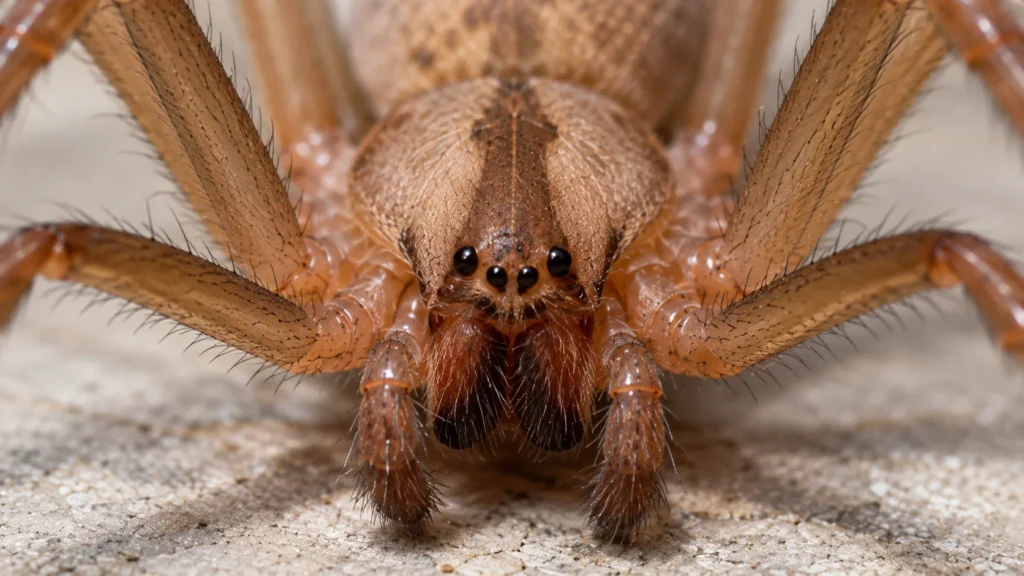
A close-up photograph or magnified specimen can make this characteristic easier to examine, although species-level identification may still require an experienced entomologist.
Close-Up Picture of a Brown Recluse Spider
A close-up picture of a brown recluse spider is particularly useful for examining features that cannot be seen clearly in ordinary photographs. The eyes, hairs on the legs, body coloration, and violin-shaped marking become easier to compare at higher magnification.
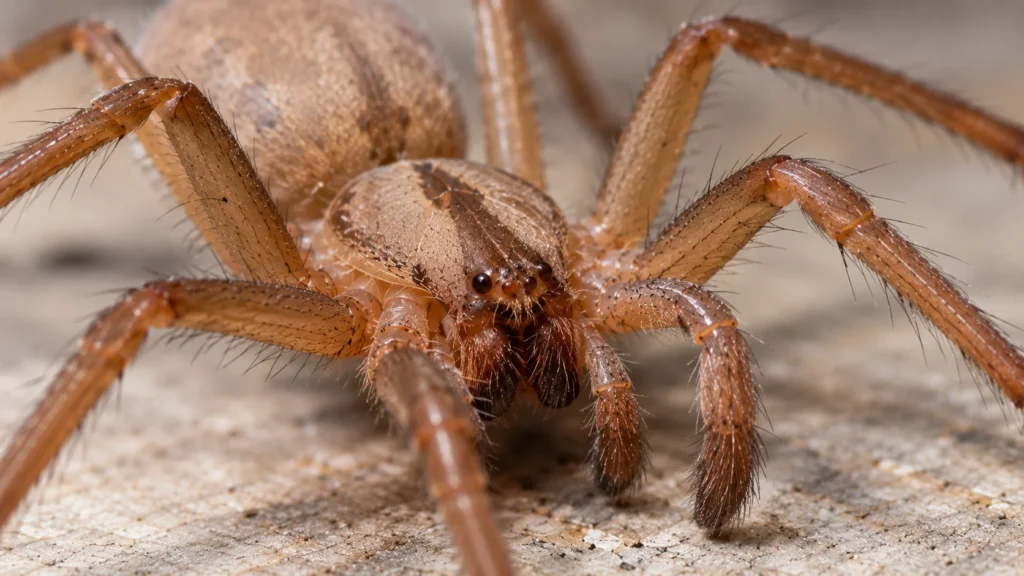
Uniform Legs Help With Identification
Brown recluse spiders have uniformly colored legs without obvious dark bands or stripes. Their legs have fine hairs rather than prominent spines. These characteristics can help separate them from several spiders that are frequently mistaken for recluses.
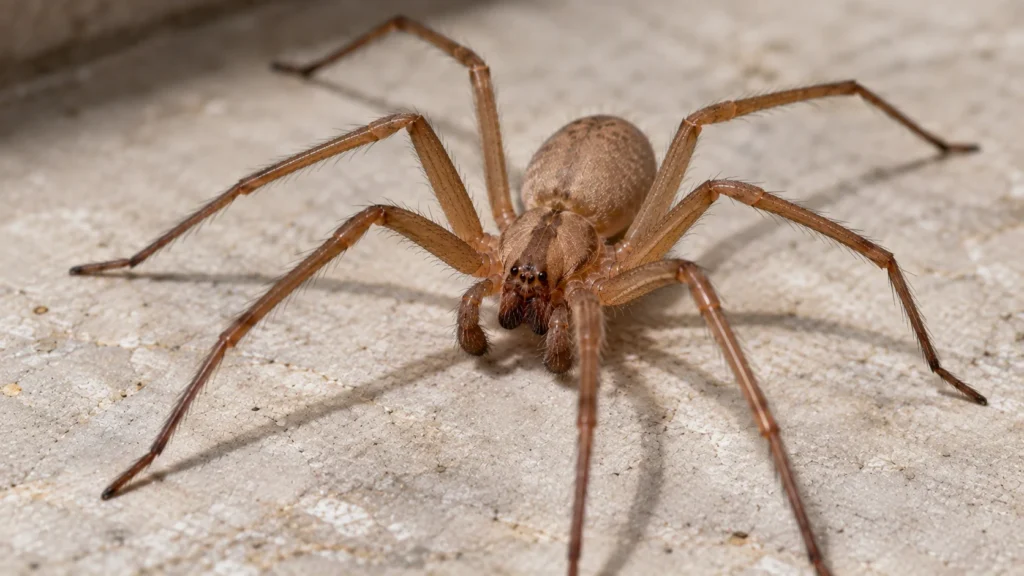
The Abdomen Has a Relatively Uniform Color
The abdomen of a brown recluse is generally a single overall color rather than displaying strong contrasting patterns. It can range from light to dark brown depending on the individual.
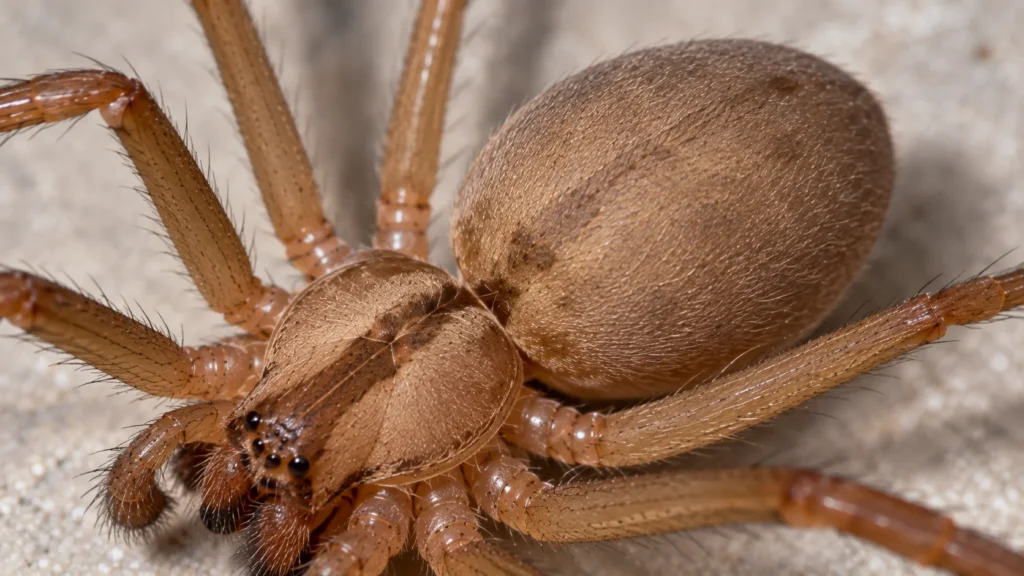
A spider with strongly patterned legs or a multicolored abdomen is therefore less consistent with a brown recluse.
Actual Size Picture of a Brown Recluse Spider
Brown recluses are relatively small spiders. Their body is generally around 3/8 inch long, although overall measurements vary depending on whether the legs are included. MedlinePlus describes the spider as approximately ¼ to ¾ inch in overall size.
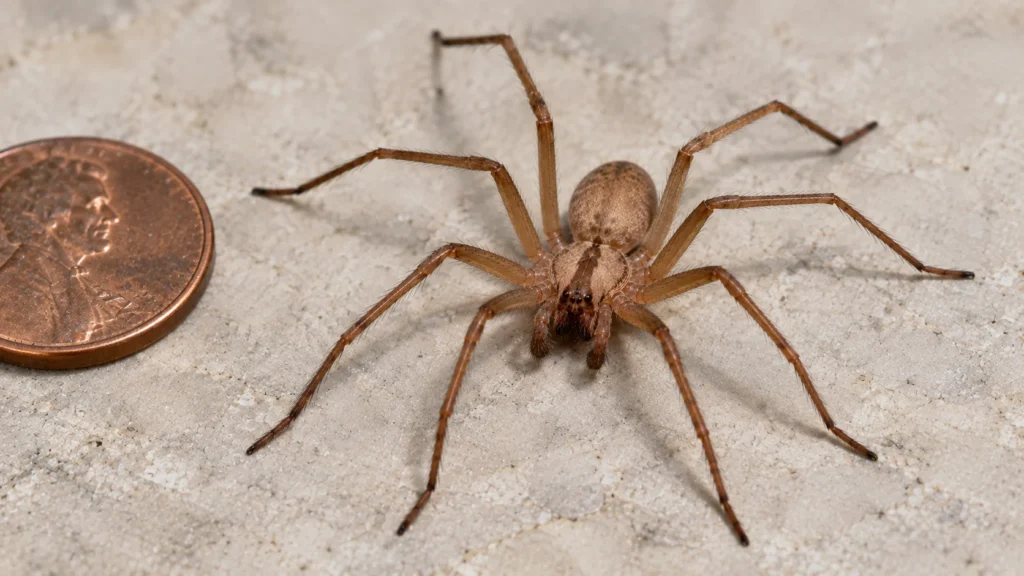
Body Size Is Smaller Than the Overall Leg Span
Long legs can make a brown recluse appear larger in photographs than its actual body measurement. For identification, entomologists distinguish body length from the total span created by the legs.
A spider with a body substantially larger than about ½ inch is unlikely to be a brown recluse according to UC Riverside's identification guidance.
Picture of a Baby Brown Recluse Spider
Young brown recluse spiders are much smaller than adults but retain the basic body characteristics of the species. They develop through multiple molts before reaching adulthood.
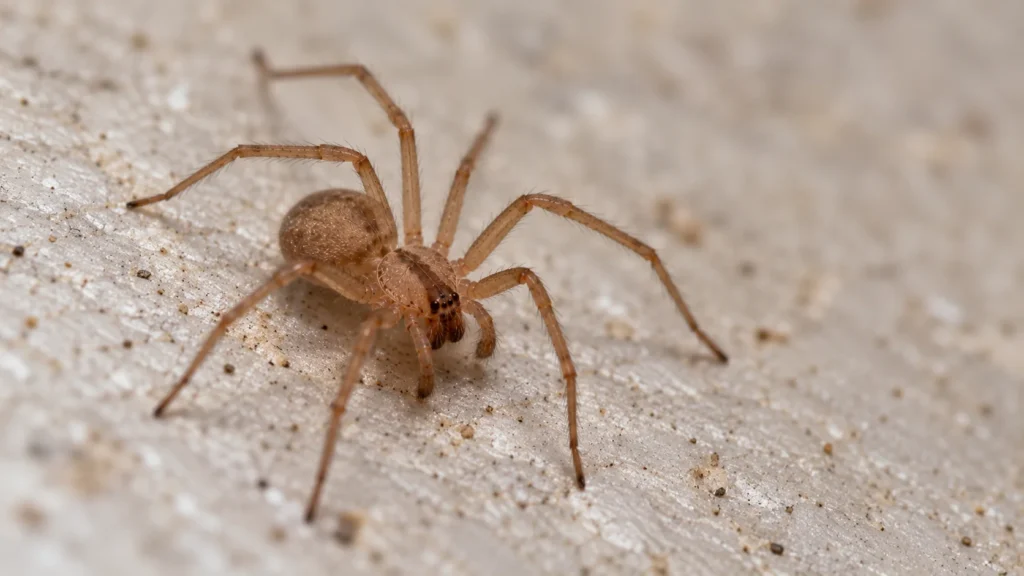
Because spiderlings are extremely small, photographs of them can be difficult to identify accurately. A very small brown spider should not automatically be labeled a baby brown recluse simply because it has a vaguely dark marking.
Young Spiders Can Be Difficult to Identify From Ordinary Photos
Size, image quality, lighting, and camera focus can make spiderlings especially challenging to identify. Magnification is often necessary to examine the eye arrangement and other diagnostic structures.
A geographic check is also valuable because established brown recluse populations occur primarily in specific areas of the United States.
Picture of a Brown Recluse Spider Web
Brown recluses do not typically create the large, conspicuous webs associated with orb-weaving spiders. Instead, they construct irregular retreat webs in concealed locations behind objects or within protected spaces.
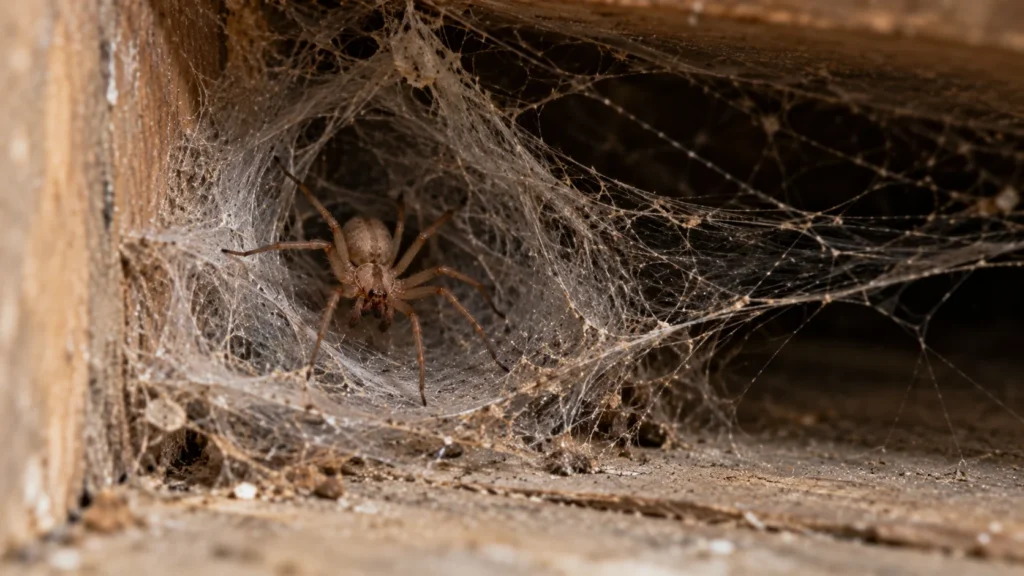
Hidden Retreat Webs Are More Characteristic
A brown recluse web may be found behind stored objects, beneath furniture, inside cracks, or in another undisturbed location. The spider uses these sheltered webs as retreats rather than creating a large open web designed to capture flying insects.
A large, highly visible circular web outdoors is therefore not typical of a brown recluse.
Brown Recluse Spider Compared With Similar Spiders
Many spiders are incorrectly called brown recluses because they are brown and have long legs. A picture of a brown recluse or wolf spider, for example, can show significant differences when body pattern, eye arrangement, leg structure, and behavior are compared.
Brown Recluse vs Wolf Spider
Wolf spiders are generally more robust and often have visibly patterned bodies and legs. They also have a different eye arrangement and do not have the defining six-eye pattern of Loxosceles. A large, hairy, strongly patterned spider is therefore not automatically a brown recluse.
Brown Recluse vs Cellar Spider
Cellar spiders have very long, delicate legs and are commonly found around indoor structures. Some can have markings that people interpret as violin shapes, but their eye arrangement and body characteristics differ from those of a brown recluse.
Brown Recluse vs Huntsman Spider
Huntsman spiders are substantially larger and have a different body structure and leg orientation. UC Riverside identifies large huntsman specimens among spiders that have been incorrectly submitted as possible brown recluses.
Explore more articles:
- Fruit Flies vs Gnats
- Rat vs Mouse
- Bugs That Look Like Flying Termites
- Bugs That Look Like Fleas
- What Do Fleas Look Like?
Brown Recluse Spider Picture by Geographic Range
Geography is an important part of identification. Brown recluse spiders have established populations in a defined portion of the United States, including states such as Missouri, Kansas, Arkansas, Oklahoma, Texas, Tennessee, Kentucky, Indiana, Illinois, Mississippi, Louisiana, Alabama, Georgia, Iowa, Nebraska, Ohio, and others listed by Penn State Extension.
Outside their established range, isolated specimens can occur, but UC Riverside notes that finding a genuine brown recluse becomes much less likely outside its known distribution.
Indoor Transportation Can Occur
Brown recluses can occasionally be transported in boxes, furniture, clothing, or other stored materials from areas where populations are established. Penn State Extension notes that isolated occurrences outside the normal range can result from transportation.
This makes geographic location an important clue, but it should not be treated as the only identification factor.
Picture of Brown Recluse Spider Bite
A picture of a brown recluse spider bite can show a lesion associated with a confirmed bite, but a skin lesion cannot reliably establish that a brown recluse caused it. Many conditions can resemble alleged spider bites, and medical sources emphasize the importance of considering other causes.
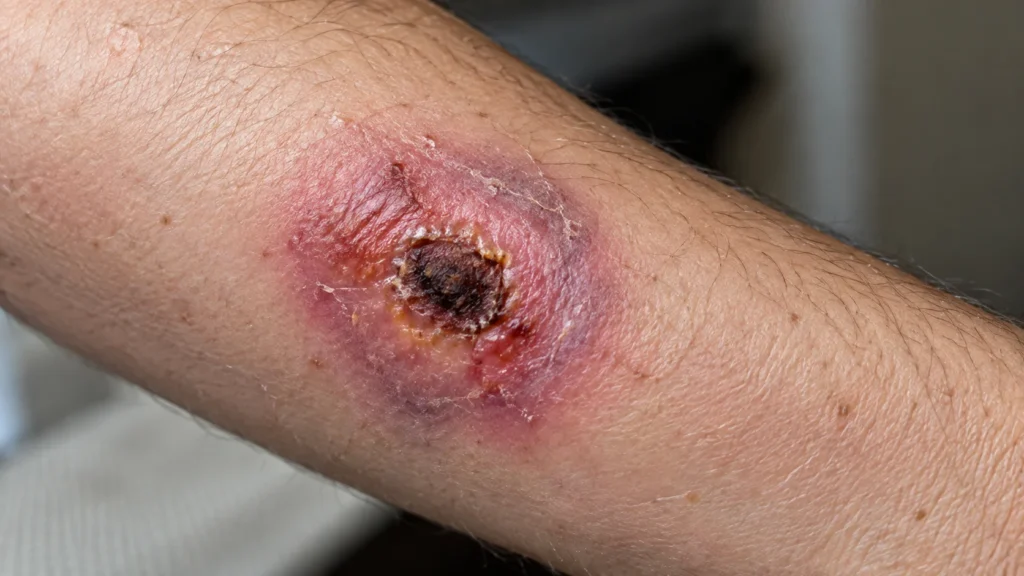
A confirmed brown recluse bite can initially be subtle. Pain may develop during the following hours, and some cases can progress to blistering, discoloration, tissue damage, or an ulcer. Serious systemic symptoms are uncommon but can occur.
Brown Recluse Spider Bite Stages
A possible progression can include:
- Little or no immediate discomfort.
- Localized pain developing over several hours.
- Redness or discoloration around the affected area.
- Development of a blister in some cases.
- Increasing tissue damage in more severe bites.
- Formation of a dark eschar in necrotic cases.
- Separation of damaged tissue.
- Formation of an ulcer.
- Gradual healing over an extended period.
- Possible residual scarring in severe cases.
Not every confirmed brown recluse bite progresses through all of these stages. Penn State Extension reports that most confirmed bites are minor, while a smaller proportion can produce dermonecrotic lesions.
Medical Evaluation Matters for Concerning Lesions
A painful or worsening skin lesion should not automatically be diagnosed as a brown recluse bite from an online photograph. Bacterial infections and other medical conditions can produce similar appearances.
If a suspected spider bite produces severe pain, rapidly worsening swelling, blistering, tissue discoloration, fever, chills, nausea, or other systemic symptoms, prompt medical evaluation is appropriate.
Brown Recluse Spider Egg Sac Picture
A female brown recluse produces spherical egg sacs containing multiple eggs. Penn State Extension reports that a female can deposit approximately 20 to 50 eggs per egg sac and may produce several batches during her lifetime.
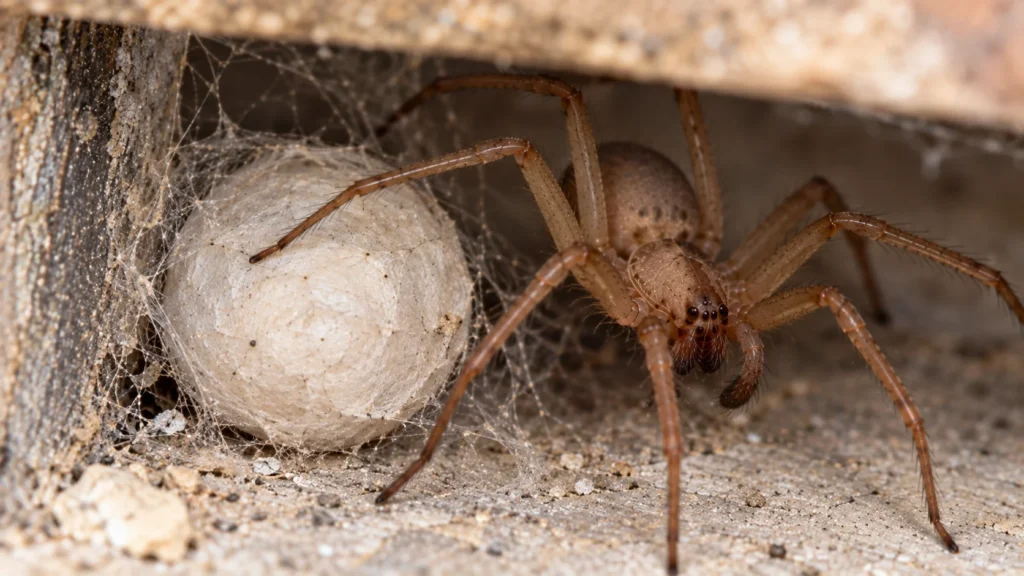
Egg sacs are usually located in concealed areas where the spider can remain undisturbed. Finding a suspected egg sac together with correctly identified adult spiders provides more useful evidence than finding an isolated sac-like object.
Hidden Locations Are Typical
Brown recluses prefer warm, dry, undisturbed areas, including spaces behind stored materials, cracks, and other protected locations.
Avoid handling unidentified spiders or egg sacs with bare hands. If a specimen is needed for identification, a pest professional or qualified entomologist can provide safer guidance.
Brown Recluse Spider Habitat and Indoor Locations
Brown recluses generally prefer secluded areas rather than busy, frequently disturbed parts of a home. Indoors, they may occur in closets, attics, storage areas, boxes, shoes, and spaces beneath or behind objects.
Shoes and Clothing Can Provide Accidental Contact
A spider hiding inside a shoe, item of clothing, bedding, or stored object can become trapped against the skin when the item is used. CDC notes that brown recluses cannot normally bite without counterpressure, such as accidental trapping against the skin.
Shaking out rarely used shoes and clothing and reducing clutter in storage areas can lower the chance of accidental contact.
10 Key Identification Facts From a Brown Recluse Spider Picture
- Brown recluses are generally small brown spiders with long, slender legs.
- The scientific name is Loxosceles reclusa.
- They have six eyes arranged in three pairs.
- A dark violin-shaped marking occurs on the cephalothorax.
- Their legs are generally uniformly colored rather than strongly banded.
- Their abdomen is generally uniformly colored.
- Their body is commonly around 3/8 inch long.
- Their webs are usually irregular retreat webs in concealed locations.
- Geographic range is an important part of identification.
- A brown recluse bite cannot be reliably diagnosed from a skin photograph alone.
Conclusion
A picture of a brown recluse spider is useful for learning the species' general appearance, but accurate identification requires more than recognizing a brown color or violin-shaped marking. The most useful combination of characteristics includes the six-eye arrangement, uniformly colored legs, relatively plain abdomen, appropriate body size, concealed retreat web, and geographic range.
Brown recluse spiders are most strongly associated with south-central and Midwestern parts of the United States and typically avoid direct contact with people. Although their venom can cause serious tissue damage in some confirmed bites, many alleged brown recluse bites are actually caused by other conditions or are incorrectly attributed to spiders.
For that reason, photographs are best used as an identification aid rather than as a substitute for professional species identification or medical diagnosis.
FAQs
What does a brown recluse spider look like?
A brown recluse is a small brown spider with long, uniformly colored legs, a relatively plain abdomen, six eyes arranged in three pairs, and a dark violin-shaped marking on its cephalothorax.
What is the easiest way to identify a brown recluse spider?
The six-eye pattern is one of the most useful diagnostic characteristics. The spider also has uniformly colored legs, a relatively plain abdomen, and a violin-shaped marking on the cephalothorax.
Can a picture prove that a spider is a brown recluse?
A photograph can provide useful identification clues, but many spiders are misidentified from photographs. Close examination of diagnostic features and geographic range provides stronger evidence than the violin marking alone.
What does a baby brown recluse spider look like?
Young brown recluses are much smaller versions of the species and can be difficult to identify from ordinary photographs. Magnification may be necessary to examine their diagnostic characteristics.
What does a brown recluse spider web look like?
Brown recluses create irregular retreat webs in concealed locations rather than the large, conspicuous webs produced by many orb-weaving spiders.
What does a brown recluse spider bite look like?
A confirmed brown recluse bite can initially appear small and may later develop redness, blistering, discoloration, or tissue damage in more serious cases. Similar-looking skin lesions can have many other causes, so appearance alone cannot confirm a recluse bite.
What are the stages of a brown recluse spider bite?
A severe confirmed bite can progress from an initially subtle lesion to redness, blistering, tissue damage, an eschar, and an ulcer before healing. Most confirmed bites do not progress to severe tissue necrosis.
What is the actual size of a brown recluse spider?
The body is commonly around 3/8 inch long, while overall size including the legs can appear considerably larger. MedlinePlus gives an overall range of approximately ¼ to ¾ inch.
Can a brown recluse spider be mistaken for a wolf spider?
Yes. Brown spiders are frequently misidentified, and wolf spiders can sometimes be submitted as suspected recluses. Body pattern, eye arrangement, leg structure, size, and geographic range help separate them.
Can a brown recluse bite be diagnosed from a picture?
No. A skin photograph cannot reliably establish that a brown recluse caused a lesion. Infections and other medical conditions can resemble alleged spider bites, so concerning or worsening lesions should receive appropriate medical evaluation.